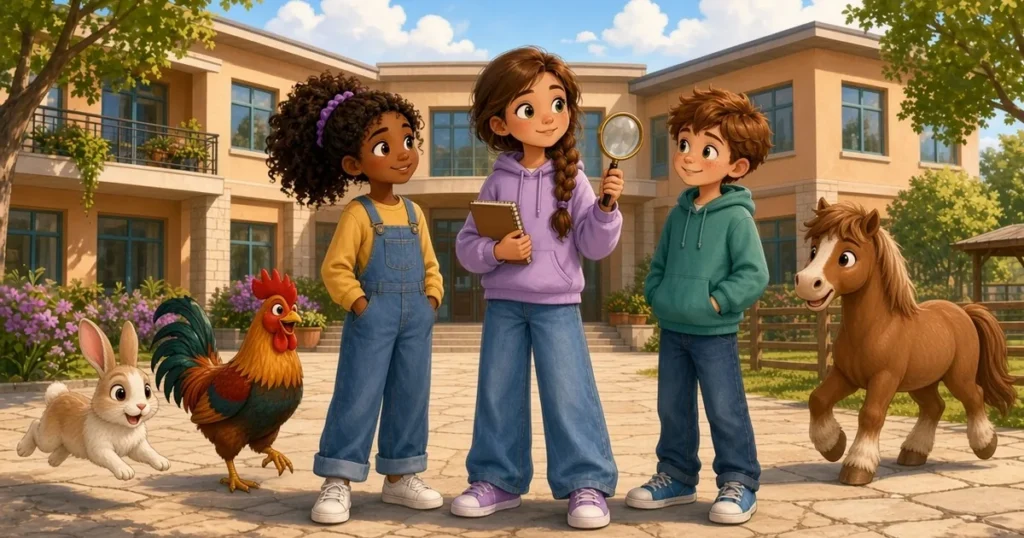
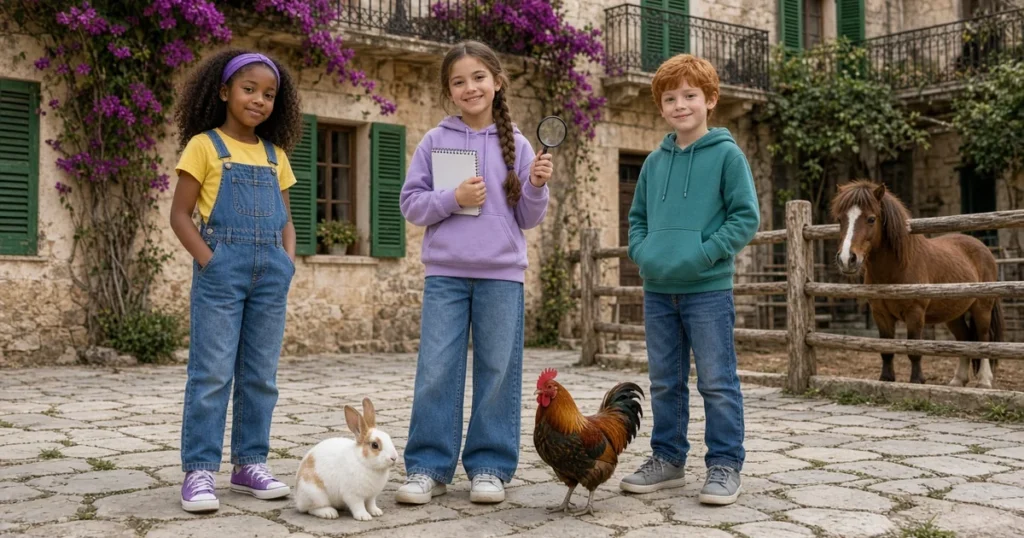
Three detectives hiding behind one water butt is not easy. Especially when one of them is Leo, who is too tall, and one is Hutie, who cannot keep quiet for more than six seconds.
“Shh,” whispered Amy.
“I am shh,” whispered Hutie. “That’s my heart. It’s beating loudly.”
“Hearts don’t beat out loud,” whispered Leo. “Medically speaking.”
“Mine does,” whispered Hutie.
The footsteps came closer. Small, quick, a little wobbly. And with every step, a slosh. Then, round the corner of the shed, appeared the secret gardener of Hilltop House.
He was one metre twenty tall. He wore a straw hat far too big for him, which slipped down over his eyes. Green wellies, on the wrong feet. And in both hands, with enormous care, he carried a kettle. Not a watering can. A kettle. Zehava’s old kettle with the flower on the side, which had vanished from the kitchen two weeks ago, and which Zehava had blamed on the jay.
It was Tom.
Tom walked along the row, stopping at every pot to water it. A little water, carefully, right beside the bookmark. And at every pot, he talked.
“Good morning, Poppy,” he said. “You look well today. Good morning, Anemone. Don’t worry, you’ve got enough sun. Cyclamen, you’re new, so drink lots.” He watered the cyclamen. “One more week. Just one more week, and you’ll be a garden.”
“It’s the afternoon,” breathed Leo.
Hutie made a small noise, like a balloon letting out air. Amy put a hand on her shoulder.
Then Amy stepped out from behind the water butt. Slowly. So as not to startle him.
“Hello, Tom,” she said.
Tom jumped, his hat fell over his nose, and the kettle nearly spilled. When he pushed up the hat and saw her, and Hutie, and Leo coming out behind her, his face went as red as the poppy. His bottom lip began to wobble.
“It’s not stealing,” he said quickly. “I’m giving them back. I promise I’m giving them back. Just after Sunday.”
“What’s happening on Sunday?” asked Amy, sitting down on the ground to be at his height. That’s how you talk to someone who’s frightened. From below.
Tom looked at her for a long time. Then he sat down beside her with the kettle on his knees.
“It’s Maya’s birthday,” he whispered. “She’s going to be eight.”
Then he told them. In the summer holidays, Maya wanted a garden. She took yoghurt pots and filled them with soil and planted seeds Grandma Rachel had brought her. Flower seeds. She put them on the windowsill in Room Seven. And Tom helped her. Every day. The seeds sprouted, and tiny green leaves came up. And then, after a week, they all wilted. Every one. All at once.
“And she cried,” said Tom. “She said everything she plants dies. That she’s no good at it. That maybe she’s no good at anything.” He wiped his nose on his sleeve. “And it isn’t true. She’s the best. She reads me stories, and she helps me with my letters, and she never laughs when I get things wrong.”
Amy said nothing. She knew that sometimes you just have to wait for the next sentence to come by itself.
“Then I saw the bookmarks,” said Tom. “Naama’s. With the flowers. And I realised they’re flowers that never wilt. Not ever. Even if you forget them. Even if you water them too much.” He pointed at the row. “So I made her a garden that won’t die. In homework hour everyone’s still writing, but I finish quickly, because in Year Two it’s only ten minutes, so I went to the library and took them. Only from the low books. I can’t reach the big ones.”
“And why are you watering them?” asked Hutie, in a soft voice Amy hardly recognised. “They’re paper.”
Tom looked at her as if she’d asked the strangest question in the world. “Because that’s what you do with a garden,” he said. “You water it. With Maya, we watered every hour. So they wouldn’t be thirsty.”
Amy and Leo looked at each other. And Amy knew Leo was thinking exactly the same thing.
“Every hour?” asked Leo.
“Every hour,” said Tom proudly. “And before bed. And in the morning, really early, before Kuku.”
They took Tom, the kettle and the secret over the fence. To Mr. Ben-Ami.
Mr. Ben-Ami listened to the whole story, leaning on his hoe in his old hat. When Tom had finished, he knelt slowly, knees creaking, until he was at Tom’s height.
“Lad,” he said, “I’ll tell you a gardener’s secret. Flowers don’t die of thirst. A lot of the time, they die of love. Of being watered too much. Their roots drown.” He laid a big, rough hand on Tom’s shoulder. “You and Maya didn’t kill those flowers because you’re no good. You killed them because you loved them too much. That’s a mistake good people make.”
“Really?” asked Tom.
“I killed three lemon trees that way,” said Mr. Ben-Ami. “And my wife’s tomatoes. She didn’t speak to me for a week.”
Tom thought about that. Then he smiled, for the first time since the hat fell over his nose.
But there were still the bookmarks. Eight bookmarks belonging to eight children, one of whom was Benny, who hadn’t known where his goalkeeper was for a week. And Amy knew you couldn’t just leave them in the soil.
So she did what a good detective does when the mystery is solved but the problem isn’t. She went to each of the eight children. On their own, quietly, she told them.
Benny listened, said nothing, then said, “Sunday? I’ll wait. I can’t remember what happened up to page sixty-three anyway.” Alice and Penny listened, looked at each other, and said together, for the first time in history without arguing, “Leave it in the garden.” Omer said his spaceship could wait, because in space time goes slowly anyway. All eight agreed. Until Sunday.
Amy took the kettle back to Zehava herself. Zehava looked at the kettle, at the soil stuck to its bottom, and said, “Two weeks I’ve been blaming that jay. Two weeks! I’d written him a letter of complaint in my head!” Then she heard who it had been for, went quiet, and handed the kettle back to Amy. “Tell Tom to look after it till Sunday,” she said. “And to mind the lid. It’s stubborn. Like me.”
And Naama, when Zehava rang her from the kitchen, wasn’t cross at all. Quite the opposite. Amy could hear her laughing down the phone from across the kitchen. “Bookmarks in flowerpots?” said Naama. “Twenty years a librarian, and nobody’s ever planted one of my bookmarks. Tell him it’s the most literary thing that’s ever happened to them.” Then she paused and said, “Zehava, you know what? On Sunday I’m coming.”
And Mrs. Cohen, when Amy told her, took off her glasses and stood holding the chain, saying nothing for a long time. Then she said, “A crime against literature, I called it.” She coughed a little. “I withdraw the charge.”
The next three days were a secret operation. All of Hilltop House knew, except Maya. Which was very hard, because forty children keeping one secret look rather like forty balloons trying not to pop. Alice and Penny nearly said it twice, and once actually began, “Maya, on Sunday”, stopped, and finished, “it’ll be… Sunday.” Maya gave them a funny look and said, “Yes. After Saturday.”
Zehava baked a cake shaped like a flowerpot. Chocolate cake, with crushed chocolate biscuits on top for soil, jelly worms wriggling out, and one pink sugar flower stuck in the middle. She hid it in the fridge behind an enormous pot of soup and put a sign on it: Soup. Do not touch. Benny opened the fridge three times a day anyway, just to check the soup was all right.
And every afternoon Tom went on watering the bookmarks. But now the right amount. Mr. Ben-Ami had measured it for him: one cup, once a week. “Even paper,” said Mr. Ben-Ami, perfectly seriously, “should start getting used to it.”
On Sunday morning, Maya woke up in Room Seven and found a note on her pillow in Tom’s writing, with one letter back to front, like Oliver’s at six: Go to the hedgehog row. Happy birthday.
She went. In her pyjamas, with the glass-bead bracelet, and Amy and Hutie behind her. And as she came round the corner of the shed, she stopped.
The hedgehog row was full. Tom’s pots stood there with the eight bookmarks, like paper flowers. But beside them, in a second row, stood more pots. Real clay pots. And in each one, a living flower. A purple cyclamen. A yellow daisy. A red geranium. On every pot was a little label, in Mr. Ben-Ami’s big writing: Water once a week. Talk to it every day.
Behind the pots stood everyone. Tom, in his hat. Mr. Ben-Ami, who had come round by the gate instead of over the fence, for the first time. Grandma Rachel, here on a Sunday for once, not a Thursday. And Naama, invited by Zehava, with a thick book under her arm: a book about pressing flowers.
Maya stood quite still. She looked at the paper poppies, at the living cyclamen, at Tom’s hat, at the glass-bead bracelet on her wrist, and back at the poppies. She opened her mouth, closed it, and opened it again.
“What is it?” she whispered.
“A garden,” said Tom. “Half of it never dies. And half you have to learn not to kill.”
Maya looked at the garden, at Tom, at the hat slipping over his eyes again. Then she hugged him so hard that his hat flew off and landed in the geranium pot.
Then Zehava came out of the kitchen with the cake. “Soup!” she announced, lifting it above her head, and all the children shouted “Soup! Soup!”, and Maya didn’t understand a thing until she saw the jelly worms. Forty children sang her “Happy Birthday”, and Kuku, whose bell David rang at exactly the right moment, crowed from the coop as if he were singing too. Sugar poked his head over the fence, sniffed the cake, and was disappointed, because it had no banana in it.
Maya blew out eight candles, and one for next year. When they asked what she had wished for, she looked at the second row, at the real pots, and said, “That one of them lives. Just one.”
“They’ll all live,” said Mr. Ben-Ami. “If you water them once a week. And talk to them. They like being talked to. Like hens.”
That day Naama taught Maya and Tom to press flowers, between the pages of a thick book with a weight on top. “That way,” she explained, “even a flower that wilts goes on living. Inside a book.” And a week later, when Maya’s first daisy bloomed and didn’t wilt, because it was watered once a week and talked to every day, Maya picked one flower, pressed it and made a bookmark. Her very first. Her own. And she gave it to Benny. “For the goalkeeper,” she said. “So you don’t lose your place again.”
The eight bookmarks went back into their eight books. And Mrs. Cohen hung a new sign in the library, under the old one: Bookmarks may be borrowed. Just bring them back. And underneath, in Tom’s writing, someone had added: And don’t water them.
Amy opened her notebook and wrote: Case Number 23: The Vanishing Bookmarks. Solved. The gardener: Tom. The flowers: alive.
That evening, in the dining room, Shira, the girls’ counsellor, sneezed. Not an ordinary sneeze. A small, thin, peculiar sneeze that sounded exactly, but exactly, like “miaow”.
The whole dining room went silent and turned round to look for a cat.
But there was no cat.