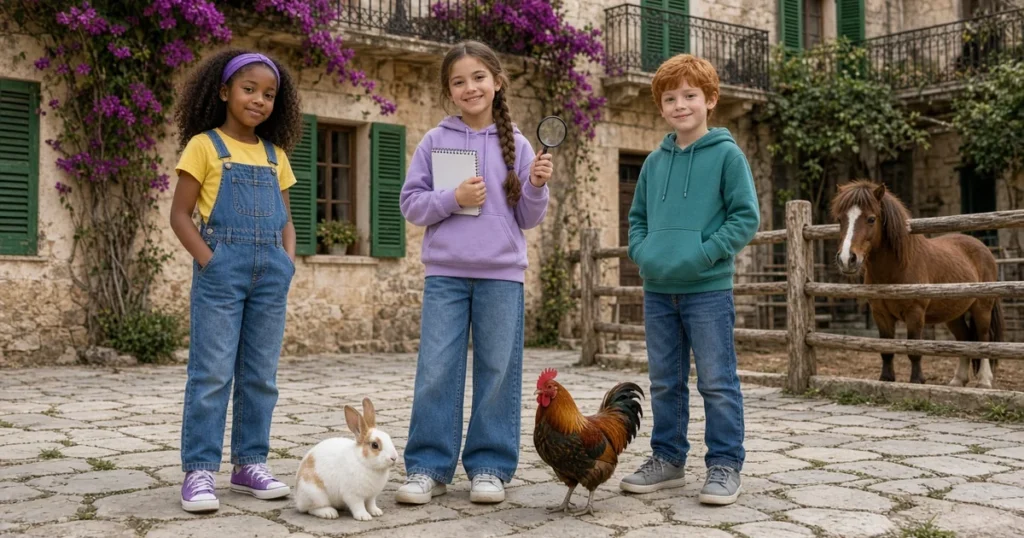
The yard at Hilltop House was the one place where nobody competed with anybody. Perhaps because there was room enough for everyone, or perhaps because the huge carob tree in the middle watched over them all like a grandfather who had seen everything already.
In one corner was the vegetable patch. In another was the hen house, where Kuku the rooster worked. Yes, worked. Kuku was no ordinary rooster. David the caretaker had trained him, and every morning, when David rang a little brass bell, Kuku leapt onto his stool and crowed. At noon he herded the hens inside, and in the evening he sat on the fence and kept guard. If any rooster ever deserved wages, it was Kuku.
And in the third corner, beside David’s storeroom, was Sugar’s shed.
Sugar was a small, plump pony the colour of honey cake, with a white mane that flopped over his eyes. He loved three things in the world: apples, sunshine, and anything that smelled of banana.
“Anything,” said Leo as they walked. “Once he ate half of Noam’s hat because Noam had put a banana in it.”
“Why did Noam put a banana in his hat?” asked Hutie.
“Excellent question. Nobody knows.”
Amy led the way, notebook in hand. Every so often she stopped, crouched, and studied the ground. Along the path between the kitchen and the shed lay single straws here and there, like breadcrumbs in a fairy tale.
“Someone came this way carrying a lot of straw,” she said.
“Or came this way a lot of times,” said Leo.
“Or straw walks by itself,” said Hutie. “I’m just saying. We don’t know everything.”
They stopped by David’s storeroom.
The door was open, and from inside came whistling. David always whistled. He whistled while fixing taps, changing light bulbs and clearing gutters. Hutie claimed he whistled in his sleep.
But the moment the three of them peeped in, the whistling stopped.
David stood at his workbench. He had a grey moustache, a peaked cap, and a belt with so many tools on it that he jingled like a kitchen drawer when he walked. On the bench lay something large, covered with an old sheet. And under the bench, squeezed small as if he believed he were invisible, sat Oliver.
“Hello, David,” said Amy. “Hello, Oliver.”
“I’m not here,” said Oliver.
“You’re under the bench.”
“That doesn’t mean I’m here. It means I’m under the bench.”
David cleared his throat and stood in front of the sheet like a guard outside a palace. “What can I do for you, detectives?”
“We’re looking for Zehava’s spoon,” said Amy.
“A spoon?” David raised his eyebrows. “There’s nothing in here but hammers, nails and one spider called Morris. No spoons.”
Amy looked around. The floor was covered in sawdust, fine and yellowish, exactly like the dust in the kitchen. On a shelf by the window stood an open tin of paint. Bright orange. And from one corner of the sheet poked a bit of smooth wood on which someone had painted a large letter: “Z”.
She wrote it all down and said nothing.
That was her second rule: sometimes, if you say nothing, people tell you things all by themselves.
“All right,” she said at last. “Thank you. We’re going to visit Sugar.”
From under the bench came a thump, as if someone had lifted his head too fast.
“Why Sugar?” asked Oliver, rubbing his head. “Sugar doesn’t know anything. Sugar is a horse. Horses don’t know things.”
“Sugar knows lots of things,” said Hutie. “He knows when there are apples.”
They went out. Behind them they heard David whisper something, and Oliver whisper back something that sounded like “Oh no, oh no, oh no.”
Sugar was waiting in his shed as if he had made an appointment with them. He lowered his head, blew warm air into Hutie’s face, and nudged her pocket with his nose.
“I haven’t got any bananas,” Hutie told him. “Only string. Would you like some string?”
Sugar would not like some string.
Amy stood in front of him and looked. She looked at his mane, his legs, his tail swishing away flies. Then she looked at his nose, and her smile began to grow.
On the tip of Sugar’s pink nose, right between his nostrils, was an orange dot. Bright orange.
“Leo,” she said. “Hutie. Look at his nose.”
“Wow,” said Hutie. “Sugar! Have you been painting?”
“Horses don’t paint,” said Leo. “But horses sniff. If he sniffed something with fresh paint on it…”
“…the paint stuck to his nose,” Amy finished. “Now smell him.”
Hutie put her face close to Sugar’s nose and breathed in deeply. “He smells like… horse.”
“Again.”
Hutie sniffed again, and her eyes went wide. “Banana! He smells of banana! And nobody’s had bananas today, because there weren’t any shakes!”
Amy was already inside the shed. In the corner, behind the water bucket, was a heap of straw, bigger than usual, arranged as carefully as a blanket. Amy plunged both hands into it and began to dig.
Straw. More straw. One old apple that Sugar seemed to be saving for emergencies. More straw. And then her fingers touched something long, smooth and round.
She pulled.
Out of the straw, like a sword from a stone in a legend, came Zehava’s giant spoon. The handle was a little wet with pony spit, and on its side, next to the words “ZEHAVA’S – DO NOT TOUCH,” were tiny tooth marks. Apart from that, the Queen was perfectly whole.
Hutie shrieked. Leo jumped. Sugar startled, and then, realising nobody was cross with him, tried to lick the spoon.
“No, Sugar! She’s not yours!”
“We found her!” Hutie danced on the spot. “We found the Queen! Sugar’s the thief! Sugar, how could you?”
“Wait,” said Amy.
They fell silent. When Amy said “wait” like that, it always meant it wasn’t over.
“Sugar hid the spoon,” she said, “but Sugar didn’t go into the kitchen in the middle of the night, take the spoon off its hook and open the back door. Ponies don’t have fingers. Someone else took the spoon out of the kitchen. And someone else brought it all the way here.”
“And left an orange dot on the door handle,” said Leo slowly.
“And sawdust on the floor,” said Hutie.
“And an orange dot on the spoon,” said Amy, showing them. Near the end, below the tooth marks, was another orange spot, exactly the size of a fingerprint.
Behind them a small voice said, “I can explain.”
Oliver stood in the doorway of the shed. His shirt was still inside out, but the big smile had gone. Behind him stood David, hands in his pockets.
“I didn’t steal it,” said Oliver. “I borrowed it. That’s different.”
“Did you ask Zehava?” said Hutie.
“…No.”
“Then you didn’t borrow it. You took it.”
Oliver hung his head. “Fine. I took it. But only for an hour. Because of the surprise.”
“What surprise?” asked Leo.
David sighed the sigh of a grown-up who knows a secret is escaping. “Come on,” he said. “No point hiding it now.”
They went back to the storeroom, and David pulled off the sheet.
Underneath was a big, beautiful wooden sign, polished until it gleamed. In the middle was carved a picture of a giant spoon, life-sized, exactly the shape of the Queen, with a bright orange crown above it. And above the crown, in curly letters: “ZEHAVA – QUEEN OF THE KITCHEN. Thirty years of love on a plate.”
“Next week Zehava has been at Hilltop House for thirty years,” said Oliver quietly. “Thirty years she’s been cooking for us. She’s been cooking for me since I was a baby. She’s like… everybody’s grandma. I wanted to give her something. And David helped.”
“We needed to trace the spoon at its real size,” said David. “So last night, after everyone was asleep, Oliver brought it here. It was still wet from washing.”
“The drop of water,” Leo whispered. “Under the hook.”
“We traced it, and at sunrise I wanted to take it back,” Oliver went on. “But I had paint on my hands and didn’t want to get it dirty. So I leaned it against the shed wall and ran to fetch a rag. When I came back, it was gone. I thought someone had stolen it from me. Then I heard Zehava shouting and… I panicked. I didn’t know how to say it.”
“And the inside-out shirt?” asked Amy.
Oliver went red. “I got dressed in the dark. I didn’t want to turn the light on and wake Mum.”
Everyone looked at Sugar, who was peering at them from his shed with an orange nose and the face of someone who had never done anything wrong in his life.
“The spoon smells of bananas,” said Amy. “Thirty years of shakes. To Sugar, that’s not a spoon. That’s a cake.”
Hutie laughed so hard she had to sit down on an upturned bucket.
They carried the spoon back together, all four of them. Amy held the tip, Leo the middle, Hutie the handle, and Oliver walked in front and explained. He explained everything, without skipping a single bit, not even the “I didn’t ask” bit.
Zehava listened to the end. She didn’t shout. She just looked at Oliver for a long time, and Hutie swore afterwards that she saw her chin tremble.
“Thirty years,” said Zehava at last. “You remember?”
“Of course I remember,” said Oliver. “You were the first person who ever fed me banana.”
Zehava hugged him so hard that he vanished completely into her flowery apron. “And next time,” came her voice from somewhere above his head, “you ask. And if you take without asking, you tell me straight away. Straight away! Not after I’ve shouted at the whole house.”
“Promise,” said Oliver, from inside the apron.
That afternoon at four o’clock, the dining hall filled with the smell of bananas and strawberries. Zehava stood behind the counter stirring with the Queen and singing in a voice that rattled the glasses, and on every shake she piled a mountain of whipped cream.
“Whipped cream!” cried Hutie. “On a Tuesday! Best thing that’s ever happened to me!”
“You said that about the pancakes at Purim,” said Leo.
“It was true then too.”
The surprise, of course, was no longer a secret. But David and Oliver decided to hang the sign on the day of the celebration as planned, and Zehava promised to pretend to be surprised. “I’ll act so surprised,” she said, “they’ll give me a prize.”
Mrs. Cohen walked between the tables and stopped by the Points Board. Everyone waited. Boys? Girls?
She picked up the chalk and wrote one point for the boys and one point for the girls.
“What for?” asked Alice.
“For the fact that nobody was punished for something they didn’t do,” said Mrs. Cohen. She put on her glasses and looked straight at Amy. “No blaming without proof. Everyone would do well to remember that.”
That night, in the bed by the window, Amy opened her notebook to a fresh page and wrote in her best handwriting:
Case Number 1: The Spoon That Vanished. Solved. Culprits: Sugar (because of the bananas) and Oliver (because of the surprise). Nobody was bad. Just a bit of a muddle.
She touched the blue button inside her jumper. Outside the window Kuku sat on the fence keeping guard, Sugar gave a small, satisfied whinny, and in the next bed Hutie was already snoring softly, with a little whipped-cream moustache she hadn’t washed off.
Amy thought about Oliver, and about the words “everybody’s grandma.” Maybe, she thought, family isn’t only the people you’re born with. Maybe it’s also the person who stirs your shake for thirty years.
Then she fell asleep, not knowing that that very night, somewhere in the girls’ wing, someone, or something, was about to begin to howl.