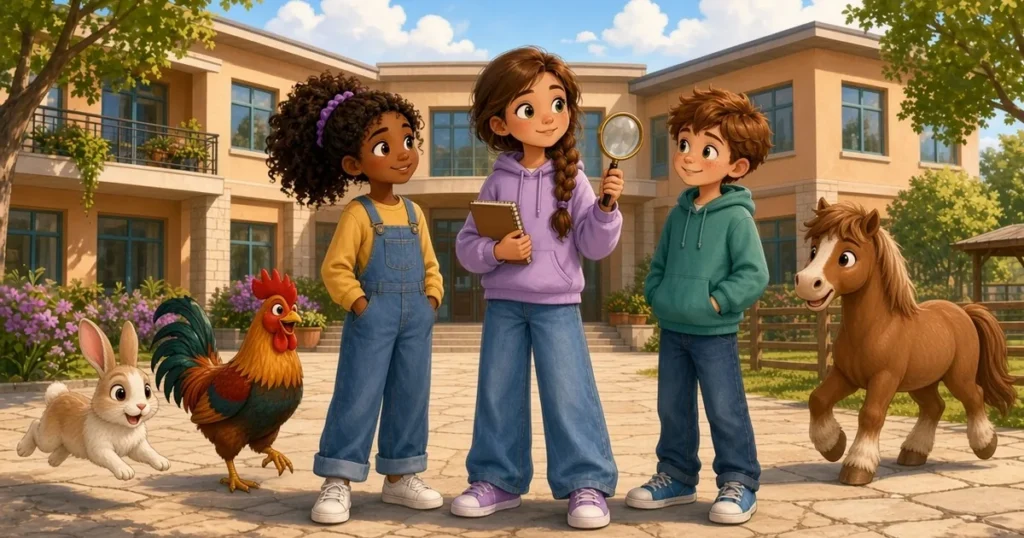
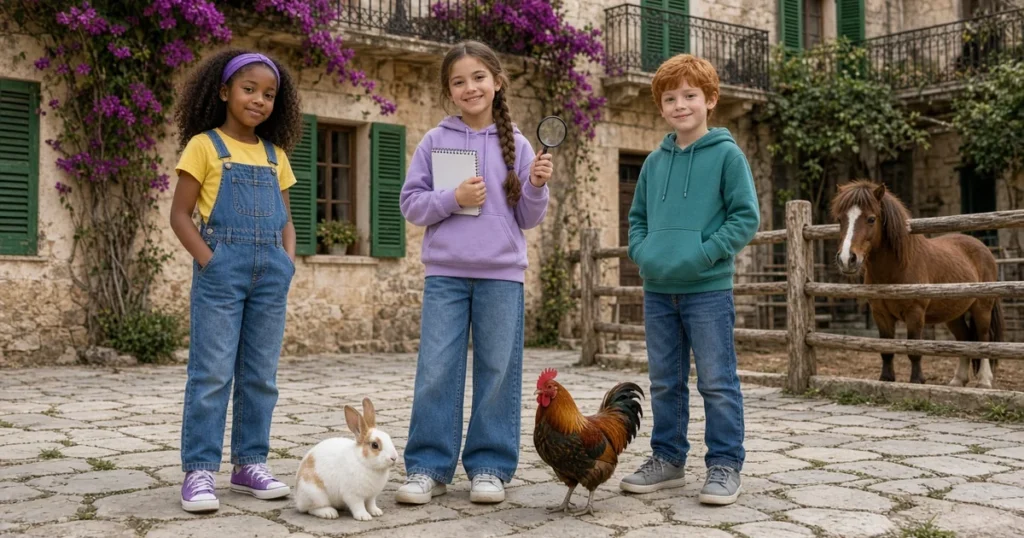
The first day of the school year at Hilltop House always begins the same way: with a shout.
This time the shout was Benny’s. “Where’s my other shoe?!” he bellowed, at half past six in the morning, in the middle of the boys’ corridor, with one shoe in his hand and one sock on his foot. “I had another shoe! I remember having another shoe!”
The other shoe turned up a quarter of an hour later in Falafel’s basket. Falafel was asleep inside it, like a sleeping bag, and refused to come out. Benny said that was fine, he’d go to school with one shoe and one rabbit. Ruti said it was not fine. In the end Falafel came out in exchange for a lettuce leaf.
At seven, Kuku crowed, because David rang the bell. At five past, Zehava handed out sandwiches, forty of them, wrapped in paper, a name on each. At ten past, Tom cried, because his sandwich had cucumber in it, and he was in Year Two now, and in Year Two you don’t eat cucumber. And at a quarter past, the yellow bus hooted at the gate, and forty school bags ran at it all at once, like a herd of colourful tortoises.
“New year,” said Hutie on the bus, taking a deep breath. “New year, new mysteries.”
“New year, new homework,” said Leo.
“You always spoil everything,” said Hutie.
“I’m always accurate,” said Leo.
At school, everything was new. Amy and Hutie’s new teacher, Miss Dafna, was tall and brisk and talked so fast that Hutie said she must have learnt it from Zehava. By first break Hutie had already tied two other children’s shoelaces together, by accident, of course, and had to untie them in front of the whole class. And Leo arrived with a new pencil case with twelve compartments, one pencil in each, all sharpened to exactly the same length. “New year,” he explained. “Start as you mean to go on.” By lunchtime he had seven pencils left, because he’d lent five and nobody had given them back. Leo wrote down all their names. “For the file,” he said.
That same week a parcel arrived at Hilltop House. A big cardboard box with a label: For the Hilltop House library. With love, Naama. Naama, Zehava’s niece, the librarian, who had lived at Hilltop House as a girl and left the note on page 88. She had sent books for the new year. Thirty of them. And in every book she had put a bookmark.
But not an ordinary bookmark. Naama had made them herself. Each was a strip of white card with a real pressed flower under clear plastic. A cyclamen. An anemone. A red poppy. A yellow daisy. And underneath, in lovely handwriting, a little saying: Whoever reads is never alone. Or: A book is a door. At the top of each one was a green thread with a tiny glass bead.
“That’s the most beautiful thing I’ve ever seen,” said Hutie, holding an anemone bookmark up to the light. “And look at the knot. That’s a double flat knot. Naama knows her knots.”
Mrs. Cohen arranged the new books on a special shelf in the library and stuck up a sign: A gift from Naama. Read with care. Within two days nearly every book was out on loan. Benny, who had never in his life read a thick book, started one about a football goalkeeper, two hundred pages long, and got to page sixty-three, and was as proud as if he’d scored a goal.
Then, on Wednesday, Benny walked into the dining room with the book in his hand and a face like a thunderstorm.
“Someone’s nicked my bookmark,” he said. “The poppy one. I was on page sixty-three. Now I’ve no idea where I am.”
“Start from the beginning,” suggested Oliver.
Benny gave him a look that sent Oliver ducking behind his porridge bowl.
But Benny wasn’t the only one. By the end of the week, seven bookmarks had vanished. From Omer’s book about spaceships. From Alice’s book and Penny’s book, both at once, and each blamed the other. From Shulamit’s in Year Five. And two from books still standing on the shelf. The books stayed. The bookmarks went.
“It was you,” Alice told Penny in the dining room. “You took my daisy, because you only had a poppy.”
“Me?” shrieked Penny. “You took my poppy, because you only had a daisy!”
“But my poppy’s gone too!” said Alice. “I mean, my daisy!”
“Then who took both?” asked Penny.
They stared at each other, baffled, and then said together, at the same moment, “Oliver!”
“I’m on a break!” shouted Oliver from the next table.
“This is a crime against literature,” declared Mrs. Cohen, her glasses trembling with fury on their chain. “Whoever takes a bookmark from a book takes away its memory.”
Amy, Hutie and Leo were already sitting in the corner of the library, beside the detectives’ cabinet, with the notebook.
“Suspects,” said Amy.
“The jay,” said Hutie at once. “They’ve got glass beads. He loves shiny things. And he’s back. I saw him on the carob yesterday with something shiny in his beak.”
“The jay can’t get into the library,” said Leo. “The windows have been shut since Monday, because Mrs. Cohen’s afraid the rain will come back.”
“Falafel,” said Hutie. “He nibbles paper. He once ate a whole letter of mine.”
“Then there’d be crumbs,” said Amy. “And Falafel wouldn’t nibble plastic. There aren’t any crumbs.” She wrote it down. Then she looked up and, without meaning to, glanced at Oliver, who was standing by the door.
“What?” said Oliver. “Why does everyone always look at me?”
“Because it’s always you,” said Hutie.
“Not always,” said Oliver, offended. “Just usually.” He held up his hands. “And look, no orange paint. A whole week. I’m on a break. It’s like a holiday, but from pranks.”
Amy didn’t write Oliver down. Instead she wrote: Seven bookmarks. Where?
“When do they vanish?” she asked. “Exactly when?”
Leo opened his own notebook. Because Leo wrote everything down, from the first day, without anyone asking. “Benny read on Tuesday night, and in the morning the bookmark was still there. At half past four, after homework, it was gone. Omer: the same. Left his book on the library table at four, and by five the bookmark had vanished. Alice and Penny: between four and five.”
“Homework hour,” said Amy. At Hilltop House, from four to five, all the children sit in the study room, quietly, doing homework, while Shira and Noam walk between the tables checking. All of them. So who could be wandering about the library then?
“Nobody,” said Leo.
“Somebody,” said Amy. “Somebody who finishes early.”
The next day, in homework hour, the three of them did something no child at Hilltop House had ever done: they finished their homework in twenty minutes. Leo solved his sums as if they were running away from him. Hutie wrote an essay on “My Summer Holidays” in three lines, and Shira handed it back and said “More”, so Hutie added one more line saying the holidays had been “really really really really good”, and Shira sighed and let her go. Amy wrote quickly and checked twice, because a detective doesn’t make mistakes, even in a hurry.
At twenty past four they were racing down the corridor to the library. But when they burst in, it was empty. Only the clock ticking on the wall. And on Naama’s shelf, in Tom’s book about dinosaurs, on the low left-hand end by the door, the cyclamen bookmark was gone.
“Missed it,” said Hutie, nearly stamping her foot. “By minutes!”
“We didn’t miss it,” said Amy, staring at the floor. “They’ve left us something.”
“Leo,” she said. “How high is this shelf?”
Leo took out his tape measure. Because Leo always has a tape measure. “Naama’s shelf is the second from the bottom. Forty centimetres off the floor.”
“And the two bookmarks that vanished from books on the shelf,” said Amy, “came from the left-hand end. Nearest the door. The lowest.” She looked at the top shelves, at the big children’s thick books. Not one bookmark had gone from those. “Whoever’s taking them only takes what they can reach.”
“Someone short,” said Hutie. “A gnome. I knew we had a gnome.”
“And look at this,” said Amy, touching the rug right under the shelf. Between the fibres was something brown. She rubbed it between her fingers. “Soil. Damp soil. Garden soil.”
Leo bent down with the magnifying glass. “There’s more,” he said. “In a line. To the door.” And it was true: if you looked very closely, there were tiny crumbs of soil every few steps, like breadcrumbs in a fairy tale.
“A trail,” said Amy. “And someone who cares about bookmarks so much they don’t crumple them, or nibble them, or throw them away. They just take them.”
They followed the soil. Out of the library, down the corridor, past the kitchen, where Zehava asked if they were playing bloodhounds and gave them each a biscuit, because bloodhounds need their strength. Through the back door. Out into the yard. And there, on the path, the crumbs vanished. Because in the yard, everything is soil.
“That’s it, then,” said Leo, disappointed, looking at the big yard, the coop, the shed, the garden, all the soil in the world. “You can’t track soil through soil.”
“That’s not it,” said Amy. “Someone carrying soil into the library is someone who digs. Where does anyone dig here?”
“Ruti’s vegetable patch,” said Hutie.
“The sandpit,” said Leo. “But that’s sand, not soil.”
“The hedgehog row,” said Amy slowly. “Behind the shed.”
Over the fence, Mr. Ben-Ami was watering his garden with a long hose and his old hat. “Looking for something?” he called, seeing them hurry along, bent double, noses to the ground.
“Crumbs,” said Hutie.
“Of soil,” added Leo.
Mr. Ben-Ami considered this. “At your age,” he said, “I looked for worms. That was interesting too.” And he went back to his watering.
The hedgehog row was the corner where, in the spring, all the children had planted flowers beside the Prickly Hotel, to keep the hedgehogs safe. But over the summer the sun had scorched everything, leaving a few dry stalks and one hedgehog who slept all day and took no interest in anything.
They went round the shed, with Sugar watching over the fence and checking their pockets for banana. And as they turned the corner, they stopped.
Because the hedgehog row wasn’t dry any more.
On the ground, in a straight line, stood pots. Little pots, all different: a yoghurt pot, an empty tin can, a broken mug with a handle, and an old shoe Benny would have recognised at once. And in every pot, stuck in the soil like a flower, stood a bookmark. The poppy. The anemone. The cyclamen. Eight bookmarks, upright and proud, glass beads twinkling in the sun, green threads fluttering in the breeze like leaves.
And the soil in every pot was wet. Very wet. As if someone had watered them that morning.
“Someone’s planted the bookmarks,” whispered Hutie. “Someone’s made them a garden.”
Amy looked at the pots, at the wet soil, at the flowers that would never wilt. She opened her notebook and wrote just one line: Who waters paper flowers?
And then, from behind the shed, she heard small footsteps and the slosh of water in something.
“Quick,” she whispered. “Hide.”