In the middle of August, without any warning at all, it rained.
It wasn’t ordinary rain. It was rain that had no business being there. The sky, which had been blue and flat as a blank page all summer, turned grey, then purple, then black. And at three in the afternoon, without asking anybody, it opened. One enormous clap of thunder rattled the cups in the dining room, and Kuku crowed in alarm, with no bell at all, for the first time in his life at three in the afternoon. Sugar backed into his shed and glared at the sky, deeply offended.
“Rain in August,” said Zehava, standing in the kitchen doorway with the Queen in her hand. “Thirty years I’ve been here, and never once. It’s a sign.”
“A sign of what?” asked Tom.
“That we need to bake biscuits,” said Zehava. “When it rains, you always need to bake biscuits.” And she went back inside.
The trouble was that rain in August also means forty children on their summer holidays, stuck indoors. No yard, no football, no sandpit, no paddling pool for the little ones. Within an hour, Hilltop House was the most bored house in the world.
Benny counted raindrops on the window. He reached one thousand two hundred and three, and then one drop split in two, and he didn’t know whether to count it twice, and he got cross and stopped. Alice and Penny played “Who Can Stay Quiet Longest”, and both lost after four seconds, because each shouted that the other had cheated. Omer tried to teach Falafel the rabbit to jump through a hoop, and Falafel lay down inside the hoop and went to sleep. Tom and Maya built a tower of blocks, knocked it down, and built it again, fourteen times.
“I’m bored,” announced Hutie, lying on the library rug with her arms flung out like a starfish. “I’m so bored I’m about to start sorting my threads by colour.”
“You’ve already sorted them by colour,” said Leo, without looking up from his book. “Twice. Yesterday.”
“Then I’ll sort them by length,” said Hutie, tragically.
Mrs. Cohen tried to rescue the situation. She took a jigsaw out of the cupboard, a thousand pieces, of a lighthouse. After half an hour it turned out three hundred pieces were missing, and that someone, long ago, had replaced some of them with pieces from a different puzzle, of a cow. “So it’s a lighthouse with a cow,” said Mrs. Cohen bravely. “That’s original.” Nobody was convinced. Then she suggested a sing-song, and the sing-song ended after a song and a half, because Omer and Benny argued about the words to the second verse.
Even Ruti, who always has an idea, sat in the office drinking tea and watching the rain, and said, “Nothing to be done. Some days are just like that.” Which was the most worrying thing anyone said all day.
Amy sat by the window with her notebook and watched the rain fall on the yard. On the sandpit, which had turned into yellow mud. On the carob tree, its leaves shining. And on the great puddle in front of Sugar’s shed, which looked like a small lake.
And then, at a quarter past four, someone pushed something under the library door.
It was an envelope. A crumpled brown envelope, a little wet at one corner. It slid across the floor and stopped right beside Hutie’s hand, as if aimed.
Hutie sat up so fast that all her threads fell out of her pocket. “Post!” she shouted. “Somebody’s sent us post! On a rainy day!”
Amy leapt to the door and flung it open. The corridor was empty. Just drops of water on the floor, in a line, up to the corner. And at the corner, almost gone, something orange. She didn’t see what.
Hutie had already opened the envelope. Inside, folded in four, was a sheet of paper. Old yellow paper, stained with brown blotches, its edges black and burnt and curling. When Hutie unfolded it, she gasped. Because it was a map.
A treasure map.
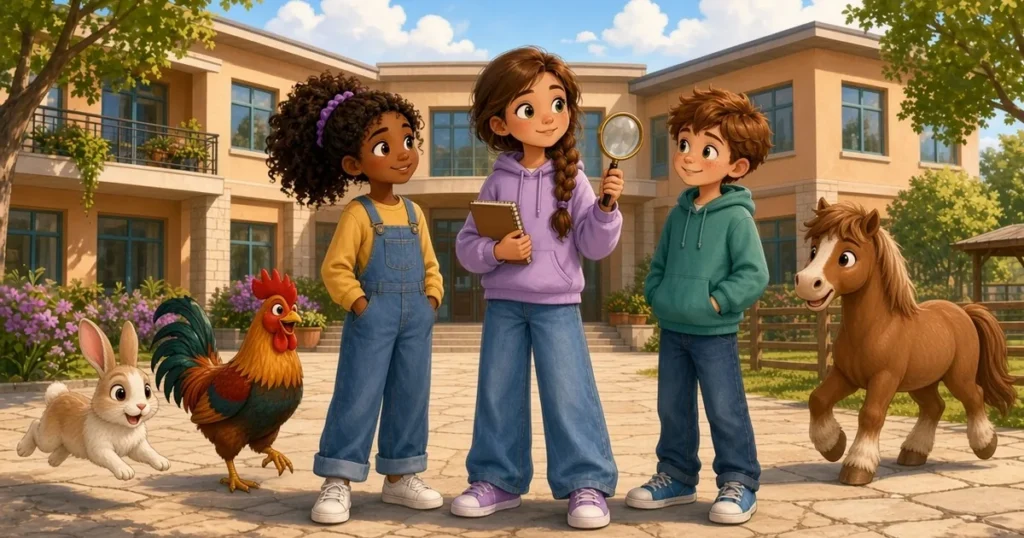
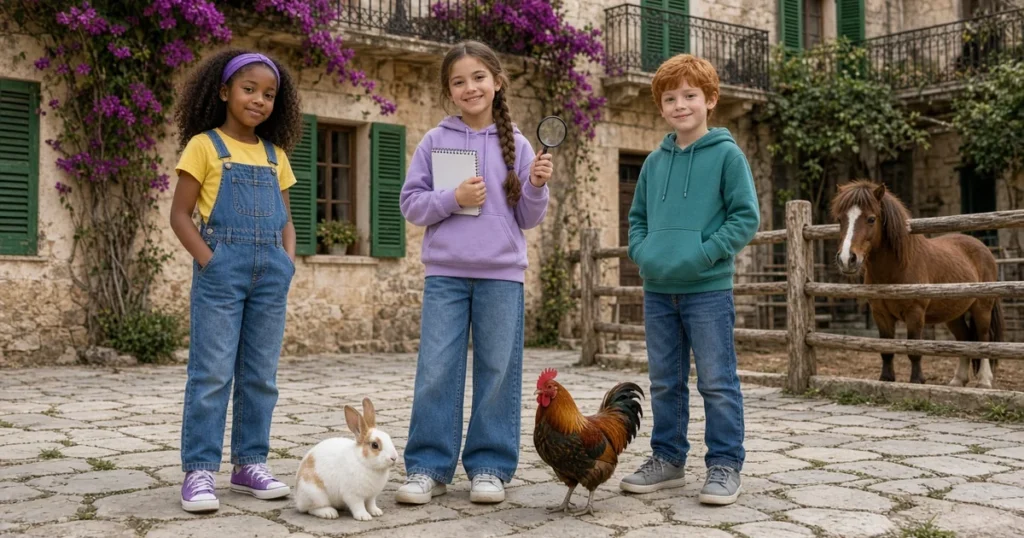
Across the top, in curly, wobbly letters, it said: The Treasure Map of Hilltop House. Top Secret. For the Brave Only. Below, the house was drawn from above, as if from an aeroplane. The boys’ wing, the girls’ wing, the dining room and the kitchen. And the yard: the coop, with a tiny cockerel. The shed, with a pony. The great carob tree. And the sandpit. From the kitchen’s back door ran a dotted line that wandered and looped round the coop, passed the shed, and ended at last under the carob, in the middle of the sandpit, at a big red X.
Down in the corner was a signature: Captain One-Eye. And beside it a little drawing of a skull with an eyepatch and a grin.
“A treasure map,” whispered Hutie, her eyes as big as saucers. “A real pirate’s treasure map. In our house.”
“A pirate,” said Leo, looking up from his book and, for the first time all day, interested. “On a hill. Fifty kilometres from the sea.”
“Pirates travel,” said Hutie. “That’s their whole job.”
Amy took the map and held it up to the light from the window. Then she brought it close to her nose and sniffed.
“Tea,” she said.
“What?”
“The brown stains. It’s tea. Someone dipped the paper in tea to make it look old. And smell the edges.” Hutie sniffed. “Matches. Fresh. Someone burnt these edges today. Not a hundred years ago. Today.”
“And this,” said Leo, already beside her with the magnifying glass, pointing at the shed on the map. Next to it, very small, was a little house with spikes on its roof. “That’s the Prickly Hotel. For the hedgehogs. David built it in the spring, four months ago.” He lowered the glass. “Captain One-Eye drew this map this week.”
“And there’s something else,” said Amy, pointing at the red X. Right in the middle of it was a single tiny dot. Orange. Glowing. Bright orange paint. An orange Amy knew from her very first mystery at Hilltop House, on the handle of Zehava’s Queen.
Amy didn’t say the name. She didn’t need to. Hutie and Leo looked at her, then at the orange dot, and understood.
“Oliver,” said Hutie, a little disappointed. “Oliver again.”
But Amy knew something they didn’t. She knew what was buried in the corner of the sandpit, under the carob. A glass jar. “It’s for someone to find on a rainy day,” Oliver had told her, on the day of the keys. “Don’t tell anyone. Not yet.” And she had promised.
And here it was. A rainy day.
Amy looked at the map. Then at Hutie, who had spent the whole afternoon on the rug like a bored starfish. Then out of the window, at the muddy sandpit. And she made a decision. Because sometimes a detective doesn’t need to solve anything. Sometimes she needs to let someone else have the fun.
“Right,” she said, folding the map. “Let’s go and find Captain One-Eye’s treasure.”
“But you know it’s Oliver,” whispered Leo.
“I know,” whispered Amy. “And he knows I know. But he drew a whole map. And burnt the edges. And poured tea on it. For us. On the most boring day of the year.” She smiled. “So we’re going.”
Within ten minutes, the whole of Hilltop House was at the front door in raincoats and wellies. Because the moment Hutie shouted “Treasure map!” down the corridor, nobody could stay bored. Even Benny, who was far too old for treasure, was first in his wellies. And Oliver stood at the back in a yellow raincoat with the most innocent face in the world, asking, “What treasure? What map? I’ve no idea what you’re talking about.”
On his cheek, Amy noticed, was a tiny spot of orange paint.
Out they went into the rain, thirty-nine children and one pirate dressed as a child. They followed the dotted line exactly: out of the back door, round the coop, with Kuku watching them as if they’d gone mad, past the shed, with Sugar watching them even harder, and on to the carob tree. The rain ran down their collars, and nobody complained. Because hunting for treasure in the rain is the best fun in the world.
Leo had brought an invention: an umbrella with three handles, a “family umbrella”, so three people could hold it together. In practice, Amy, Hutie and Leo each pulled a different way, the wind flipped it inside out, it turned into a bowl and filled with water. “It’s still at the testing stage,” said Leo, and tipped the bowl over his own shoes. And Falafel, who like every rabbit hates rain, watched from the dining-room window with his ears flat, as if they had all gone completely mad.
Under the carob, in the corner of the sandpit, they dug. The sand was wet and heavy and stuck to their hands. Benny dug with his hands, Omer with a spoon he’d smuggled from the kitchen, Tom with a little bucket. After ten minutes, Benny’s hand struck something hard.
“Found it!” he yelled.
A glass jar with a red lid. And inside, through the wet glass, were sweets. Lots of sweets. Toffees and chewing gum and little chocolates wrapped in silver. And a note.
Benny opened the jar and read the note aloud to everyone:
GOTCHA!!! There is no pirate. There is no One-Eye. There are only sweets, and there’s me. Enjoy. Oliver the Great.
For a moment there was silence. Only the rain. Then the whole of Hilltop House exploded with laughter. Oliver gave a deep bow in his yellow raincoat and nearly fell in the mud. Benny hauled him up and gave him a high five. The sweets were shared out one by one, counted so that every child got some, and there were exactly two left over, which Oliver gave to Tom and Maya, because they were the smallest.
“Best treasure ever,” said Hutie, her mouth full of chocolate. “Even if it’s fake.”
But Leo wasn’t eating. He stood in the rain under the carob with Oliver’s map in his hands, staring at the X. His face looked strange. Like someone remembering something.
“Amy,” he said. “The album. The green one. The last page.”
“What about it?”
“There’s a drawing,” said Leo. “I saw it when we were counting the children. I didn’t notice it properly then. A plan of the garden. Of the yard. From fifty years ago, drawn by hand in pen. The carob’s on it, still small. And the coop, in a different place. And no sandpit at all.” He swallowed. “And under the carob there’s a little cross. And next to it, in tiny letters, one word.”
“What word?” whispered Amy. But her heart was already pounding.
“‘Box’,” said Leo.
They looked at the hole Benny had dug. Then at Oliver’s X. Then up at the carob tree above them. And Amy heard, in her head, Grandma Rachel’s voice at the gate: We buried a box here. Avraham drew a map. And when we came back to look, there was a sandpit on top.
“Benny,” said Amy, her voice trembling. “Dig some more.”
“But we’ve found it,” said Benny. “The sweets.”
“More,” said Amy. “Please. Deeper.”
Benny looked at her, and something in her face made him not ask. He took the spoon from Omer and dug. Omer joined in with his hands. Then Hutie, and Oliver, who suddenly wasn’t grinning any more, but staring with his eyes wide open. The sand ran out, and under it came earth. Brown, wet, heavy earth. The hole grew deep. Deep as an arm. Deeper.
And then the spoon hit something.
Not sand. Not stone.
Clang.
The rain kept falling. But under the carob tree, forty children held their breath at once. Because that sound, they all knew, was the sound of metal.