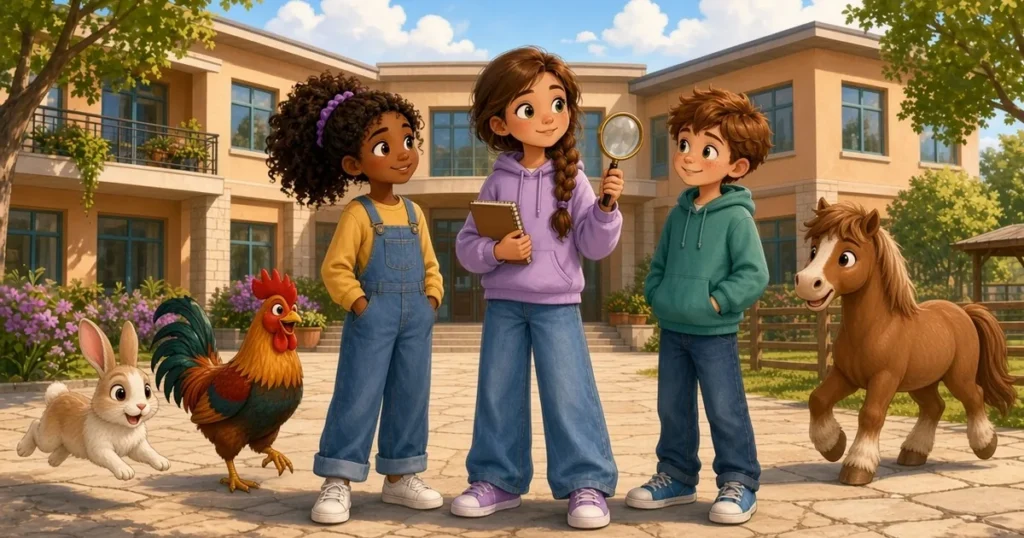
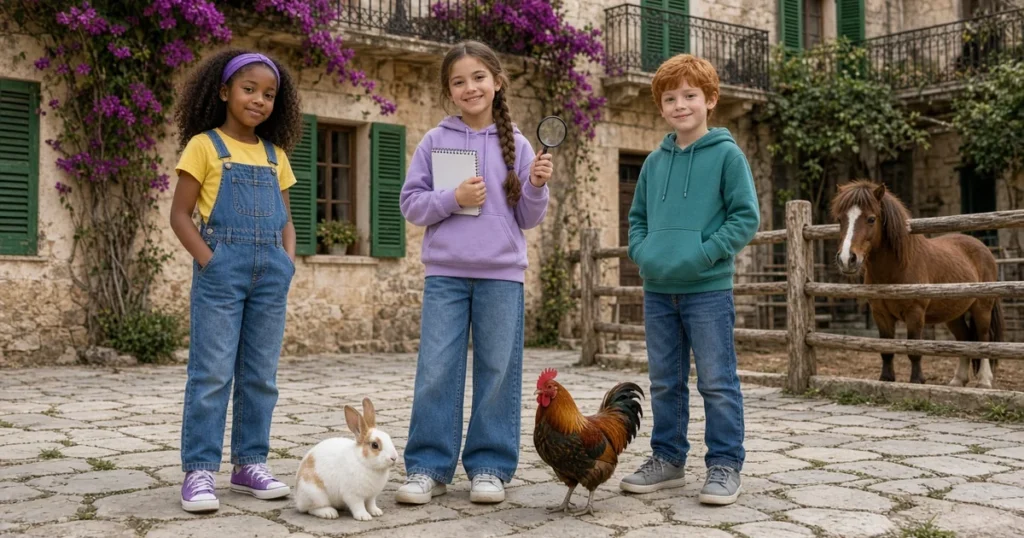
“Two pictures in one?” David took off his cap, and Morris the spider clung to the brim like a sailor in a storm. “Of course you can. In the old days it happened all the time.”
It was Thursday, eight in the morning, and the three of them had found him in the yard mending the garden hose. Amy showed him the photo. He looked at it and gave a small, strange smile.
“Wait here,” he said. And off he went. His jingling faded away up the stairs to the attic. Ten minutes later he came back with a black box in his hand. A leather box with a strap and a round glass eye at the front.
“This is Avraham’s camera,” said David, setting it on the grass as carefully as an egg. “Tova’s husband. The man who built the house. Every photo in the album was taken with it.”
Leo bent over it, eyes shining.
“In the old days, cameras weren’t like today,” David explained. “No screen. No ‘delete’. Inside the camera was film. A long strip of special paper, rolled up. Every time you pressed, light came in through the eye, touched the film and left a picture on it. And then…” He pointed at a small knob on the side. “Then you had to turn this. So the film moved on, and a fresh, clean piece stood in front of the eye.”
“And if you forgot to turn it?” asked Amy. But she already knew.
“Then the second picture landed on top of the first,” said David. “On the same piece of film. And they came out together, one on top of the other. Each a little see-through. It’s called a double exposure.” He looked at the photo. “And Avraham, believe me, forgot to turn it at least once a week.”
Leo had already taken the photo and the magnifying glass and was looking again. “The second window!” he said. “The big crooked one. It’s the Room Seven window, but from inside! Close up! Avraham photographed her first, by the window, from inside. And forgot to turn the knob. Then he went down and photographed everyone outside. On the same piece.”
“And that’s how she got into everyone’s picture,” said Hutie. “See-through. But in it.”
“So she would be in it too,” said Amy quietly, thinking of the sentence on the back of the photo.
She wrote in her notebook: Double exposure. Camera with film. Avraham forgot to turn the knob. The girl photographed from inside, everyone from outside, on the same piece. No ghost. After a moment she added: There is a girl.
Oliver, of course, immediately asked to try. “Just once,” he begged. “I’ll photograph myself twice and be a ghost. An orange ghost.” But David explained that no shop sells film like that any more, and that Avraham’s camera had taken its last picture before Oliver was born. Oliver sighed like an inventor fifty years too late and said that in that case he’d invent his own camera. “A camera for forgetters,” he added. “It turns itself and reminds you to smile.”
But Amy didn’t want to ask David the most important question. She wanted Maya to ask it. Herself. Because it was her grandmother.
“Do you want me to be with you?” Amy asked her at lunch.
Maya thought. Then nodded. “You, and Hutie, and Leo,” she said. “But I’m asking.”
At exactly four, the gate opened, and Grandma Rachel came up the hill with her walking stick and green scarf, as she had every Thursday since the spring. Every Thursday she went up to Room Seven, sat on Maya’s bed and taught the girls to fold paper birds that flap their wings. But this time, when she came in, the girls weren’t waiting with paper. They were sitting quietly. And in the middle of Maya’s bed lay the green album.
Grandma Rachel saw it. And stopped in the doorway.
Maya stood up, took the photo and carried it to her in both hands. “Grandma,” she said, in her bravest voice. “Is that you? In the window?”
Grandma Rachel didn’t answer at once. She sat down slowly on the bed and propped her stick beside her. She took the photo and held it at arm’s length. And she looked at the see-through girl with two plaits for a long time.
“That’s me,” she said at last. “Rocheleh. Ten years old. With measles, red spots all over, and a temperature of forty.” She gave a small laugh, with a tear in the corner of her eye. “They called me ‘the ghost of Room Seven’. The whole year. The boys. Because of this photo.”
“They still call you that,” said Hutie, then panicked and quickly added, “But they don’t know it’s you.”
Grandma Rachel laughed, a real laugh this time. And then she told them.
She was one of the first children. The very first in Room Seven, in fact. She arrived in the autumn, fifty years ago, with one small suitcase, two plaits and a great big fear. Tova taught her music, and Avraham taught her to fold paper birds. “That’s how I fell asleep,” she said. “Counting birds, the way other people count sheep.” And on the day of the big photo, at the start of summer, she came down with measles. She wasn’t allowed out, so she wouldn’t infect everyone. And she stood by the window and cried, because everyone had dressed up and combed their hair and gone outside, and she was left alone.
“And then Avraham came up,” she said. “With the camera. And he said, ‘Rocheleh, stand by the window. I’m photographing you from inside, so you’ll be in it too.’ And he did. And ran downstairs. And forgot to turn the knob.” She ran a finger over the see-through girl. “When the photo came back from the shop, everyone laughed. Avraham too. But afterwards he gave me my little photo from the album. As a present. And he said, ‘Keep it. That way you’ll always know you were here.'”
“The picture on the fridge!” said Maya.
“The picture on the fridge,” said Grandma Rachel. “Fifty years.” She looked at the Room Seven window, at the sill, and Amy saw she was searching for something. “And I left one more thing here.”
“R,” said Amy. “Under the sill. We found it. Under Naama’s N and my A.”
Grandma Rachel got up, leaning on her stick, and went to the window. She bent down slowly and touched the small, crooked letter. She didn’t say anything. But Maya, beside her, held her hand.
“Grandma,” said Maya quietly. “Why did you stand at the gate? All those days? Why didn’t you come in?”
Grandma Rachel took a deep breath. “Because I grew up here,” she said. “This was my home when I didn’t have one. And when you came here, little bird, I couldn’t give you a home of my own. And I was ashamed. To come back after fifty years and say: I’m Rocheleh from Room Seven, and I didn’t manage.” She looked at the window. “So I stood outside. Like back then. And looked in.”
Maya hugged her hard, with her whole body, the way she had hugged her at the gate in the spring. “But now you’re inside,” she said. “And in the photo you were inside then too. Avraham made sure.”
Just then came the jingling in the corridor. Ding-dang-dong. David stopped in the doorway of Room Seven with the black camera in his hand, thinking Grandma Rachel might like to see it. He looked at her. She looked at him. And her stick fell over.
“Rocheleh?” said David, in the voice of an eight-year-old.
“Dudi?” said Grandma Rachel, putting a hand to her mouth. “Little Dudi? Who cried every night his first week, and I brought him a bird?”
“The green bird,” said David, and his voice cracked. “I’ve still got it. In a box. With the carrot.”
Nobody knew what to say. So Hutie, as always when nobody knows what to say, took a string out of her pocket and braided, quietly. And Amy wrote in her notebook, in small letters, just for herself: Some things the house keeps for you. Even for fifty years.
Three weeks later, there was a reunion at Hilltop House.
It was Mrs. Cohen’s idea, but Grandma Rachel made the phone calls. She still remembered most of the names, and with the help of Naama the librarian she found eight of the twenty-one first children. And they came. On a Friday morning, one after another, they walked up the hill. Yosef, who had been eight and was now completely bald, with seven grandchildren. Shula, who had been ten and was now a retired teacher, and corrected Oliver’s grammar within three minutes. Batya, the big girl who had stood on the steps. And Aharon. Little Aharon, the one who sneezed in the photo, now a tall man with a white beard, a scarf and a red nose.
They wandered round the house as if in a dream. They found their beds. They found the broken third stair, and Yosef laughed and said it had creaked back then too. Batya showed the children her initials carved behind the kitchen door, which Zehava swore she had never seen in thirty years. Zehava cooked a meal for eight old children and forty young ones, and they all sat together at long tables, and it was hard to tell who was telling more stories.
And Aharon, the littlest back then, found Tom, the littlest now. They sat side by side on the steps, a man with a white beard and a boy with a seven-knot bracelet, talking very seriously. “I was the littlest here too,” said Aharon. “Everyone picked me up and patted my head, and nobody listened when I talked.” He leaned towards him. “But do you know what? In the end, the little ones grow up. And then they remember everything. Because they watched the most.”
Tom thought about it. “So I’m the best detective,” he said at last, “because I’m the shortest, and I see from underneath.”
“Exactly,” said Aharon, and sneezed, and they both laughed.
At the end, everyone went outside. Everyone. For a new photo. Forty children, eight first children, all the counselors, Mrs. Cohen and David with Morris. Grandma Rachel sat in the middle of the front row with Maya on her lap. And Naama the librarian held the camera, a new one with a screen, where you can’t forget to turn anything.
“One,” said Naama. “Two…”
“Atchoo!” sneezed Aharon.
The whole of Hilltop House exploded with laughter. And Naama clicked at exactly that moment. In the photo, which was hung a week later in the entrance next to the Pink Day picture, everyone is laughing with their heads thrown back, and Aharon, in the middle of the second row, came out blurred. Exactly like fifty years ago.
And in the window of Room Seven, Amy checked twice, there was nobody. Because everyone was outside.
That evening, Amy wrote:
Case Number 21: The Girl in the Window. Solved. Who: Grandma Rachel, Rocheleh from Room Seven. How: measles, an old camera and Avraham forgetting to turn the knob. What I learned: sometimes what looks like a ghost is just someone who wanted very much to be inside. And someone else who made sure she was.
Before Grandma Rachel left, she stopped by Amy at the gate and said one more thing, almost without noticing. “You know,” she said, “that first summer we buried a box here. All twenty-one of us. With letters for the children of the future. Avraham drew a map.” She laughed. “But none of us remembered where. And when we went back to look, there was a sandbox there.”
Amy looked at the sandbox. Then at Falafel, sitting in it, digging. And she put that away in her head, in the drawer for important things.