The summer holidays began on a Tuesday, and by Wednesday the whole of Hilltop House knew that a ghost lived in Room Seven.
It wasn’t on purpose. Amy hadn’t told anyone. She had only shown the photograph to Hutie and Leo in the library, by the open cabinet of the detectives’ archive. But Oliver, Guest of Honour, happened to walk down the corridor at that very moment, “by chance”, for the seventh time that morning. And he saw. And he shouted “Ghost!” so loudly that Zehava dropped a tray of omelettes in the kitchen. From there, as always at Hilltop House, it took exactly four minutes until all forty children were standing in the library doorway, pushing and begging to see.
Amy held up the green album with the gold letters, “Hilltop House – The First Year”, and showed them. One at a time. Carefully. The way you show something broken.
The photo was black and white, with curly white edges. Twenty children stood in front of the house in three rows. The little ones sat on the grass, the middle ones stood behind them, and the big ones stood on the front steps. The boys wore shorts with braces, the girls dresses with white collars. And they were all smiling, except one small boy in the front row who had just sneezed, so his face came out blurred, like a smudge.
And behind them, on the first floor, in the third window from the left, the window of Room Seven, was the girl.
She was see-through. Not completely. But enough. You could see the window frame through her, and the curtain, and even, if you looked hard, the stones of the wall. She was pale and light, with two plaits and a round face, and she was looking straight at the camera. Straight at whoever was holding the photo. And she wasn’t smiling.
“A ghost,” whispered Omer.
“The ghost of Room Seven,” whispered Penny, looking at Amy, Hutie and Maya, the three girls who live in Room Seven, with deep pity.
“She lives with you,” said Alice. “Fifty years. In the dark. Under the bed.”
“She does not live under the bed,” said Hutie, though a little less confidently than usual. And that night, Amy noticed, Hutie slept with all her strings tied round her bed, like a fence.
Only Tom wasn’t afraid. He stood in front of the photo, wearing his seven-knot bracelet, with Oliver’s certificate folded in his pocket, and announced: “I’m allowed not to be afraid of ghosts. I’ve got a certificate.” Then he added more quietly, “Besides, she looks sad. Not scary. Sad.”
Amy looked at him, then back at the girl in the window. And Tom was right. She didn’t look scary. She looked like someone who wanted very much to be outside with everyone, and couldn’t.
But by evening, the ghost of Room Seven had grown, the way ghosts grow when people talk about them. At lunch, she was a girl who got lost in the house fifty years ago. By teatime, she was a girl who vanished inside the wall. And by supper, Benny announced that she climbed out of the window every night, wandered the corridor looking for her photograph, and visited whoever was holding the album.
Everyone looked at Amy.
“I’m holding the album,” said Amy. “And I’m not afraid. And I’m telling you: no blaming without proof. Not even ghosts.”
“How do you prove a ghost isn’t a ghost?” asked Oliver, genuinely interested.
“You find out who she is,” said Amy.
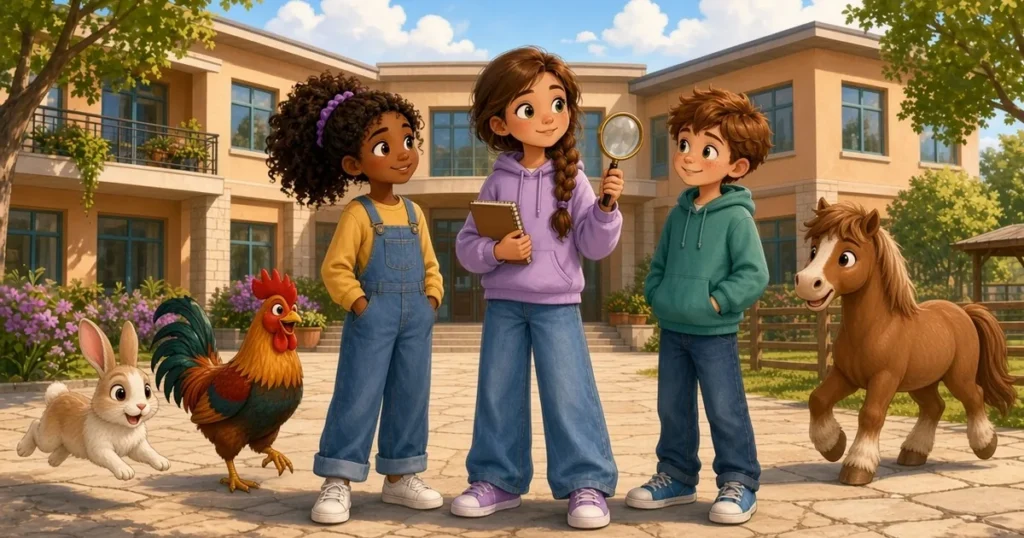
After supper, the three of them sat on the library rug with the album between them, Leo’s torch, and the little wooden magnifying glass tied to the archive key.
“What do we know?” asked Amy, opening her notebook. “Not what Benny says. What we can see.”
“Twenty children,” said Leo, counting again with his finger, one by one. “Seven in the front row, including the sneezer. Seven in the second. Six on the steps. Twenty.”
“And one girl in the window,” said Hutie. “Twenty-one.”
“But the album,” said Amy, turning a few pages on, “has more photos. Of each child on their own. A picture of the front door. Of the first day. Let’s count.”
They counted. On every page were two small photos with a handwritten name underneath. “Yosef, 8”. “Shula, 10”. “Aharon, 7, the littlest”. “Batya, 11”. They counted twenty-one small photos. Twenty-one names.
“Twenty-one,” said Leo, looking up. “In the first year there were twenty-one children. And in the big photo, outside, there are only twenty.”
“So one is missing outside,” said Amy slowly. “And she’s inside. In the window.”
“So she isn’t a ghost,” said Hutie, so relieved that a string fell out of her pocket. “She’s a girl. A real one. Who just didn’t make it into the photo.”
“But why is she see-through?” asked Leo. “A real girl in a window doesn’t come out see-through. She comes out normal. Like everyone else.”
It was a good question. And none of them knew the answer.
Leo took the magnifying glass and bent over the big photo, close, closer, until his nose nearly touched the girl in the window. And he looked for a long time. So long that Hutie started braiding a new bracelet to keep from getting bored.
“Amy,” he said at last, in an odd voice. “Look here. Not at the girl. Around her.”
Amy looked. At first she saw nothing. Then, slowly, the way eyes get used to the dark, she saw. Around the see-through girl was another window. A second window. A bigger one, with a thick frame, that didn’t quite match the house window. It was slightly crooked. Slightly too big. And it ran, see-through like the girl, over the wall and even, if you looked hard, over the head of one of the big children standing on the steps.
“Two windows,” whispered Amy. “One of the house, from outside. And one… from somewhere else. From close up.”
“As if someone laid one picture on top of another,” said Leo. “Like two slides in a magic lantern.”
Amy wrote in her notebook, heart thumping: Twenty-one children. Twenty outside. One in the window. The girl is see-through. Around her – a second window, big, crooked, see-through too. Two pictures in one?
“But how do you make two pictures into one?” asked Hutie. “Is it camera magic?”
“That’s exactly what I want to know,” said Amy. “But not today. Today I want to know who she is.”
She went back to the small photos. Twenty-one children and twenty-one names. If twenty of them stood outside, they only had to find the one who didn’t. So they compared. Face by face. Leo held the magnifying glass, Hutie held the torch, and Amy compared and ticked, in pencil on a page of her notebook, every name she found in the big photo. Yosef – tick. Shula – tick. Aharon, the littlest, the sneezer – tick, probably, since nobody can recognise a smudge.
It took an hour. And at the end, one small photo was left without a tick.
Except that this small photo was missing. Only its place was left in the album: four little black paper corners that had once held a photo and now held nothing. And under the nothing, in faded handwriting, was a name. But the ink had run, as if long ago a drop of water had fallen on it. Or a tear. Only the first letter was left.
R.
“R,” said Leo. “Rebecca. Ruth. Rina. Ronit. Rachel. Reuma. Reut.” He sighed. “Loads of names start with R.”
“Ruti!” said Hutie. “Maybe it’s Ruti! Maybe Ruti lived here when she was little!”
“Ruti is forty,” said Leo. “Fifty years ago she didn’t even exist.”
“Oh,” said Hutie. “True. Not Ruti, then.”
Then Amy remembered something. She jumped up off the rug so fast that the torch rolled under the armchair. “Room Seven,” she said. “Come on. Now.”
They tiptoed along the corridor and up the stairs, skipping the third one because it creaks. And in Room Seven, by the window, Amy crouched under the sill. There, in the wood, for months now, two letters had been carved. N, which Naama carved thirty years ago. And A, which Amy had added in pencil after Naama told her. And Amy had always thought that beneath them was just an old scratch. A thin, deep scratch, dark with age.
Leo switched on the torch. And Amy ran her finger slowly along the scratch.
It wasn’t a scratch. It was a letter. Small and crooked, carved by a girl’s hand, long before Naama. R.
“She was here,” whispered Hutie. “In our room. By this window.”
Amy sat down on her bed with the album on her knees and decided to look at the big photo up close right here, beside the very window inside it.
Hutie sat next to her. And Leo stayed in the doorway, one foot in and one foot out, because boys aren’t allowed in the girls’ rooms after nine, and that’s Shira’s rule. But nobody said you weren’t allowed to peep.
Amy carefully slid the big photo out of its black corners to see it better. And when it came out, something happened that she didn’t expect. On the back of the photo, in pencil, in a grown-up’s small, neat handwriting, were names. Twenty names in three rows, in exactly the order of the children in the picture. And in the bottom corner, on its own, with a little arrow pointing up towards the spot where the window was on the other side of the paper, was one more sentence:
And R. – in the window. Measles. Not allowed out. I photographed her from inside, so she would be in it too.
Amy read it twice. Then aloud, slowly, to the other two.
“I photographed her from inside,” repeated Leo. “So someone went into Room Seven and photographed her by the window. And someone else photographed everyone from outside. Or the same someone. And then…”
“And then the two photos became one,” said Amy. “Somehow.”
“And she was ill,” said Hutie quietly. “And they wouldn’t let her out. And everyone had their photo taken outside, and she watched them from the window.” She was silent a moment. “It’s like Tom said. She isn’t scary. She’s sad.”
Just then, in the bed by the wall, Maya sat up in her pyjamas with a paper bird in her hand. She hadn’t been asleep at all. She’d only been pretending. “I want to see the ghost,” she said, in a small, brave voice. “Because she lives in my room. So she’s like a neighbour.”
Amy handed her the photo. And Maya looked at the window. And at the see-through girl with two plaits. For a long time. Then her eyes grew wide, and the paper bird fell from her hand.
“I know her,” she whispered.
“From where?” asked Amy.
“From the picture on the fridge,” said Maya, her voice shaking. “At Grandma’s. In her house. She’s got a picture there of a little girl with two plaits. And once I asked who it was, and Grandma said, ‘That’s me, little bird. When I was your age.'” She lifted her eyes to Amy. “My grandma’s name is Rachel.”
Room Seven went completely silent. Even the clock on the wall, it seemed to Amy, stopped ticking.
R. Rachel. The window of Room Seven. And one Thursday, a few months ago, an old woman in a green scarf who stood outside the gate and gazed at this very window for a long, long time.
And tomorrow, Amy suddenly remembered, was Thursday.