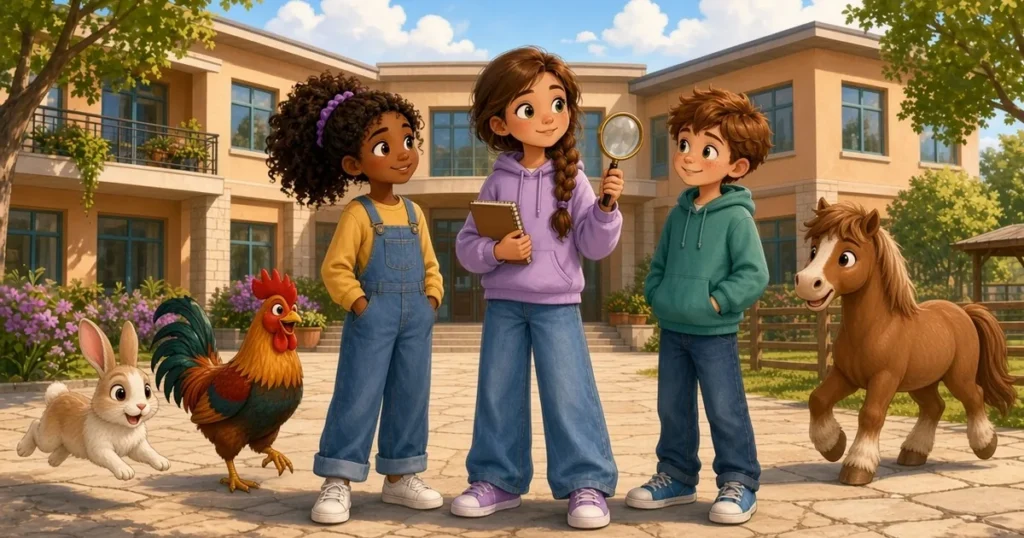
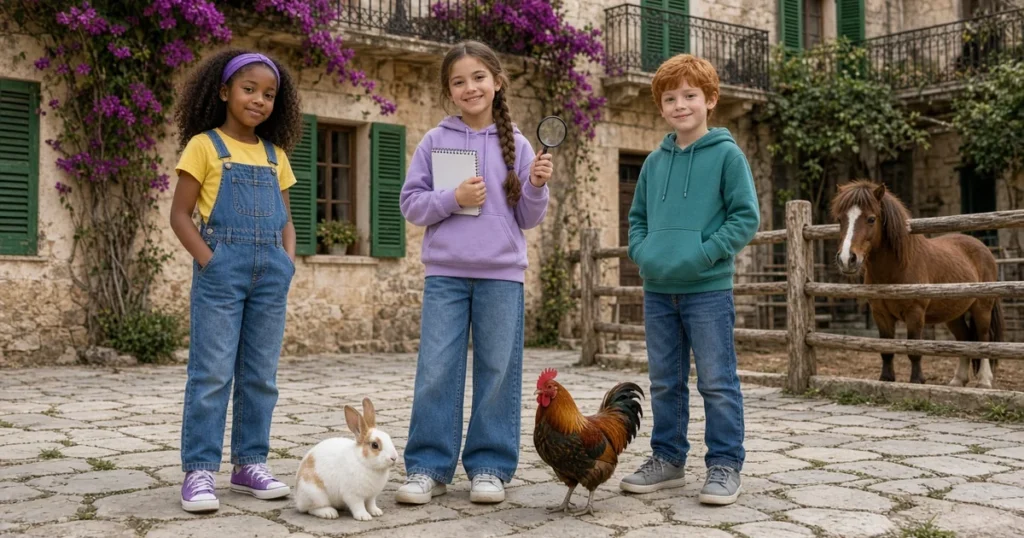
“Don’t move,” whispered Amy.
“I’m not moving,” whispered Hutie. “I’m not even breathing.”
They stood by the swing, perfectly still, watching the yellow fountain in the corner of the sandbox. Falafel was digging. He was digging the way a rabbit digs when he’s sure nobody is watching: head down, tail up, back legs going so fast they looked like four. And every few seconds, from inside the sand, came: ding. Dang.
Then Amy stepped on a dry twig.
Crack.
Falafel froze. He pulled his head out of the hole, with sand on his nose and sand on his whiskers, and looked at them. Then, slowly, with the noblest movement a rabbit can make, he sat down. Right on the hole. Bottom first. Like a king settling on his throne whom nothing in the world will shift.
“He’s guarding it,” whispered Hutie. “Like a dragon in a story. Sitting on its treasure.”
“A dragon the size of a cushion,” said Amy.
“A dragon the size of a cushion,” agreed Hutie, “with a sand moustache.”
Amy didn’t want to frighten him. So she sent Hutie quietly to the kitchen. Hutie came back two minutes later, followed, of course, by the whole of Hilltop House, because at Hilltop House you can’t run to the kitchen without forty children realising something is up. And in her hands she held the one thing in the world Falafel loves more than any treasure: a carrot. A real one, long and orange, with green leaves, which Zehava had pulled out of the fridge.
“Everyone sit down,” whispered Amy. And forty children, David, Zehava and Mr. Ben-Ami with his basket of eggs sat down on the grass round the sandbox, quietly, as if at a play.
Hutie crept closer on her knees. She put the carrot on the edge of the sandbox, a metre from Falafel. Then half a metre closer. Then another half.
Falafel looked at the carrot. Then at the hole beneath him. Then at the carrot. You could see on his face, Leo said afterwards, the greatest struggle of a rabbit’s life. Treasure or carrot. Carrot or treasure.
The carrot won.
Falafel leapt off the hole, grabbed the carrot in his teeth, and in three hops was sitting under the carob tree, munching, eyes half closed, as if his treasure had never existed.
“Now,” said Amy. “Slowly. No spoons. Just hands.”
“Like archaeologists,” said Leo, pulling a little watercolour brush out of his pocket. Everyone looked at him. “What?” he said. “I’m always prepared.”
They dug, Amy, Hutie and Leo, carefully, with hands and brush. Falafel’s hole was deeper than they’d thought. As deep as an arm. And inside, layer after layer, they found the treasure.
The first thing was a sock. A red striped sock, full of sand.
“That’s mine!” shouted Benny. “I thought Omer took it!”
“I only take green ones,” said Omer seriously.
The second thing was a pencil. A blue pencil, chewed at the end. Leo recognised it at once. “That’s from my pencil case! From the winter!” After that, a straw. A crumpled pink plastic straw from the day Zehava made banana milkshakes for the whole house, and Falafel, apparently, had joined in. After that, a corner of pancake, as dry and hard as a stone.
“The ghost’s pancake!” cried Oliver, moved almost to tears. “He didn’t eat it! He saved it! For later!”
After that, a corner of orange paper with half a dinosaur drawn on it. Tom’s mouth fell open. “That’s the corner of the invitation! The bit Sugar didn’t eat!”
“So Falafel was in the paddock yesterday too,” said Amy, writing, “and took whatever fell.”
Then, beneath all the layers, Leo brushed the sand once more. The sand slid aside. And underneath, iron appeared. A big iron ring. And on it, side by side, like the teeth of a giant comb, keys. Lots of keys.
Amy reached in, took hold of the ring and lifted.
And the key ring came out of the sand. Heavy, full of sand, dripping sand. And it jingled. Ding-dang-dong. Exactly like every morning at seven in the corridor. And hanging from it was a little wooden carrot, painted orange. With small round tooth marks at its tip.
Forty children clapped. Zehava shouted “Lunch is saved!” and raised the Queen, and Mr. Ben-Ami raised his basket of eggs like a trophy. But Amy wasn’t looking at them. She was looking at David.
David was sitting on the grass, not moving. She went over and put the key ring in his hands. And he didn’t look at the keys. He looked only at the carrot. He cleaned the sand off it with his thumb, slowly, the way you clean an old photograph. And he found the tooth marks.
“He bit it,” said David. His voice sounded a little odd.
“I’m sorry,” said Amy.
“No,” said David, looking up at her. His eyes were wet, but he was smiling. “Don’t be. For more than forty years it hasn’t had a story. Only Tova and I knew where it came from. And now it’s got a story. A rabbit thought it was carrot cake and buried it with all his treasures. And a girl found it.” He closed his hand round it. “That’s the best story that could happen to a carrot.”
Later, when everyone had gone to watch Zehava open the pantry, Leo explained to Amy and Hutie what had happened, with a drawing in the sand, the way he likes to. “Last night the ring fell off the back of the toolbox onto the grass. Falafel smelled carrot cake. He came over. He sniffed the box, a bit of fur got caught in the catch, and some sand from his feet fell in through the gap. Then he grabbed the carrot in his teeth and dragged. But the ring is heavy. More than a kilo. And Falafel weighs two kilos. So every two metres he rested and dug a bit, because rabbits dig when they’re tired. Those are the holes. And at the end he reached his treasure spot. And buried it.”
“And what have we learned?” asked Hutie.
“Never keep carrot cake in your pocket,” said Leo.
“And also,” added Hutie, “that dragons can be soft and sweet. If you just give them a carrot in time.”
At twenty to one, the pantry opened. At two o’clock, forty children and Mr. Ben-Ami ate schnitzels made with his hens’ eggs. Zehava gave him the biggest schnitzel and said his eyebrows were “welcome every Friday”. And Mr. Ben-Ami blushed right up to his eyebrows.
Falafel got another carrot, a whole one of his own, and buried it at once. And Benny, officially and ceremoniously, gave him back the red sock. “Look after it,” he said. “But not in the sand.”
The next morning at seven, the jingling came back to the corridor. Ding-dang-dong. And all over Hilltop House, in every room, everyone smiled under their duvets.
But this time, the jingling didn’t carry on. It stopped. Outside the door of Room Seven.
A knock. Three knocks.
Amy opened the door. There stood David, with his cap, with Morris and with the key ring on his belt. And beside him stood Leo in his pyjamas, rubbing his eyes, because David had woken him first. “Come on,” said David. “All three of you. I want to show you something.”
He led them to the library. The Hilltop House library is a small room with an old rug, an armchair everyone fights over and shelves up to the ceiling. And in its corner, behind the armchair, stood a cabinet. A tall cabinet of dark wood with two doors and a small, polished keyhole. Amy had walked past it a hundred times, and it had always been locked. And nobody knew what was inside.
David took a key from his pocket. Not from the ring. A small, new, shiny key. Tied to it was a blue ribbon. And hanging on the ribbon was a tiny wooden magnifying glass that David had carved himself, in the night.
“This is for you,” he said. And he put the key in Amy’s hand.
Amy opened the cabinet. The doors creaked, like the third stair. And inside were shelves. Empty shelves. Clean. Waiting.
“Detectives need an archive,” said David. “A place to keep all their cases. The clues. The notes. The evidence.” He pointed at the top shelf. “Notebooks here, when they’re full.” The middle shelf. “Clues here. The threads, the hairs, the invitations.” The bottom shelf. “And here, whatever you haven’t solved yet.”
“The detectives’ archive,” whispered Leo, as if saying a sacred word.
“Twenty cases,” said David. “In one year. You deserve a place.” He smiled. “And whoever has a key belongs.”
That day they moved everything they had into the archive. Amy’s old notebook, the one Ruti gave her on her first night, full to the last page. Hutie’s red string, which had fished out the cup. Leo’s map, with the thirty centimetres. The page with the two alphabets. Tom’s orange invitation, minus its corner. And the folded note from the gap by the stage, which nobody had opened yet, on the bottom shelf, for “what we haven’t solved yet”.
In the afternoon, Mrs. Cohen peeped into the library with her coffee. She looked at the open cabinet, at the shelves and at the three detectives sitting on the rug sorting clues, and said nothing. But five minutes later she came back with an envelope and put it on the middle shelf. Inside was one red sock with a clover on it. “Evidence,” she said, with her most serious face. “From Case Number Fourteen. Don’t tell anyone.” And she left, the corner of her mouth twitching, just a little, on one side.
And Oliver, who happened to walk down the corridor six times, finally stood in the doorway peering in with the eyes of someone looking at a cake through glass. “Can I come in?” he asked. “Just to look?”
Amy, Hutie and Leo looked at one another. Then Hutie braided him an orange bracelet in two minutes, and Leo wrote on a strip of sticky tape in felt-tip: Guest of Honour. “You can visit,” said Amy. “Once a week. And don’t touch the bottom shelf.” Oliver put on the bracelet as if he’d been given a medal, and didn’t take it off for a week.
In the evening, Amy wrote in her new embroidered notebook:
Case Number 20: The Key Ring. Solved. Who: Falafel, the Sandbox Dragon. How: carrot cake in a pocket, a wooden carrot and a great love of treasure. What I learned: everyone hides what they love. Rabbits too. David too. Me too. And: whoever has a key belongs.
She closed her notebook and held the little key with its wooden magnifying glass in her palm for a moment. The way David held his carrot. The way she held her blue button. And she felt, for the first time, that Hilltop House wasn’t just a place where you live. It was a place you belong to.
And there was one more thing in the cabinet when they opened it. She only noticed it at the very end, when she put her old notebook on the top shelf. In the furthest corner, covered in dust, lay an album. An old photo album with a green cloth cover and the words “Hilltop House – The First Year” in faded gold.
Amy opened it in the middle. And there, in a black-and-white photograph, twenty children stood in front of the house, smiling at the camera, fifty years ago. And behind them, in the window of Room Seven, her window, was one more figure. Pale, almost transparent, as if made of mist. The figure of a girl, looking straight at the camera.
But all the children, Amy counted twice, were standing outside.