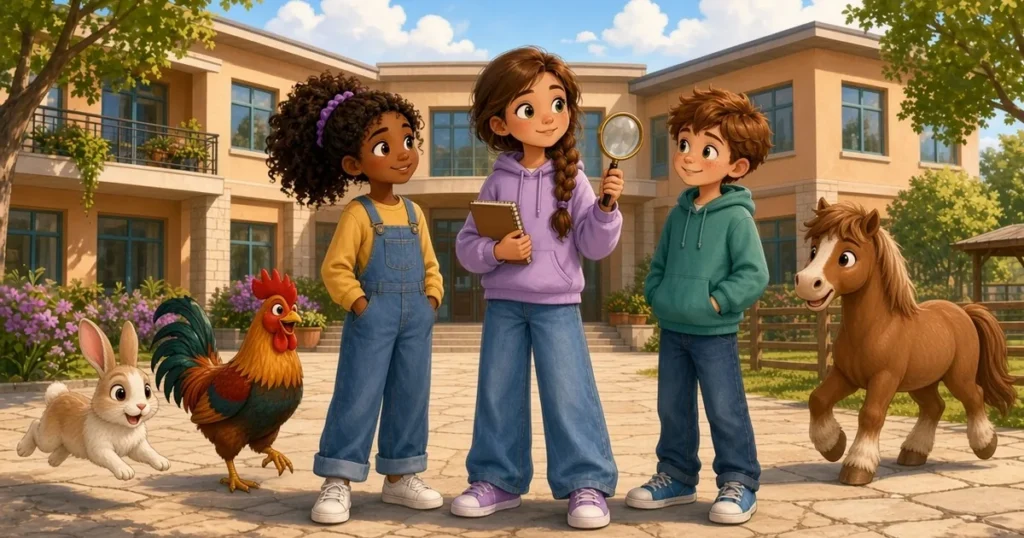
The first thing Amy noticed that morning was the silence.
Every morning at seven, David walks down the corridor. And with him, always, comes the jingling. Ding-dang-dong, ding-dang-dong, like little church bells out for a stroll. It’s the sound of his key ring. A huge, heavy ring with twenty-three keys, which has hung from his belt for thirty years. At Hilltop House they say you can tell where David is at any moment just by the jingling. And that he can never surprise anyone, not even on a birthday.
But that morning, David walked down the corridor in complete silence.
Amy came out of Room Seven, toothbrush in hand, and saw him standing in front of the pantry door. He patted his right pocket. Then his left. Then his shirt pockets. Then his cap, even though caps don’t have pockets, and Morris the spider, sitting on top, swayed in alarm.
“David?” asked Amy.
David looked at her, his face as bewildered as a child lost in a supermarket. “They’re not here,” he said. “The keys. The ring.” He patted his pocket again, as if they might have come back in the meantime. “Thirty years, Amy. Thirty years, and never, ever, have I lost them. Not a single key.”
Within ten minutes, the whole of Hilltop House knew. And within twenty, everyone understood why it was so terrible.
“The pantry is locked,” announced Zehava in the kitchen doorway, Queen in hand, with the face of a general before a battle. “And everything I need for lunch is inside. The flour. The oil. The eggs. The breadcrumbs for the schnitzel. The potatoes. Forty schnitzels, and I haven’t got a single egg to dip them in.”
“Breakfast is fine,” said Ruti, bringing bread and cheese from the fridge. “But lunch…”
“Lunch is in danger,” said Oliver in a newsreader’s voice, holding a spoon to his mouth like a microphone. “I repeat: lunch is in danger.”
“Isn’t there a spare key?” asked Mrs. Cohen.
“There is,” said David with a sigh. “It hangs on a hook. Inside the pantry.”
For a moment, everyone was silent. Then everyone laughed, even David. A slightly sad laugh, but a laugh.
“I could open the lock,” offered Oliver. “With a knitting needle. I’ve got experience.”
“No,” said Mrs. Cohen, Zehava and David at the same moment.
Amy was already beside David with her notebook open. Hutie and Leo stood on either side of her, like two bookends.
“David,” said Amy, “let’s start from the end. When did you last see them?”
David closed his eyes and thought. “Last night,” he said. “After Tom’s party. I hung the sign on Sugar’s gate. I checked the clip. Four times.” He smiled a little. “Then I went to fix the swing, the one by the sandbox. Its chain had been creaking for a month. I brought my toolbox. And I took the ring off my belt, because it jingles and gets in the way when you bend down. And I put it…” He opened his eyes. “I put it on the lid of the toolbox. By the swing.”
“And then?”
“Then it started getting dark. And Shira called me to help with the balloons stuck on the ceiling. So I closed the toolbox, carried it to the shed and went inside.” He paused. “And I didn’t take the ring. I must have left it on the lid. And when I closed it, it fell. Or something.”
“But you looked?” asked Hutie.
“I looked at six this morning,” said David. “On the lid, in the box, by the swing, under the swing, all over the yard. Nothing.”
Amy wrote: Key ring – last night, about eight. On the toolbox lid. By the swing and the sandbox. This morning – gone.
“Now,” she said. “Tell us what it looks like. Exactly.”
“Twenty-three keys,” said David. “Big and small. For every door in the house. The pantry, the shed, the cellar, the coop, the attic. And the ring itself, a big iron ring. And hanging on it…” He stopped and suddenly went shy. “Hanging on it is a carrot.”
“A carrot?” asked Leo.
“A wooden one,” said David. “A little carved carrot, painted orange. Tova carved it for me when I was eight, in my first week here. So I wouldn’t be scared at night. She told me that if I held it in my hand, I’d never be alone.” He cleared his throat. “It’s been with me ever since. On the ring.”
Amy looked at David and felt something warm in her heart. She thought of her blue button. Everyone needs something to hold at night.
“And there’s something else,” said David, going even redder. “Every morning, Zehava gives me a slice of carrot cake. Wrapped in a napkin. I put it in my pocket, with the ring, and eat it at ten. For twenty years now.” He sighed. “So the carrot, and in fact the whole ring… smells a bit of carrot cake.”
Leo stepped closer and carefully sniffed David’s pocket. “True,” he announced, as seriously as a scientist. “Cinnamon. And walnuts. And carrot.”
Amy wrote it down and underlined it. The key ring smells of carrot cake.
The first suspect, as always, was Oliver. And not only because he had offered to break into the pantry.
“I saw him last night,” said Penny. “In the sandbox. When it was already dark. He was digging. With a spoon.”
Everyone turned to Oliver. And Oliver, for the first time in his life, looked genuinely flustered. “I was digging,” he admitted. “But that’s got nothing to do with it. It’s… a project. A secret one. For something else. For the future.” He put a hand on his heart. “And I don’t need keys. I’ve got a knitting needle.”
“That doesn’t help you, Oliver,” said Hutie.
“I know,” said Oliver sadly. “But it’s true.”
Amy wrote: Oliver – dug in the sandbox last night. “Secret project for the future.” Check.
Later, to one side, when nobody could hear, Amy asked Oliver to show her. Just show her. Oliver hesitated, looked in every direction, then led her to a corner of the sandbox, dug with his hands and showed her the lid of a glass jar, buried deep. “It’s not keys,” he whispered. “It’s for someone to find on a rainy day. Don’t tell anyone. Not yet.” And he covered it up again.
Amy promised. And wrote in her notebook, in tiny letters: Oliver – a jar. Not connected. (For now.) Then she crossed Oliver off the list of suspects.
“The jay,” said Benny. “Obviously. It steals anything shiny. It stole the bell, and Zehava’s spoon, and everything that sparkles in the yard.”
“Twenty-three keys weigh more than a kilo,” said Leo. “I checked once. A jay weighs about a hundred and ninety grams. It would need seven more jays for that. And a crane.”
“What about the hedgehogs?” asked Tom, who was still wearing his birthday hat. “They took the carrots once.”
“The hedgehogs didn’t take the carrots,” Hutie corrected him. “They were digging for beetles, and the carrots were in the way. Besides, they sleep all day under the shed, in the Prickly Hotel. And they’re not interested in cake.”
They went to the shed, to David’s toolbox. It was a heavy green metal box with a lid that opened upwards and a little catch at the front. David opened it. Inside were hammers, screwdrivers, nails, pliers and a tape measure that Leo eyed enviously. And on the top tray, among the nails, was sand.
Not much. A little. Fine, soft yellow sand. Like the sand in the sandbox.
“How did sand get into a closed box?” asked Hutie.
“It wasn’t closed,” said Amy slowly. “Not all night. David, when you closed it last night in the dark, the ring was still on the lid. Right?”
“Probably,” said David.
“So if the ring was on the lid and the lid was closed, the ring didn’t fall into the box. It fell off the back. Onto the grass. By the swing.” She looked at the sand. “And the sand? Someone brought it. On their feet. Or on their fur. Someone who’d been in the sandbox, and then sniffed this box, and the grass behind it.”
And when Hutie bent down to check the little catch at the front, she found it. Caught in the catch, where it didn’t quite close. A small tuft of fur. Soft. Very soft. Golden-brown, the colour of a falafel ball. And at its tip, one white hair.
“Fur,” whispered Hutie.
“Golden,” said Leo.
“With a white tip,” said Amy. And she slowly wrote all the clues, one under another: Sand in the toolbox. Golden fur with a white tip. A key ring that smells of carrot cake. And something inside her began to jingle. Not like keys. Like an idea.
Benny and Omer had already searched the grass behind the shed using Leo’s method: in rows, metre by metre, like police in a film. They didn’t find the key ring. But they found something else. In the grass, in an almost straight line from the shed to the sandbox, were little holes. Hollows. As if someone small had stopped every few steps, dug for a moment, got bored and carried on. And at every hollow, a little earth flung backwards.
“Like someone dragging something heavy,” said Omer, “and resting every two metres.”
“Or someone who loves digging,” said Amy, writing.
Meanwhile, back in the house, lunch was still in danger. Zehava stood in front of the open fridge counting what there was: half a cheese, three tomatoes, leftover pancake cake and one lettuce. “With this,” she said, “I don’t feed forty children. I feed a rabbit.”
At twelve, with the sun high in the sky, David sat on the kitchen steps, cap in hand, looking more tired and sad than Amy had ever seen him. “I don’t care about the keys,” he told her quietly when she sat down beside him. “Locks can be changed. But the carrot…” He didn’t finish.
“I’ll find it,” said Amy. “I promise.”
Then there was a knock at the back door. And in the doorway stood Mr. Ben-Ami, the new neighbour, with his brush eyebrows and a straw basket. And in the basket were twelve brown eggs.
“My hens,” he said, a little embarrassed. “I bought three, as I said I might. And they lay like mad. I didn’t know what to do with all the eggs. I heard there are forty children here.”
Zehava looked at him, at the eggs and at the eyebrows. Then she hugged him, Queen in hand, so hard that his eyebrows nearly flew off. “You,” she said, “deserve a schnitzel. If only I had breadcrumbs.”
But Amy wasn’t in the kitchen any more. She was sitting on the swing David had fixed the night before, at the far end of the yard, by the sandbox. The swing didn’t creak any more. It swung quietly, to and fro, and Amy thought. Sand. Fur. Carrot cake. Who loves carrots more than anyone at Hilltop House? And who, whenever he finds something he loves, hides it?
And then she heard it.
It was a tiny sound, faint, almost nothing. Ding. And then another one. Dang. From the direction of the sandbox.
Amy stopped the swing with her feet and turned slowly. And Hutie, who had just come to call her for lunch, stopped beside her mid-step.
In the corner of the sandbox, in the shade of the carob tree, sand was flying in every direction. Like a little yellow fountain. And in the middle of the fountain were two golden back legs, digging as fast as a machine. And a round white tail, bobbing up and down.
Falafel was digging. And beneath his feet, from inside the sand, for the first time since that morning, something jingled.