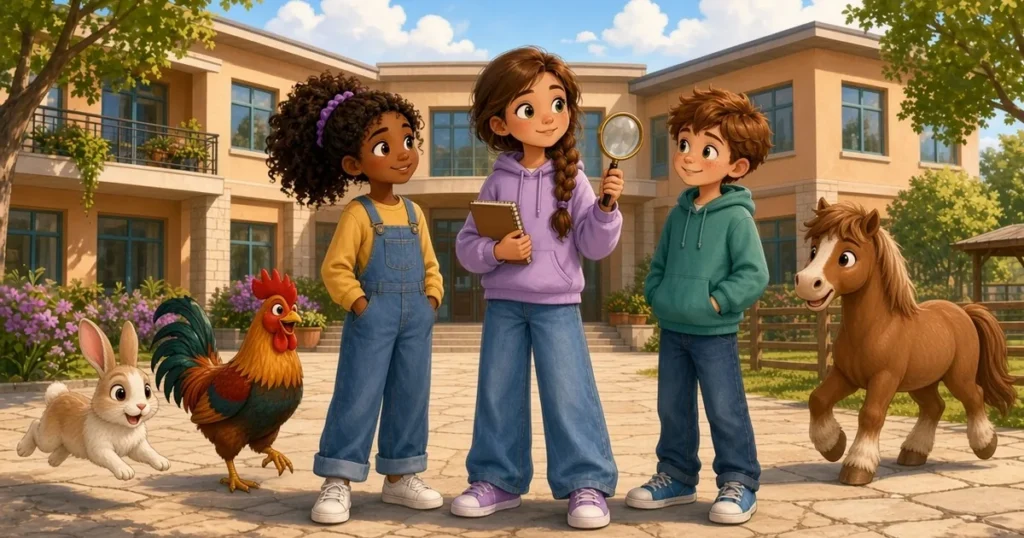
Leo’s chess club met every Wednesday at four o’clock, in the library. It had exactly five members, and Leo knew this by heart, because he had written the rules. Five pages. With numbers.
The members were: Leo, who was the chairman, and the secretary, and the treasurer, and the referee. Benny, who had joined because he thought chess was a kind of chocolate, and stayed because he found out he was good at it. Omer from Leo’s class, who thought slowly but never got anything wrong. Tom, who was seven and couldn’t play, but was in charge of “looking after the pieces that fall off”, a job he took extremely seriously. And, since last week, Ari, whom Leo had invited after noticing that he remembered exactly where every piece had stood, even after the board had been knocked over.
They played on the most beautiful board at Hilltop House. An old board of dark and pale wood, with wooden pieces, each of which had a tiny crown or a tiny head made of brass that gleamed in the light. Tova, the founder’s wife, had brought it fifty years ago, and David said she had taught all the first children on it. “And nobody,” he added, “ever beat her. Not once. She moved her queen like someone stirring soup.”
Every Wednesday, before the game, Leo polished all the little brass heads with a soft cloth, one by one, thirty-two pieces, checked they were all there, and wrote in his notebook: 32/32. All correct.
Until the Wednesday he wrote: 31/32. Missing: white knight.
“Maybe it fell off,” said Benny, looking under the table.
“Tom,” said Leo, with the seriousness of a chairman, “you’re in charge of pieces that fall off. Did a piece fall off?”
Tom looked under the table, and under the chair, and under the rug, and even inside his own shoe, just in case. “Nothing fell off on my watch,” he announced. “I was awake the whole time.”
They played with a rubber instead of the knight. Benny lost to Omer and said it was because the rubber “didn’t look enough like a horse”.
The week after, Leo wrote: 30/32. Missing: white knight, black bishop.
And the week after that, before they had even started, Leo opened the box, counted, counted again, and turned as white as the white pieces. 29/32. Missing: white knight, black bishop, white queen.
“The queen,” he whispered. “Tova’s queen.”
That evening, on the third stair, Amy opened her notebook.
“First,” she said, “what do we know?”
“Three pieces,” said Leo, who had already made a list. “One every Wednesday. Always between one week’s game and the next time the box is opened. The box lives on the shelf by the window. The library isn’t locked. And…” He hesitated. “And wherever a piece has gone, there’s something else instead.”
“What do you mean, something else?” asked Hutie.
Leo took a small clear bag out of his pocket, with a label on it, like detectives on television. Inside were three things. A red bottle cap from a juice bottle. A silver button with a little anchor engraved on it. And a blue bead, round and see-through, like a drop of sea.
“The cap was in the box where the knight should be,” he said. “The button where the bishop was. The bead where the queen was. In exactly the same slot.”
Amy took the bag and looked. “Someone takes,” she said slowly, “and leaves something in its place. Like… payment.”
“Or like a joke,” said Hutie. “A bottle cap instead of a knight? That sounds exactly like a certain someone.”
And everyone looked, without wanting to, towards Room Three. Oliver’s room.
“It wasn’t me!” shouted Oliver the next morning, before Amy had even opened her mouth. He was standing by the coop with a basket of eggs, and Mrs Cohen’s gold star pinned to his jumper, as it had been ever since. “I’m the Egg Knight! Knights don’t steal queens!”
“But knights do like jokes,” said Hutie.
“That’s true,” Oliver admitted. “But if it was me, I’d leave something funnier. Like an egg. An egg instead of a queen. That’s funny. A bottle cap isn’t funny. A bottle cap is just a bottle cap.”
Amy wrote: Oliver. Argument: a bottle cap isn’t funny. I agree.
“Or maybe,” said Benny, who had joined them by the coop because he’d heard the word chess, “it’s Omer. He always wins. Maybe he wants us playing with rubbers so everyone gets confused and he keeps winning.”
“Omer wasn’t even here last week,” said Leo. “He was at his aunt’s. In Haifa. Four days.”
“Then maybe it’s Tom,” said Benny. “He planted bookmarks once.”
And Tom, who heard this from the other side of the fence, where he was feeding Falafel, was so offended that he dropped the carrot. “I was in charge of the pieces!” he shouted. “If I took a piece, I’d say so! I always say so in the end!”
That, Amy knew, was true. Tom always said so in the end. Usually in tears, but he said so.
“And Falafel?” asked Hutie. “He buried David’s keys once.”
“Falafel can’t open a box,” said Leo. “And he can’t leave a button with an anchor on it. He can only leave one kind of thing, and nobody wants that in the box.”
Everyone laughed. Even Tom, who was still a bit offended.
But Ari, who had been standing quietly beside Amy the whole time, didn’t laugh. He was looking at the clear bag, and at the blue bead.
“That bead,” he said at last, softly, “is Maya’s.”
Everyone turned to him.
“From her necklace,” said Ari. “The one with the blue beads. It had twelve when I arrived. On Tuesday I noticed it only had eleven. She said the string snapped by the coop.” He pointed at the button. “And the button with the anchor is from David’s coat. The blue winter one he wears when it rains. It’s missing the third button down. It has been for two weeks.”
Leo opened his mouth, shut it, then opened it again. “How do you know all that?”
Ari shrugged, almost embarrassed. “I look at people,” he said. “It’s what I do.”
Amy smiled and wrote in big letters: The things left instead of the pieces are things that went missing too. Someone takes from everywhere, and leaves everywhere.
“And the bottle cap?” asked Hutie.
Ari thought. “Grape juice,” he said. “The kind Zehava only buys on Fridays. But everyone drinks that. So it could be anyone’s.”
That evening the four of them went up to the library with Hutie’s torch. The box stood on the shelf by the window, as always. Leo opened it and counted. 29/32. Nothing else had gone. Yet.
Amy went to the window.
It was the old, tall window that faced the carob tree. And someone, as usual, had left it open a crack, because the library got hot from the heater. On the sill, outside, there were marks. Small ones, in dried mud. Three lines forward, one back. Again. And again.
“Footprints,” whispered Hutie.
“A bird’s,” said Leo, taking the tape measure out of his pocket and measuring. “Four centimetres. Not a small bird.”
And Amy, without a word, took something out of her notebook, from between the pages of Case Number 4, something she had kept there for more than a year. A feather. Blue, with black stripes. She laid it on the sill beside the new feather Leo had found the week before.
They were identical.
“The jay,” said Hutie and Leo together.
“The jay?” asked Ari, who hadn’t been at Hilltop House for Case Number 4.
“One very clever bird,” explained Hutie, “who once stole Kuku’s bell, and my bracelet, and an orange ball, and half the shiny things in the house, to decorate a nest for his babies. And he can miaow. Like a cat. It was extremely alarming.”
Ari looked at the feathers. “But it’s winter,” he said slowly. “There aren’t any babies in winter. So what does he need a queen for?”
Nobody knew the answer.
“There’s only one way to find out,” said Amy. “We watch him.”
And so the stake-out began.
Leo turned the chess box into a trap. Not a real trap, but a trap for eyes: he set the box open on the inside sill, with the remaining pieces, and a little sun made of silver foil above them, to make it extra shiny. Then he wrote a rota. Five pages. With numbers.
“First shift,” he read out, “morning: Amy and Hutie, behind the curtain. Second shift, lunchtime: me and Ari, behind the sofa. Third shift, afternoon: Benny and Omer, behind the armchair. And fourth shift…”
“Me!” shouted Tom. “I want a shift!”
“Fourth shift,” said Leo, “Tom. In charge of telling everyone when their shift is.”
And Tom, who didn’t realise this wasn’t really a shift, was overjoyed.
They sat there all day. Amy and Hutie behind the curtain, until Hutie fell asleep and snored, and Amy had to put a hand over her mouth. Leo and Ari behind the sofa, until Leo had counted every book on the bottom shelf: a hundred and seventeen. Benny and Omer behind the armchair, until Benny had quietly eaten three slices of bread and jam, and Omer complained that he chewed so loudly the jay would hear.
The jay didn’t come.
“Maybe he knows,” said Hutie that evening, disappointed. “He’s clever, after all. Maybe he saw us.”
“Or,” said Amy slowly, looking at Leo’s rota, “maybe he only comes when someone’s playing.”
Leo looked up. “Wednesdays,” he said. “He always took them after a Wednesday. After we’ve played, and the pieces are polished and shiny and…” He stopped. “And I polish them,” he said quietly. “I polish them for him.”
On Wednesday at four, the club met as usual. Five members, plus Amy and Hutie, who sat at the side, as if by chance, holding books upside down. Leo polished the pieces one by one, twenty-nine of them, until they shone like treasure. Benny played Ari, and Omer played Leo, with a rubber, a bottle cap and a sugar cube from Zehava standing in for the missing pieces.
And at twenty-two minutes past four, Amy heard it.
“Miaow.”
Everyone froze. Benny with a rook in mid-air. Tom with his hand in the sweet jar.
On the sill of the open window sat a bird. Bigger than Amy remembered. Pinky-brown, with blue-and-black striped wings, like stripes of sea, and bright, clever eyes that looked straight at the board. It tilted its head one way, then the other, like someone considering a move.
Then it hopped, one small hop, into the room, onto the box on the table. It took something small and shiny out of its beak and placed it in a slot. And, carefully, like a jeweller, it picked up the black rook.
“Now!” whispered Leo.
But Amy caught his arm. “No,” she whispered. “Look what he’s left.”
With a whirr of wings the jay was already outside, up in the carob, with the rook in his beak.
They all ran to the box together, Tom first, because he was in charge of pieces that fall off.
In the black rook’s slot lay a ring. A small gold ring, with one tiny green stone.
Hutie looked at it closely and went pale. “Amy,” she whispered. “I know that ring. It’s Zehava’s ring. Her mother’s. Zehava’s told us about it a million times: how she took it off to knead dough and put it on the kitchen windowsill, and in the morning it was gone. Twenty years ago.”
Amy looked at the ring, and then, through the window, at the carob tree. At its top, swaying in the wind, as if someone up there were laughing.