“Help,” Shimon repeated. “Anyone. Please.”
Forty children looked at him. Then, without anyone planning it, forty heads turned slowly towards the second row on the right. Towards Amy.
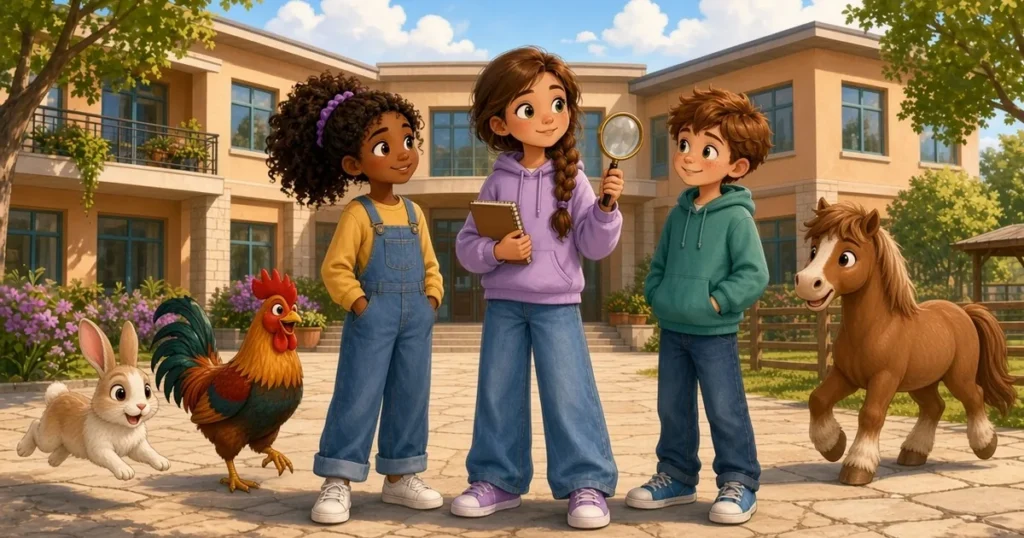
Amy swallowed. Then she stood up, notebook in hand, and walked to the front of the coach. Hutie followed at once, as always. And Leo, with the map.
“First of all,” said Amy, and her voice came out steadier than she felt, “we need to know where we are. You can’t know where to go if you don’t know where you’re starting from.”
“But we don’t know where we are,” said Shimon. “That’s why we’re lost.”
“Then the sign will tell us,” said Amy, pointing outside at the old post with the thorny bush.
“The sign’s covered,” said Leo.
“Not for long,” said Hutie, and opened her third bag.
They climbed down from the coach: Amy, Hutie, Leo, and Benny, because somebody had to be tall. The bush was enormous and thorny, its branches poking into every hole in the sign like fingers. Benny tried to push one aside, yelled “Ow!” and sucked his finger. But Hutie was already at work. She looped string round one branch, tied a knot, pulled it back and tied it to the post. Then another branch. And another. “A stage knot,” she explained, without looking up. “Comes undone with one tug. That way we don’t ruin the bush’s life.” Benny lifted her onto his shoulders, Hutie tied back the top branches, and after five minutes the bush was gathered to either side like a stage curtain. And behind it, rusty and bent but readable, stood the sign.
Arrow left: Poplar Heights 9. Arrow right: Mulberry Village 2.
“Mulberry Village!” shouted Hutie from Benny’s shoulders. “That’s the village with the mulberry tree! We went through it twice!”
Leo was already kneeling on the road with the map spread on the tarmac, lit by the torch on Shira’s phone. His finger raced along the lines and stopped. “Mulberry Village,” he said. “Here. And Poplar Heights, here. And our junction, between them. Here.” He put his thumb on a tiny dot. Then he moved his finger up and to the right, to a circle he had pencilled at the petrol station. “And Oak Farm, here. North. Not far at all. Eight, nine kilometres.”
“So left,” said Amy. “To Poplar Heights.”
“How do you know that road goes north?” asked Benny. “Maybe it twists round. Like every road here.”
“We’ll check,” said Amy. “By the sun.”
They got back on the coach. And Shimon, without asking a single question, turned left. The coach climbed slowly along the narrow road. Amy stood beside the driver watching the windows. The right-hand side. And the left-hand side.
After one bend, then another, it happened. The red stripes of sunlight, which until now had come in from the right, moved. They slid across the ceiling of the coach like the hands of a clock and settled, slowly, on the other side. On the left-hand windows. On Alice and Penny’s faces, on Maya’s hair, on Tom’s dinosaur.
“The sun’s on the left,” said Amy. “West is on the left. We’re going north.”
The whole coach clapped. And Shimon, behind the wheel, wiped his eyes with his sleeve and said it was the dust.
But the sun didn’t wait for them. It touched the hills, turned orange, then red, then vanished. Within a quarter of an hour it was dark. Not town dark, with streetlights. Hill dark. Black and deep, with stars beginning to come out one by one, and the coach’s headlights showing ten metres of road and nothing else.
Then, of course, came another junction.
This time there was no sign at all. Just two roads, both narrow, both dark, one straight ahead and one dropping away to the right. And the sun, which had been their compass, had gone to bed.
“Now what?” whispered Mrs. Cohen. She no longer sounded sure. She was simply asking.
At the back, Tom began to cry. Quietly, into his dinosaur. And Maya, who was frightened too, Amy could see, because her hands were shaking, hugged him and whispered something in his ear. Amy caught only half: “…the house talks a lot, but never mean. The road too.” Tom stopped crying and asked, “The road talks too?” And Maya said, “If you listen.”
Amy, standing at the front of the coach, heard that, and felt something in her head open, like a window.
She shut her eyes. And thought. What did she know? She knew Oak Farm was beside Poplar Stream. She knew the stream was close. And she knew something Leo had said a week ago in the library, reading about trees.
“Leo,” she said, opening her eyes. “Poplars. Where do they grow?”
“By water,” said Leo at once. “Only by water. They need lots of it. They’ve got white trunks, and leaves that rustle like rain, even when there’s no wind.”
“Shimon,” said Amy. “Please switch off the engine. And open the door.”
Shimon switched off. The door opened with a hiss. And Amy said, to the whole coach: “Quiet. Everyone. One minute. Listen.”
Forty children went quiet. Which was a miracle in itself.
And in the silence, from outside, they heard it. Cicadas. Wind. And then, from the right, from below, from the direction of the road dropping away, a soft, distant, endless sound. Like someone pouring water and never stopping.
“A stream,” whispered Leo.
“And look,” whispered Hutie, pointing.
In the dark, to the right, under the stars, stood a row of trees. Tall and slim, their trunks glimmering faintly white in the moonlight, like a row of ghosts standing in a queue. Their leaves rustled softly, like rain. Though there was no wind.
“Poplars,” said Amy. “Right. Along the poplars.”
Then a voice came from the back row. “Wait.”
It was Oliver. He stood up with his locked box, took a cord with a small key from round his neck and opened it. The whole coach leaned over to look. And inside, arranged with a neatness nobody expected from Oliver, were: a big, powerful torch with new batteries. A coil of rope. Plasters. A tiny screwdriver. Three bars of chocolate. A small jar of glow-in-the-dark paint, orange, naturally. And a compass. A real metal compass with a lid.
“Survival kit,” said Oliver, going a bit red. “Mum always says one day I’ll get lost. So I got ready.” He held out the compass to Amy. “Just give it back.”
“You made this yourself?” asked Hutie, astonished. “And never told anyone?”
“Course I didn’t tell anyone,” said Oliver. “A prankster with plasters? That’d wreck my whole reputation.”
Amy flipped open the lid. The needle quivered and settled. She looked at the needle, at Leo’s map and at the road dropping to the right along the poplars. “North-east,” she said. “Exactly where we need to go.”
“Ruti,” called Shimon, his voice choked, “I want your boy on every trip.”
They drove along the poplars. Slowly, windows open, to hear the stream. Oliver stood by the door with the torch, lighting the roadside. Leo stood beside Amy with the map and the compass, counting bends. And after ten minutes that felt like an hour, Oliver’s torch beam touched something tall. Something round on legs, standing on a small hill above the fields.
A water tower.
And on it, painted in black and white, enormous and smiling, a cow.
“That’s it!” cried Mrs. Cohen, snatching the Oak Farm leaflet from her bag and nearly tearing it. On the leaflet, in the big photo, stood exactly that tower, with exactly that cow. “Oak Farm. Next to the tower with the cow. You can’t miss it.“
“You can,” said Shimon. “Believe me. You can.”
At twenty past seven that evening, the white coach with the blue stripe drove through the gate of Oak Farm. At the gate, lantern in hand, stood Yaakov, the farmer, a tall man with a beard, who had been waiting two hours, had rung Hilltop House eight times and Zehava three, and been shouted at every time. “You made it!” he cried, hurrying to the door. “How? Phones don’t work out here, the roads are a maze, what, what did you do?”
Shimon climbed down first and put his captain’s cap on Amy’s head. “Her,” he said. “And her friends. And the sun. And the trees. And one cow.”
In the farm office there was a telephone. An old one with a cord, which worked when nothing else did. Mrs. Cohen rang Hilltop House. And from the other end, before she could even say hello, everyone, even those standing outside, heard Zehava. “Where’ve you been?! Three hours! I made you a pot of meatballs for the first day, and I said to myself, if they don’t ring by eight, I’m coming myself! With the Queen! And I can’t drive!” Mrs. Cohen held the receiver away from her ear, as everyone always does with Zehava, and explained. Zehava went quiet for a moment, then said, in her smallest voice, “Amy? Amy got you there?” And then, loud again: “Tell her it’s double meatballs when she’s home!”
That night the whole of Hilltop House slept in an enormous sukkah roofed with palm branches and decorated with paper chains Alice and Penny had made on the way. Through the branches you could see the stars. More stars than Amy had ever seen in her life. Leo lay on his back counting them, reached two hundred and seventy-three and fell asleep mid-count. And Maya, away from Hilltop House for the very first time, lay beside Amy and whispered, “The house talks here too. But differently. In cicadas.”
The morning at the farm began with goats. Twelve goats with yellow eyes and little beards, all of whom decided in the first second that they loved Tom. Or rather, the tiny straw hat on his dinosaur. “Rule number two!” shouted Mrs. Cohen, seeing a goat happily chewing the hat. “Nobody feeds the animals!” “I didn’t feed it!” shouted Tom. “It took it!” In the end it was decided, after a long debate, that a goat helping itself didn’t count. And the dinosaur went home without a hat, but with a story.
That morning Shimon and Leo mended Rina. It was one loose screw inside the cable plug, and Leo tightened it with the little screwdriver from Oliver’s survival kit. Rina woke up and said, in her pleasant metallic voice, “You have reached your destination.” And Shimon laughed until his moustache bounced, and said, “Now you tell me?”
Afterwards, in Poplar Stream, Hutie put her feet in the water. The tiny fish came and tickled. Hutie shrieked, laughed, shrieked again, and refused to get out until lunch.
Amy opened her notebook on a warm stone by the stream and wrote: Case Number 25: The Bus That Got Lost. Solved. The clues: sun, sign, poplars, a tower with a cow. And Oliver’s compass. (Given back.)
On the way home on Wednesday, Shimon drove exactly, but exactly, as Rina said. “Continue straight,” said Rina, and Shimon said, “Yes, love.” “Turn right,” said Rina, and Shimon said, “Whatever you say, love.” And at every junction, when he thought nobody was looking, he glanced at the windows to see which side the sun was coming in. Amy, in the second row, saw, and smiled.
And in Oliver’s box, she noticed when she gave the compass back, the jar of glow paint was missing. When she asked, Oliver just grinned and said, “It’s equipment. For home.” And he didn’t say another word all the way back, not even when Hutie tried to bribe him with chocolate, or when Benny tried tickling him.