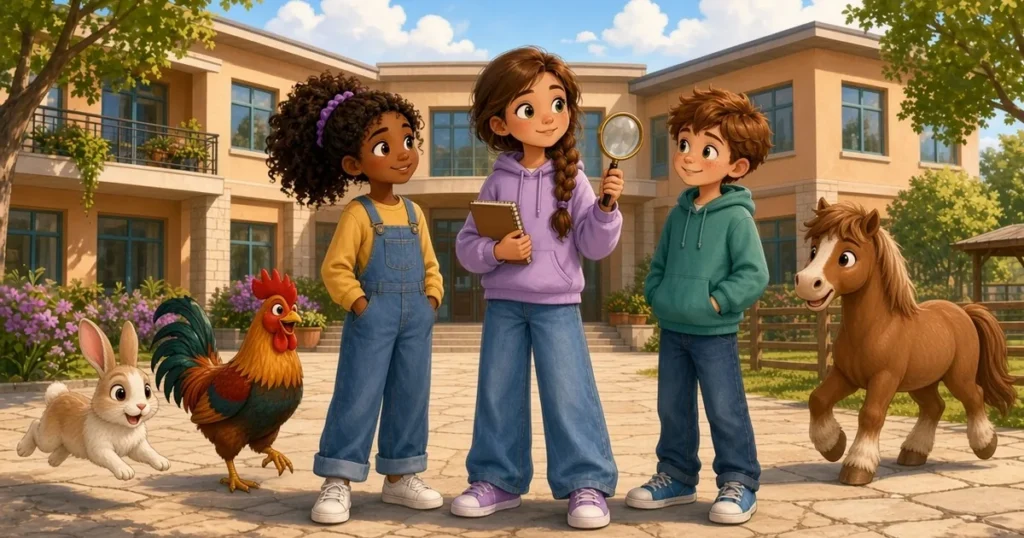
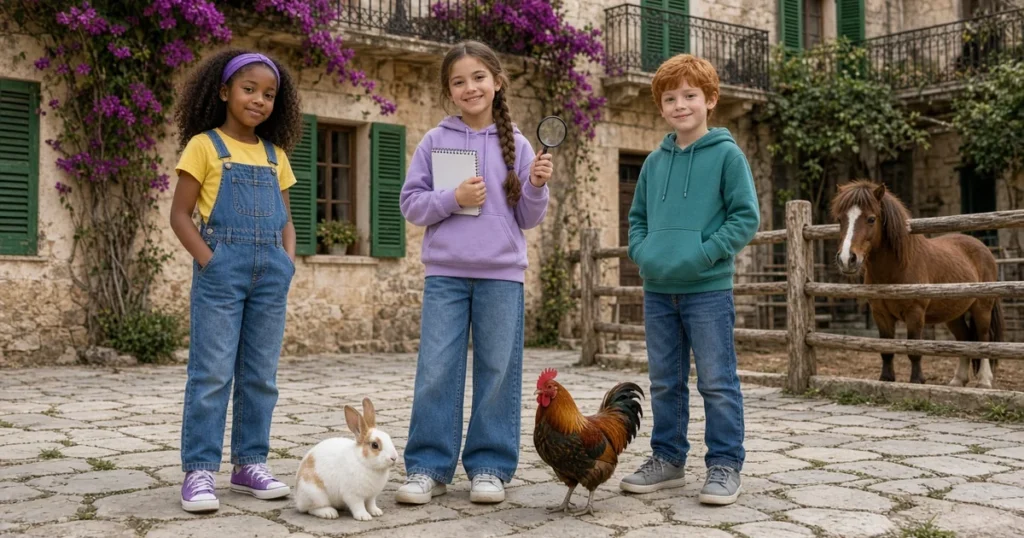
Zehava woke, as she did every morning, at half past four.
She doesn’t need an alarm clock. She never has. “My alarm clock,” she says, “is the dough. It gets up before me and starts to rise, and I can feel it from my bed.” That’s how she has got up for thirty years, in the dark, putting on her big apron with the pocket for the Queen, going to the kitchen to light the oven, and then to the coop to collect eggs for breakfast. Forty children, forty omelettes. You can’t manage without eggs.
But for three weeks now, the coop had been dark.
The coop bulb had blown on the very day they came back from the trip. A little “pop”, then silence. And David, who changes bulbs all over the house with his eyes shut, said this one was special. A bulb for coops, which doesn’t get too hot and doesn’t frighten the hens. It had to be ordered. It would come. “In a week,” said David. A week later: “In a week.” And after another week David just raised his hands and looked at the sky, and everyone understood.
So Zehava collected eggs in the dark. With a little torch whose battery was always weak. She groped in the straw, in the nest boxes, under hens who were cross with her, and found an egg, and another, and sometimes, by mistake, Kuku’s beak. In the last week she had broken seven eggs. And one morning she slipped on the wet coop floor, fell on her knee, and came into the kitchen limping with an empty basket and red eyes, and said it was the onions. Amy saw. Oliver saw too. He was in the kitchen early that morning, having come to pinch a biscuit, and he stayed sitting quietly in the corner for a long time.
Then, on Tuesday, at five in the morning, the whole of Hilltop House woke to a scream.
It wasn’t one of Zehava’s ordinary shouts. Zehava has a voice that rattles windows, and everyone is used to it. This was a different scream. High. Frightened. And straight after it Kuku crowed, with no bell, in alarm, then all the hens clucked at once, Sugar whinnied in his shed, and Falafel leapt out of his basket straight into Benny’s shoe.
Amy was at the window in one second. Hutie in a second and a half. Outside, by the coop, they saw Zehava standing in the doorway in her apron, holding the torch and pointing inside, opening and closing her mouth like a fish.
By the time Amy, Hutie and Leo arrived, in pyjamas with coats round their shoulders, Ruti, David, Mrs. Cohen in hair rollers, Noam and half the boys’ wing were already there. All of them were staring into the coop. In silence.
Because inside the coop, in the total darkness, in the nest boxes, something was glowing.
Eggs. Six eggs. In six different nest boxes. Glowing a soft, faint orange, like little embers not yet gone out, or tiny tangerine-coloured moons. In the dark of the coop they looked like eyes. The eyes of something sitting there, waiting, watching.
“Ghost eggs,” whispered Zehava. “Thirty years. Thirty years I’ve been collecting eggs. And never, never once, have they looked at me.”
“Dinosaur eggs,” said Tom, who had come running with his dinosaur, eyes like saucers. “I knew it. I knew hens are really dinosaurs. Leo said.”
“I said they’re relatives,” said Leo. “Distant ones.”
“Radioactive eggs,” said Benny from the back, and everyone took a step backwards.
“It’s a magic hen,” said Hutie. “One of them lays golden eggs. Like in the fairy tale. Only orange.”
“Nobody touch anything,” said Mrs. Cohen in her headteacher’s voice, holding her rollers on. “Until we know what it is.”
But Amy had already gone in. Slowly, carefully, the way you go into a room where someone’s asleep. She crouched by the first nest box, next to the brown hen called Mrs. Cocoa, and looked. Then, without touching, she brought her nose close.
The smell was faint, but she knew it. Paint. Not ordinary wall paint. A sweetish smell, like modelling clay.
“Leo,” she whispered. “The torch.”
Leo switched on the torch and pointed it into the box. In the strong white light the glowing egg stopped glowing and became simply an egg. An ordinary brown egg of Mrs. Cocoa’s. But on its shell, if you looked closely, was something. A thin, almost transparent layer, a little shiny, like varnish.
“It isn’t magic,” said Amy. “It’s paint. Somebody’s painted the eggs.”
“Who paints eggs at four in the morning?” asked Zehava. “It isn’t even spring.”
Amy didn’t answer. She looked around. At the straw. At the floor. And at the bolt on the coop door, an old wooden one with a little handle. On the handle, right at the edge, was a fingerprint. A small one. And in the dark, when Leo switched the torch off again, it glowed. Orange.
Everyone saw. Everyone understood. And at that moment, without a word, they all turned towards the house. Towards the third window on the upper floor of the boys’ wing. Oliver’s window.
The window was dark. And the curtain, Amy noticed, moved. Just a little.
Zehava refused to touch the eggs. “I’m not making an omelette out of something that’s been looking at me,” she announced. And Mrs. Cohen, who didn’t want to argue with Zehava at half past five in the morning, or at any other time, agreed. So that morning, for the first time in the history of Hilltop House, there were no omelettes. There was bread, cheese, vegetables and porridge. Benny sat in front of his plate, looked at it and said, in the voice of someone who has lost something precious, “This isn’t breakfast. It’s just supper that got confused.”
Meanwhile Leo took one egg, in a glove, in a box, and examined it in the light, then in the dark, then in the light again. “The paint’s only on the shell,” he announced. “Outside. Inside it’s a normal egg. And this paint only glows after it’s been in light. Like glow-in-the-dark stars on a ceiling. In the dark it lasts about three hours, then fades.”
“So someone painted them in the evening,” said Amy. “While it was still light. And they glowed till morning.”
“But the hens are still laying in the evening,” said Leo. “So it must be later. A few hours before Zehava.”
“Someone who gets up in the night,” said Amy. “For eggs.”
At breakfast, Oliver denied everything.
“Me?” he said, through a mouthful of bread. “I was asleep. Like a baby. Like two babies. Ask Omer.”
“He was snoring,” Omer confirmed. “Loud. Like a tractor.”
“See?” said Oliver. “A tractor. Tractors don’t paint eggs.”
“But your break’s over,” said Hutie. “On Wednesday. Mrs. Cohen said.”
“My break’s over,” Oliver admitted. “But I haven’t decided what to do with it yet.” Then he stood up, took his plate to the sink, and kept his hands in his pockets. All the way.
“His hands,” whispered Leo. “He’s hiding his hands.”
“I saw,” whispered Amy.
But something didn’t fit. She opened her notebook and wrote, slowly: Glowing eggs. Glow paint. Orange. Fingerprint on the bolt. Oliver hiding hands. And below that, one more line: But why? Oliver does pranks so people see. Who paints something so it can be seen in the dark?
Tom, for his part, wasn’t giving up on dinosaurs. That afternoon he came into the kitchen with a shoebox lined with cotton wool and a little torch, and asked Zehava for the most beautiful glowing egg. “I’m going to hatch it,” he explained. “In my room. Under the torch. And if a Tyrannosaurus comes out, I’ll call it Oliver.”
“Why Oliver?” asked Zehava.
“Because it’ll be orange,” said Tom, as if it were obvious.
Maya, who had come with him, gently explained on the way back that nothing comes out of an egg that’s been in the fridge, not even a chick. Tom thought about it, then decided to hatch the egg anyway. “Just in case,” he said. And he put the box under his bed with the dinosaur on the lid, on guard.
The next morning it happened again. The scream again, Kuku again, six glowing eggs in the dark again. But this time Zehava didn’t scream for long. She stood in the coop doorway with her basket and looked. Then, quietly, almost without noticing, she went in, reached out and took one glowing egg, then another, then another, until the basket was full. No torch. No groping. Not a single egg broken.
“Six eggs,” she said when she came back to the kitchen, amazed. “Six. And I didn’t break a single one. For the first time in three weeks.”
Amy, standing by the door, wrote that down. Then she looked up. Across the dining room, by the sink, Oliver stood with his hands in his pockets, watching Zehava’s basket. And he was smiling. A small smile, which he wiped off very quickly when he saw Amy looking.
“So what do we do?” asked Hutie.
“A stakeout,” said Amy. “Tonight.”
They got permission. First from Noam, who said “Only till midnight”, then from Ruti, who said “Only till two”, then from Zehava, who said, “All night. And catch me that ghost. I want to look it in the eye.” She gave them a flask of hot chocolate, three biscuits each and one more for the ghost, in case it was hungry.
Before they went out, Amy checked one more thing. She quietly asked Ruti whether she could see Oliver’s survival kit. And Ruti, who didn’t ask why, because Ruti knows Amy, fetched the box from his room. The box was open. The big torch wasn’t in it. And the jar of glow paint, missing since the trip, was still missing.
They hid in Sugar’s shed, right opposite the coop, behind a sack of hay. Sugar eyed them suspiciously at first, then discovered the biscuits and started snorting down their necks, until Hutie gave him the ghost’s biscuit. “The ghost will manage,” she said.
At ten, nothing happened. At midnight, nothing. Leo counted stars through the hole in the shed roof, got to a hundred and two, and fell asleep on the sack. Hutie braided a bracelet in the dark without looking, and it turned out, when she checked it in the morning, to be shaped like a snake with a knot in it. And Amy sat awake with her notebook on her knees, and waited.
At ten past midnight David crossed the yard on his night round, keys jingling, as he did every night. He stopped by the shed, didn’t look their way, and said to the darkness in his ordinary voice, “Tell the ghost not to catch cold. It’s chilly tonight.” And walked on. And Amy thought, not for the first time, that David knew far more than he said.
At half past three, she heard footsteps.
Quiet, careful footsteps on the gravel. Someone who knew the way in the dark and didn’t want to be heard. Amy nudged Hutie with her elbow, Hutie nudged Leo, and Leo woke and said aloud, “A hundred and three,” and three hands clamped over his mouth at once. Well, two. The third was his own.
They peered over the sack.
In the dark, by the coop, there was nobody. Only darkness. Then suddenly something glowed. Something small, orange and glowing, moving slowly through the air like a firefly. It rose, dipped, and stopped by the coop bolt.
A hand. A small, glowing, orange hand. No body. No head. Just a hand, glowing in the dark, opening the bolt of the coop.
Hutie grabbed Amy’s arm so hard that Amy nearly cried out.
And the coop door swung slowly open, with a creak.