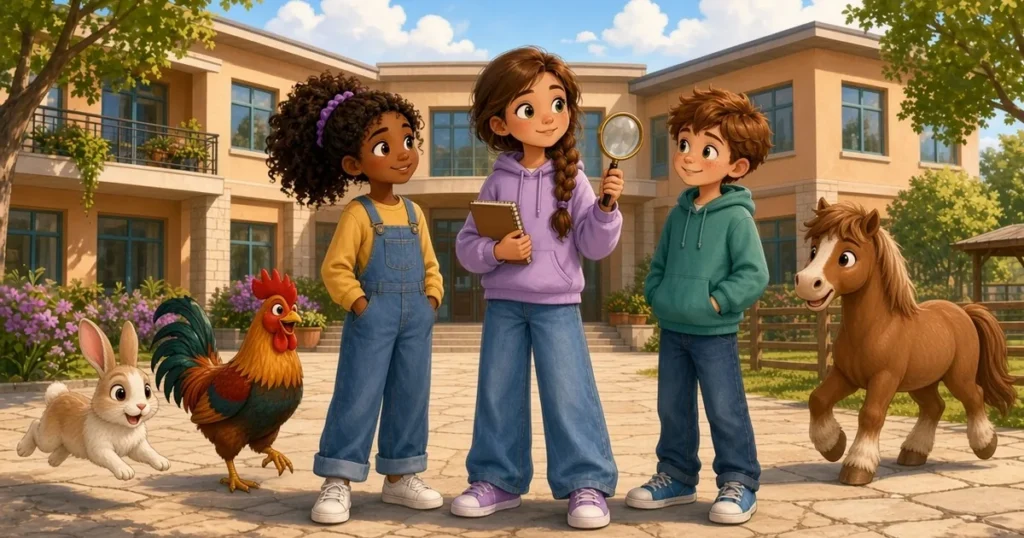
“COCK-A-DOODLE-DOOOO!”
Kuku crowed in the white light, so loudly that the hens on the perch woke in alarm and all started clucking at once. In the boys’ wing someone shouted “Not again!” in a voice that sounded like Omer’s.
But Amy wasn’t looking at Kuku. She was looking at the light.
It hung on a tall pole in the corner of Mr. Ben-Ami’s garden, above the fence. A big square lamp with glass, shining straight ahead like a giant eye. And it was aimed, Amy saw, not at Mr. Ben-Ami’s garden. It was aimed a little to the side. At the narrow path along the fence. And from there the light spilled on, over the fence and straight into the coop.
“A lamp,” whispered Leo. “That’s the lamp he mentioned. But why now? Why exactly at ten past twelve? It isn’t on a timer, because on the rainy night it didn’t come on.”
“Because it doesn’t come on by the clock,” said Noam, now wide awake and rubbing his eyes. “It’s got a sensor. I’ve seen them. A motion-sensor lamp. It only comes on when something moves in front of it.”
“So something moved,” said Amy. “At ten past twelve. Every clear night.”
She looked at the path in the strong white light. At first she saw nothing. Only weeds, stones and dry leaves.
Then one of the dry leaves moved.
It rolled. Really rolled. Like a little ball with legs. And after it, in a line, one after another, rolled three smaller balls, like an engine with three carriages. They walked along the path, close to the fence, slowly, in no hurry, their pointed noses going up and down. And as they went, they made a small and very familiar noise.
“Hrrrr. Pfff. Hrrrr.”
“Mother Hedgehog,” whispered Hutie, her eyes flying open. “And Prickle, and Needle, and Pin!”
Amy took out her notebook, and in the strong white light, as good for writing as daylight, she turned back to Case Number 12. There, in her own handwriting, it said: Eleven p.m. Four. One big, three small. Snoring. And the week after, she remembered, the hedgehogs had moved into their new hotel behind the coop. In the quiet corner of the yard. Right by the fence.
“They moved house,” she said slowly. “Three weeks ago. Into the hotel. And from the hedgehog hotel, the shortest way to Mr. Ben-Ami’s garden, which is full of snails, is exactly this path. Along the fence.”
“And they go out at the same time every night,” said Leo, scribbling fast. “Because hedgehogs are creatures of habit. I read it. They take the same route at the same time. At ten past twelve they pass the sensor. The light comes on. And the light shines into the coop.”
“And Kuku thinks it’s the sun,” finished Amy.
“And on the rainy night,” added Noam, “the hedgehogs stayed at home. Who goes for a walk in the rain? Not even a hedgehog. So the light didn’t come on, and Kuku slept.”
“And Mr. Ben-Ami,” said Hutie, “hears them in his garden. Rustling. Snorting. So he puts up a lamp to catch whoever’s wandering round his garden. And the lamp wakes Kuku. And Kuku wakes us. And him too.”
They looked at each other in the white light. Then, all at once, they began to laugh. The laugh of a week without sleep, a laugh you can’t stop, that starts in your tummy and comes out of your nose. Noam fell backwards laughing. And Falafel, who didn’t see what was funny, hopped onto his tummy, stood there and looked very pleased.
In the garden, Mother Hedgehog stopped, looked at them with small black eyes and went “pfff” in a very insulting way. Then she walked on, with her three carriages, to her snail supper.
After three minutes, the light went out. And Kuku, having crowed three times, sat down on his stool and fell asleep.
The next day, Friday afternoon, a delegation left Hilltop House through the gate and went to the house with the red roof.
The delegation consisted of Amy, with her notebook. Hutie, with a new bracelet she had knotted specially, in hedgehog colours, brown and white. Leo, with his exercise book and a drawing of the hedgehogs’ route, with arrows and times. Ruti, with a coffee mug, “because I’m the responsible adult, and because I don’t go anywhere without my mug.” And Zehava, who hadn’t been invited but brought a tray of cinnamon biscuits and said, “You don’t meet a neighbour empty-handed. Not even a neighbour with eyebrows like that.”
They knocked. Once. And again. Then the door opened, and Mr. Ben-Ami stood in the doorway, tall, grey-bearded, eyebrows frowning, with dark rings under his eyes.
“If this is about a ball,” he said.
“It’s about hedgehogs,” said Amy.
Mr. Ben-Ami’s eyebrows rose, for the first time, to the middle of his forehead. “Hedgehogs?”
Leo opened his exercise book and showed him the drawing. And Amy explained everything. The hotel David had built. The route along the fence. The snails in his garden. The sensor, and the light, and Kuku, who thought the light was the sun. And forty children who hadn’t slept for a whole week.
Mr. Ben-Ami listened without a word. Then he said, “Wait.” He fetched his glasses and studied Leo’s drawing for a long time.
“So that’s who’s been wandering round my garden,” he said at last, in his deep voice. “Hedgehogs.”
“Four,” said Hutie. “Mother, and Prickle, and Needle, and Pin. Pin is the little one. She’s friends with our rabbit.”
Then something surprising happened. Mr. Ben-Ami’s eyebrows, those two thick brushes, slowly parted and moved upwards. And his mouth, under the beard, did something nobody at Hilltop House had ever seen it do. It smiled.
“A week,” he said. “For a week I’ve been going out at night with a torch and a broom to catch thieves. And all along it was hedgehogs.” He laughed, a deep, rolling laugh, like a small thunderclap. “And I thought it was the children from the house over the road. Coming to look for their balls.”
“We wouldn’t dare,” said Hutie honestly. “You said you’d open a shop.”
Mr. Ben-Ami looked at her and laughed again. Then he said “Wait” a second time, disappeared, and came back with a box. In the box were seven balls. Three footballs, two basketballs, a tennis ball, and one orange ball with a smiley face drawn on it.
“This orange one,” he said, “must belong to the lad with the wild hair who always shouts ‘Sorry, it wasn’t me!’ before the ball even lands.”
“Oliver,” everyone said together.
“How did you work it out?” Mr. Ben-Ami asked Amy, while Zehava poured everyone more tea as if it were her own kitchen. “A serious question. I’m a retired engineer. I like knowing how things work.”
“You said ‘snorting’,” said Amy, opening her notebook to show him. “Yesterday, by the fence. You said you heard rustling and snorting. I circled the word because it sounded familiar. And at night, when the light came on, I heard it. ‘Hrrrr. Pfff. Hrrrr.’ Exactly like in the carrot case. And then I knew it wasn’t someone. It was several someones. Small, with spines.”
Mr. Ben-Ami looked at the notebook, at the small writing, the circles round words and the hedgehog drawn in the margin. “An engineer’s notebook,” he said approvingly. “I used to circle words too. That’s how you find faults.” And he raised his tea to her, the way you raise a glass at a wedding.
They sat in his garden on plastic chairs, with Zehava’s biscuits and the tea he’d made in mismatched cups. And Mr. Ben-Ami told them about himself. He had grown up on a farm in a little village in the north, with cows and hens. Every morning of his childhood, his mother’s rooster had woken him. “When I moved to the city, I couldn’t sleep in the mornings,” he said. “It was too quiet. Then I lived alone for many years, in a flat on the eighth floor. And then I found this house. And on the very first morning, at half past five, I heard from beyond the fence…” He paused. “Your rooster. And I cried like a baby. Because it was exactly like at my mother’s house.”
“Kuku,” said Amy softly.
“Kuku,” repeated Mr. Ben-Ami, as if tasting the name. “So I don’t want Kuku crowing at midnight. I want him crowing in the morning. As he should. And sleeping at night. Like the rest of us.”
That evening, David and Mr. Ben-Ami stood together at the pole, on either side of the fence, and the two tallest grown-ups Amy knew argued for half an hour about how to turn a lamp. In the end they tilted it down, so it lit only Mr. Ben-Ami’s door, not the path, and not the coop. And Mr. Ben-Ami put a small dish of water by the fence, “for the hedgehogs, in case they’re thirsty after the snails.”
“And perhaps,” he said by the fence, suddenly looking a little shy, “perhaps I’ll get a few hens. I’ve got room. Then Kuku would have neighbours.”
“Kuku would love that,” said Amy. And she had no idea how much.
That night, at ten past twelve, Leo woke up. He said afterwards he hadn’t meant to; he was just used to it. He looked at his watch and waited. The coop was dark. The path was dark. And in the darkness he heard, very faintly, “Hrrrr. Pfff. Hrrrr.” Apart from that, silence.
And at half past five in the morning, as the sky began to turn pink above the hill, David rang the little bell. Kuku stood up on his stool, stretched his neck, puffed out his chest and crowed, in his loudest and proudest voice, the morning crow. The real one.
Beyond the fence, in the house with the red roof, a window opened. And someone in pyjamas with a grey beard stood in it with a cup of coffee, listening, eyes closed.
At breakfast, Hilltop House looked like a house of people again. Tom ate porridge without falling asleep in it. Zehava burned nothing. Noam sat first at the table, with the face of someone who had slept twelve hours. And Mrs. Cohen announced she was writing five points in the Together column, “for solving a mystery, for peace with the neighbours, and because I’ve finally found my glasses.” They had been on her head the whole time.
Oliver got his orange ball back and swore never again to kick towards the fence. He kept his oath for two days.
On the third day he went to the red-roofed house himself with a tin of orange paint and a brush, knocked on the door and offered to paint Mr. Ben-Ami’s fence “as a thank-you, and as an apology for seven balls.” Mr. Ben-Ami looked at the orange paint for a long time, and his eyebrows tried very hard to frown, and failed. “Not the fence,” he said at last. “But if you paint me a little sign with a hedgehog, to go by the water dish, I won’t object.” And ever since, by the fence, there has stood a small wooden sign with a smiling orange hedgehog on it, saying: Hedgehog Filling Station. Open All Night.
And Amy wrote:
Case Number 16: Kuku Crows at Midnight. Solved. Who: Mother Hedgehog, Prickle, Needle and Pin, on their way to a snail supper. How: Mr. Ben-Ami’s motion-sensor lamp. What I learned: sometimes the grumpiest-looking person is really the one who misses something most. Also: Mr. Ben-Ami’s eyebrows can smile.
She didn’t know that in two weeks’ time, on the night of the big quiz against Oak House, Leo would answer the final question and Hilltop House would win for the first time in ten years. And that the next morning, the silver cup standing on the stage would vanish.