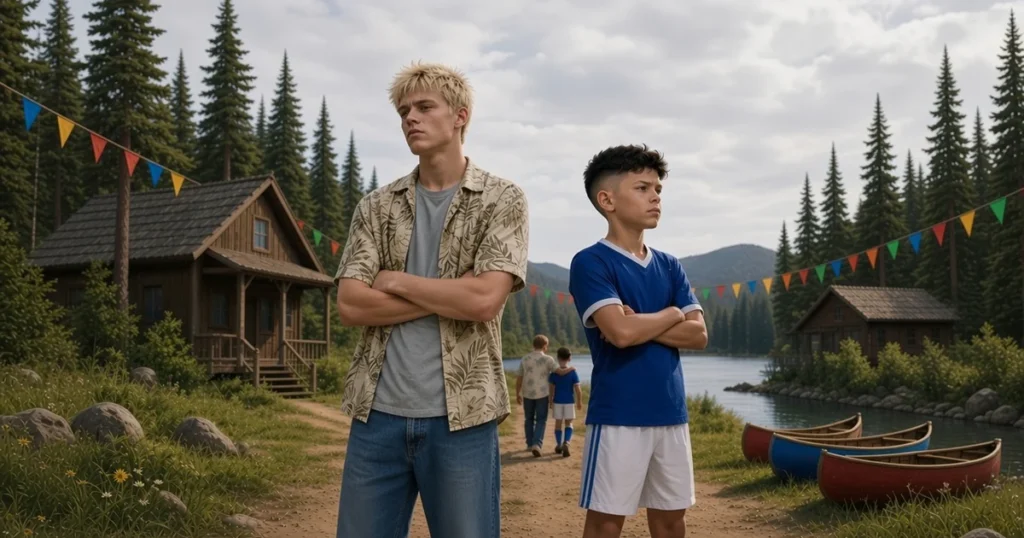
Ben woke up because something smelled like home.
Not the old apartment in Givatayim, with the smell of asphalt and the neighbors’ cat. Not the house in Ramat Gan, with the smell of Amir’s burnt Friday pancakes. Something else. Something he couldn’t put his finger on, because he was still half asleep and the other half was confused.
He opened one eye. Above him was green canvas with a damp patch shaped like Australia. Under him was a sleeping bag. On top of him was a blanket. Yellow and blue.
He opened the other eye.
The Maccabi blanket.
The blanket he’d left on Daniel’s bed on the day of the treasure hunt, with the note, with the crossed-out “Th…”. The blanket he never expected to see again, because what you give, you don’t ask back; everyone knows that. And here it was. On him. Up to his chin. Tucked in at the edges, the way you tuck in a little kid.
Ben remembered. The fire. Messi and Ronaldo. The word “because.” And then nothing.
I fell asleep. By the fire. On him.
He waited for the shame to arrive, that heat that climbs from your neck to your ears. He waited and waited. It didn’t come. Instead there was a strange feeling in his stomach, a quiet one, like getting home after a long trip and dropping your bag by the door.
The tent flap was open, folded back and tied with string like a curtain. Not inside, he remembered saying. Near him. Three metres. And Daniel had apparently taken it seriously, because Daniel’s sleeping bag was outside. On the ground. By the ashes.
And the smell was coming from outside.
* * *
It was half past five. The sky was the color of milk with a very small amount of coffee. The grove’s birds had already started work, all at once, with no conductor, like an orchestra tuning up.
Daniel sat on the stump with his back to the tent. He’d managed to bring the fire back to life. Not a big fire. A few small sticks, a blue flame at the bottom, and above it, on two stones, Shimon’s dented pot, with water just starting to bubble.
Ben stayed inside under the blanket and watched through the opening.
Daniel took two tea bags from his pocket. Wissotzky, the yellow ones from the dining hall. He put one in each of two tin mugs. He waited until the water was properly boiling, not just bubbling, and only then lifted the pot off with his sock and poured. Then he took little sugar packets from his other pocket. Ben counted. Six.
Three in one mug. Three in the other. Then, with the plastic spoon, Daniel stirred. Counterclockwise.
Ben stopped breathing.
Counterclockwise.
That was Mom’s thing. Mom said that if you stir clockwise, the sugar “gets confused” and sinks. It made no sense. Ben knew it made no sense; Nadav could have explained in three graphs why it made no sense. But that was how Mom had made his tea for as long as he could remember. Three sugars, counterclockwise, and then one tap of the spoon on the rim of the mug, ting, like the bell at the end of a lesson.
Daniel lifted the spoon out of the mug and tapped it once on the rim.
Ting.
* * *
Ben thought about all the mornings at the house in Ramat Gan. A whole year of mornings. Mom in the kitchen in her robe with the kettle, Amir humming something from the eighties, wrong, and Daniel at the table with his headphones and his face, not looking at anyone. Ben had been sure Daniel saw nothing. That he didn’t even know what grade Ben was in, because why would he care. That to him, Ben and Mom were furniture someone had brought into the house without asking.
And he’d seen. All that time, behind the headphones, he’d seen. Three sugars. Counterclockwise. Ting.
What Ben needs to feel at home. Ben didn’t know such a list existed. He didn’t know there was a blue notebook with a page that had his name on it, and five things on the page, and that none of them was tea. But if he had known, he’d have said one thing was missing. A sixth. That someone notices.
He came out of the tent with the blanket around his shoulders, like the cloak of a very tired king.
Daniel turned. He didn’t look surprised. He looked like someone who’d slept three hours on the ground, with leaves in his hair and the print of a root on his cheek.
“Morning,” said Daniel.
“Morning,” said Ben.
Daniel held out a mug. Ben took it in both hands, because it was hot, and because his hands were suddenly not entirely steady. He sat on his rock, three metres from the stump. Then, without deciding to, he dragged the rock closer. A bit more. And a bit more. Now there were two metres between them. Maybe less. Nadav would have measured.
He sipped.
That was exactly it. Too sweet, too hot, tasting of tin mug and a little smoke. Exactly as sweet as it should be.
* * *
“How did you know?” Ben asked. He couldn’t look at Daniel. He looked at the tea.
“A year,” Daniel said. “Every morning. She does it like it’s a ritual. At first I thought she was just weird.” He sipped from his own mug and made a face, because he drank his tea with no sugar at all, and three packets was like drinking syrup. “Then I realized it was for you. That she only does it that way for you. So I took sugar from the dining hall yesterday. Just in case.” He hesitated. “Shimon caught me.”
“Shimon caught you stealing sugar?”
“I was at the tea trolley filling my pockets, and suddenly he was behind me. You know how he appears. No sound. Like a shark in an apron.” Daniel sipped. “He looked at my pockets. He looked at me. Then he went into the kitchen, came back, put two more tea bags in my hand, and said, ‘Boiling. Not bubbling. Boiling.’ And left.”
“That’s it?”
“That’s it. No questions.” Daniel shrugged. “I think he knew who it was for.”
Ben thought about Shimon, who at every meal put an extra meatball on his plate without being asked, and without looking at him. It seemed that at this camp, all the grown-ups knew things about him he hadn’t told anyone yet.
“You took sugar from the dining hall,” Ben said slowly. “Yesterday. Before camping. When we still weren’t talking.”
“Yes.”
“When I still hated you.”
“You didn’t hate me,” Daniel said. “You were just angry. That’s different.”
Ben held the mug in both hands and felt the heat pass from the tin into his fingers. He had loads of things to say. About the note. The blanket. About how millions of people had watched Daniel in that clip, and he, Ben, had only watched Daniel’s face, and told Roy to shut up. About the look on his own face when he said “Got you” to Omer’s dog, and didn’t know where it came from, and then knew. About the potatoes. About “Crispy. Tastes like home.” All of it.
But he wasn’t good at long things. He was good at kicks.
So he kicked.
“Thanks,” said Ben.
* * *
It came out small. Almost without a voice. The voice of someone practicing a word in a foreign language. But it came out. Whole. Not “Th…”. Not crossed out. The entire word, all the way to the end.
Ben waited for something to happen. For the sky to fall, or the ground to open, or at least for Roy to pop out from behind a tree with a phone, yelling “Gotcha!” Nothing happened. One bird on the branch above the tent kept singing the same little phrase over and over, as if it were practicing something too. The tea stayed hot. And the word he’d carried all summer like a stone in his shoe just came out, and vanished into the morning air, and didn’t hurt at all.
Daniel didn’t move. He didn’t turn, didn’t put down his mug, didn’t do any of the dramatic things Ben had dreaded. He just nodded, slowly, and took another sip of his terrible syrup. After a moment he said, in a completely normal voice, the voice of someone talking about the weather:
“You’re welcome.”
And then, after another moment: “There’s more water if you want another cup. But the sugar’s gone. So you’ll have to drink it like a normal person.”
Ben laughed. It came out through his nose, a short, surprised laugh, and he spilled a little tea on the Maccabi blanket.
“Your mom’s going to kill you,” said Daniel.
“It’s my blanket.”
“You gave it to me.”
“Then she’s going to kill you,” said Ben, and Daniel laughed, and Ben thought it was the first time he’d heard Daniel laugh in the morning. It turned out Daniel had a morning laugh. It sounded like Amir’s.
* * *
From the Baraks’ blue tent came the rasp of a zip.
Nadav’s head emerged. He was wearing a wool hat, in the middle of summer, and holding his cloud notebook, because it was half past five, and at half past five, as everyone knows, Nadav classifies. He looked at the sky. Then he looked at them. At Ben, two metres from Daniel. At the two tin mugs. At both their faces.
“What happened?” he asked suspiciously. “Something happened. I can feel that something happened. There’s been a change in air pressure.”
“He said thanks,” said Daniel, without turning around.
Nadav froze, half in and half out of the tent.
“He said…”
“Don’t faint,” said Ben.
“I am not fainting,” Nadav said with great dignity, holding the tent pole just in case. “I’m not fainting. Write that down.”
From inside the tent, Shira reached out with her book and a pen and, without opening her eyes, wrote something in the margin. “Written,” she said, in the voice of someone still asleep. “Five thirty-two. Nadav did not faint. Bet: under ten seconds before he starts talking about it.”
“I won’t talk about it,” said Nadav.
He talked about it for three minutes. Then he went back inside, and Ben heard him whispering to Shira: “Thanks. Thanks! I have to update the model. The entire model has collapsed.”
* * *
Maya came out of the Sterns’ tent wearing two purple hoodies, one on top of the other. She saw Ben and Daniel, and the distance between them, which was suddenly a lot less than three metres. She didn’t say anything. She didn’t take out her phone. She just smiled, a small smile, not a Maya Maybe smile, the smile of someone who sees, and went to wash her face at the tap.
At six on the dot, from the edge of the grove, came Zehava’s brass whistle. Three blasts, as every morning, and then her voice through the megaphone: “Good morning, families! Overnight score: surprise bonus, ten points, to the family whose fire burned the longest.” A pause. “The Carmeli-Navon family. Spot seventeen.”
Ben looked at Daniel. Daniel looked at the pot.
“She saw us,” Ben said. “Last night. She saw you didn’t sleep.”
“No,” Daniel said. “She saw the fire didn’t go out.”
Ben held the empty tin mug and decided not to wash it. Not today.