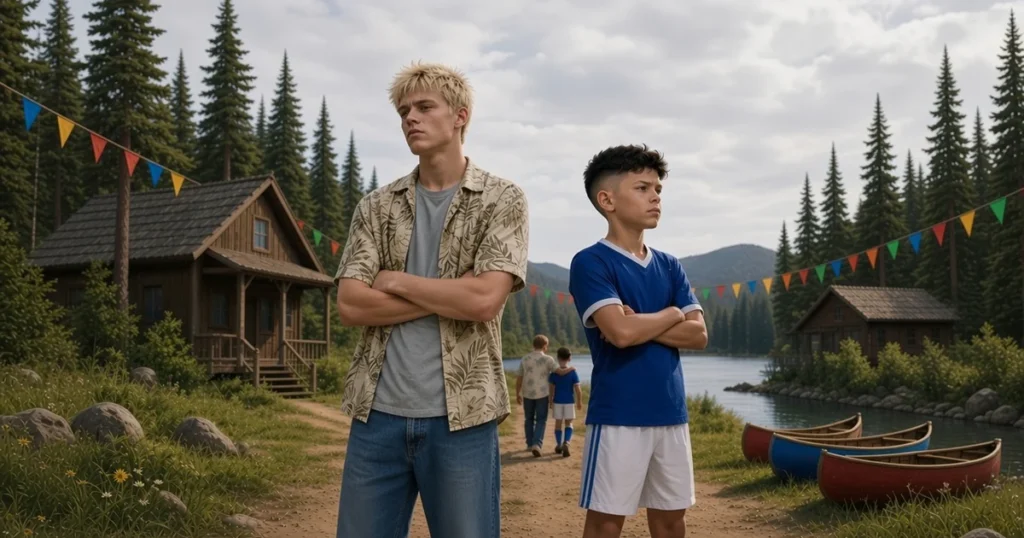
Zehava pinned the list to the notice board at six in the evening, between the label “What Zehava needs” and an old note that said “Whoever took Shimon’s blender, Shimon knows.”
Evening swim: junior lifeguards.
It was a new idea of Zehava’s. By the fourth week, she explained, the teenagers on the hill were responsible enough to sit on the lifeguard tower beside the real lifeguard and watch over the younger kids at evening swim. “Responsibility,” she said, “is a muscle. And I want to see it.”
Underneath were pairs. Daniel read the list from the top. Nadav and Shira, “provided they don’t argue about who’s watching whom.” Alon and Lihi, “Alon watches, Lihi shouts.” And on the third line, in Zehava’s handwriting, which was always too straight, like a fence:
8:00–9:00 pm. Carmeli and Stern.
“No,” said Daniel.
“Yes,” said Nadav, standing behind him. “Nothing to be done. Statistically it had to happen. There are eight possible pairs. The probability of you getting the same pair for the song, for water polo, and for this is…” He stopped. “Actually, it’s pretty low. Zehava’s doing it on purpose.”
“Why would Zehava do it on purpose?”
Nadav gave him the look you give a child who can’t add two and two. “I have no idea,” he said. “Genuinely none.”
* * *
The Camp Green Waves lifeguard tower was an old wooden structure two and a half metres high, with a ladder, a faded umbrella, and a narrow bench that could seat two, provided they didn’t hate each other. Since the night the lights went out, the whole camp had called it “Shmuel.” One of its legs already wore a label from Lihi: “What Shmuel needs: for people to stop climbing him in pyjamas.”
The real lifeguard, Uri, sat on a plastic chair by the water with a whistle and a book about fish. “You’re up there,” he said. “You’re the eyes. I’m the hands. If someone disappears under the water, you shout. If someone acts like an idiot, you also shout. That’s how it works.”
Maya climbed up first. She sat at the left end of the bench, as far left as possible, one leg almost in the air. Daniel sat at the right end, as far right as possible. Between them there was room for another person, maybe two, if they were thin.
They both looked at the water.
There were about thirty kids in it. Gull kids, Flamingo kids, Omer floating on his back singing the Hapoel anthem, and Ben, waist-deep, throwing a ball with Roy and not looking toward the tower even once. Yuval was playing in the shallows, with armbands and his glasses tied around his head with elastic.
“He’s in the water,” said Daniel.
“What?”
“Yuval. Two weeks ago he wouldn’t go in up to his knees.”
Maya looked at her brother. Her face softened for a second, then remembered it was on duty and hardened again. “Yes,” she said. “He sails now. He says someone taught him that fear is like wind. You can’t stop it, but you can trim the sail.” She didn’t look at Daniel. “He won’t say who.”
Daniel said nothing. He watched the water with the concentration of a professional lifeguard.
“It’s annoying,” said Maya. “That he has secrets from me. He’s nine. You’re not supposed to have secrets at nine.”
“Nine is when you have the most secrets,” said Daniel. “They’re just small.”
* * *
For ten minutes they sat in silence. It wasn’t a pleasant silence. It was the silence of two people each waiting for the other to say something stupid, so they’d have something to answer.
But neither of them said anything stupid. And that, in the end, was stranger.
“Did your parents come?” Maya asked suddenly. “On Family Day?”
The question caught Daniel off guard. “Yes,” he said. “My dad and… yes.”
“Mine didn’t.” Maya said it the way people say the weather. “They’re doctors. Both of them. They were on call. My dad sent a long voice message, and my mom sent a heart.” She shrugged. “It’s fine. They save lives. Hard to argue with that.”
“It’s not fine,” said Daniel, before he could think.
Maya turned her head toward him. “Excuse me?”
“It’s understandable,” Daniel corrected. “That’s not the same as fine.”
She looked at him for a long time. Then she went back to watching the water. “At home,” she said slowly, “I make Yuval’s sandwiches. I check his homework. I go to parents’ evenings, because somebody has to. I have two million followers, and all of them ask me which lipstick I wear. Not one of them has ever asked who makes Yuval’s sandwiches.”
“Who makes Yuval’s sandwiches?” asked Daniel.
Maya laughed. It escaped without permission, a short, stunned laugh, like a hiccup. “You are really not funny,” she said.
“I know.”
“Me,” she said. “Peanut butter. No crusts. He hates crusts.”
“Ben hates peanut butter,” said Daniel. And instantly regretted it, because he heard himself. A big brother who knew what his little brother hated. A big brother who paid attention. It didn’t fit the role.
But Maya didn’t notice. Or she noticed and didn’t say. She just nodded, as if he’d said something she recognised.
“And you?” Maya asked after a moment. “What are you even doing here?”
“Watching the water.”
“Not now. At all. At camp.” She nodded at his shoulders, his sun-bleached hair, his rough hands. “You look like someone from surf camp. Not like someone from knot club.”
“I was supposed to go to surf camp,” said Daniel. “At Mikhmoret. With a friend.”
“And?”
“And I changed my mind.”
“Just like that? From surfing to bird-watching?”
“Just like that.”
Maya narrowed her eyes, like someone looking for the trap in a question. She didn’t find it, so she grew even more suspicious. “Nobody changes their mind just like that,” she said. “People change their minds because of something. Or someone.”
“Maybe I like knots,” said Daniel.
“Nobody likes knots.”
“Omer likes knots. He tied Mr. Button to a beam to teach him to climb.”
Maya tried not to laugh and managed about half of it. “You’re changing the subject,” she said.
“Yes,” Daniel admitted. And that was, perhaps, the most honest sentence he had said to her all summer.
* * *
Down by the water, Uri blew his whistle twice. A Flamingo kid was trying to climb onto another kid’s shoulders, and the other kid didn’t agree. Maya leaned forward, pointed and shouted, “You! With the hat! Get off him!” in the same voice she used to run all the Gull kids, and the kid got off at once, and so did several other kids who hadn’t done anything, just to be safe.
“You’re good at that,” said Daniel.
“I know,” said Maya. “So are you.”
It was the nicest thing Maya Stern had said to Daniel Carmeli in twenty-two days. They both noticed at the same moment, and they both looked quickly at the water, as if someone were drowning.
Nobody was drowning.
“Tell me,” said Maya, and now her voice changed. It went careful, like someone walking along a dock unsure which plank was rotten. “The pillow.”
Daniel’s heart did something clumsy.
“You said you found it on the path,” she went on. “That someone dropped it. I’ve been thinking about it. All night. Because Shira said something, and then she wouldn’t explain. And that pillow…” She stopped. “That wasn’t true. Was it? What you said.”
Daniel looked at the water. Ben threw the ball to Roy. Roy missed. Ben laughed, a real laugh, head back, which Daniel had heard from him about three times in his life.
He could tell her. This was the moment. High above the water, far from everyone, with someone who had asked quietly instead of shouting, and who maybe, for the first time, really wanted to know.
Nobody knows about the “step.” Nobody hears about my father.
“I should have given it back quietly,” Daniel said at last. “That’s what wasn’t right.”
Maya looked at him. She opened her mouth. Daniel saw the words coming, different words, words that might have changed everything, like a wave rising a moment before it breaks.
And then the ladder creaked.
* * *
They both looked down.
The Admiral was standing on the second rung.
It was impossible. Geese don’t climb ladders. That’s what Nadav would have said, and Nadav would have been right, but the Admiral had never read Nadav’s research. She went up another rung, wings spread, with the air of someone doing something very hard and refusing to admit it, and looked at them with her orange eye, the eye of a queen come to collect taxes.
“She left the egg,” whispered Maya. “She never leaves the egg.”
“Something’s bothering her,” whispered Daniel.
“What?”
They understood at the same moment. The whistle. The junior lifeguard whistle, red and shiny, hanging around Maya’s neck, which Maya had blown a minute ago at a kid in a hat. The sound had reached the reeds. And someone in the reeds didn’t like anyone else whistling in her cove.
“Give it to her,” said Daniel.
“No!”
“Maya.”
“It’s my whistle! I’m the lifeguard!”
The Admiral climbed another rung. Now her head was level with the bench. She opened her beak, slowly, without a sound, which was more frightening than any shriek.
Maya pulled the whistle off her neck in one movement and held it out at arm’s length, like someone offering a banana to a gorilla.
The Admiral took it in her beak. Gently. Almost politely. Then she climbed down the ladder rung by rung, took the long way round the beach, walked past Uri, who raised his fish book in front of his face, and disappeared into the reeds with the red whistle dangling from her beak like a medal.
Below, every swimmer was staring at them. Omer had stopped singing. Ben stood in the water with the ball in his hand and, for the first time that evening, looked straight at the tower. At the two of them, together, sitting closer than before, because while the Admiral climbed, without either of them noticing, each of them had shifted a little toward the middle.
“She took my whistle,” said Maya, weakly.
“She took your whistle,” Daniel agreed.
They looked at each other. Then Maya started laughing, and Daniel started laughing, and they laughed until Uri shouted from below, “Eyes! You’re the eyes!”, and they went back to watching the water, still shaking with laughter, still too close, and didn’t move back to the ends.
The words Maya had almost said, she didn’t say. And he didn’t ask. But until the end of the watch, every time a small wave broke on the beach, Daniel thought about them. About all the waves that rise, and stop, and wait for the right moment.
The next morning, someone discovered the red whistle hanging from a tall reed right above the egg, like a doorbell. Lihi printed a new label and stuck it on the end of the long stick, next to the old one: “What the Admiral needs: a red whistle. She has one. Don’t ask for it back.” Zehava read it and added the whistle to the camp’s list of lost equipment, under “taken by senior management.”