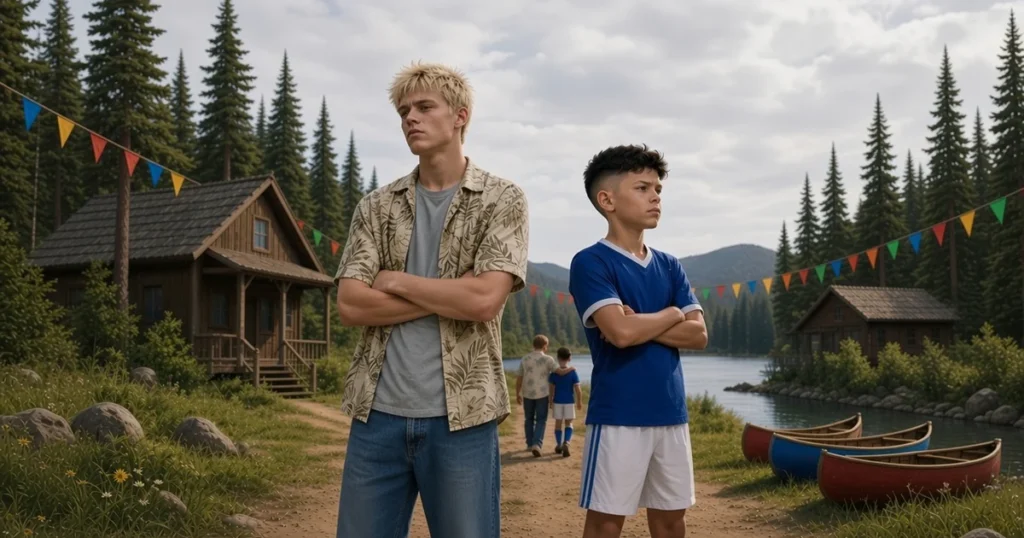
Talent night had been postponed twice.
The first time because of the storm, when the stage by the water filled up with mud and three frogs who refused to leave. The second time because of Family Day, since Zehava had decided you couldn’t ask parents to sit on wooden benches for both a sailing race and two hours of performances. “There’s a limit to parental love,” she said. “I’ve seen that limit. It’s located exactly at the thirteenth act.”
So now it was tomorrow. And today was the dress rehearsal.
Gili stood at the front of the stage with his guitar slung on his back and a clipboard in his hand, looking like an opera director who had been given, instead of singers, a hundred and thirty children and a kettle. “Each pair comes up, does their two minutes, goes down,” he announced. “No comments from the audience. No applause in the middle. And no,” he looked toward the bushes, “birds.”
Nobody answered from the bushes. Which, everyone knew, meant the Admiral was listening.
Beside Gili, with big headphones on his head, a clipboard of his own and a new badge on his shirt, stood Ben.
The badge said Assistant Director. Lihi had made it. She said it was an important job and nothing to be embarrassed about. Ben said he wasn’t embarrassed, and that he’d only taken the job for the points. Zehava had announced that morning that anyone who helped with the production would get two points toward the Wave Cup, and Ben had been the first to put his hand up. Everyone saw. Daniel saw too. Daniel also saw that Ben only put his hand up after Gili said, “And I need someone who understands the stage, because I only understand strings.”
“Someone who understands the stage,” Ben repeated to himself, with the badge, as if tasting the words.
And in fact, within ten minutes, he did understand it. He arranged the benches in straight rows. He decided where each pair would stand. He shouted “Quiet please!” at the Gull kids in a voice so full of authority that two of the counselors went quiet as well. And when Gili asked him something, Ben answered without hesitating, as if someone had finally given him a place where he was allowed to know things.
* * *
The pairs went up in order.
Shira and Alon did a piece in which Shira read a dramatic poem about the loneliness of a streetlamp, and Alon, beside her, was the streetlamp. He stood for two minutes without moving, holding a lit flashlight. At the end, when she finished, he switched it off. The small rehearsal audience sat in stunned silence. Then it clapped so hard that Gili forgot it wasn’t allowed.
Lihi and Nadav did “Statistics in Motion,” in which Nadav read out facts about the camp and Lihi demonstrated them with stickers. “Forty-three percent of campers were afraid of the Admiral on the first day,” Nadav announced. Click, whirr. Lihi stuck forty-three goose stickers on a board. “Today, ninety-seven percent.” Click, whirr. She stuck on fifty-four more. She didn’t manage to finish before time ran out, but the board was impressive.
Then Gili raised his clipboard and read: “Carmeli and Stern.”
Daniel came up from one side. Maya from the other. They had two minutes: a sailing lesson on dry land, an imaginary boat, a rubber life ring, and one question they still hadn’t solved. The song.
Because Gili had decided, three days earlier, that every duet had to include at least one line of singing. “It’s a talent night,” he explained. “Not a night of other talents.”
“Daniel can’t sing,” Maya told him.
“Nobody can sing,” said Gili. “Except me. And I sing about clothespins. So.”
So they decided to sing at the end, after the imaginary boat sinks and the instructor saves the student and they both sit “on the beach,” wet. Daniel suggested a song. An old, small song nobody knew, which Maya had heard once while he was humming it, and said: “That. Only that.”
He didn’t tell her where he knew it from.
* * *
The sailing part went well. Maya sank in slow motion with her operatic shriek, and a whole row of Gull kids shrieked with her, in harmony, because they had seen it three times already. Daniel hit himself on the head with the life ring. Someone from Catfish shouted “Kobi!” and Kobi, in the back row, raised his hand proudly.
Then they reached the end. They sat down on the stage, on “the beach,” shoulder to shoulder. Maya looked at him. Daniel took a breath.
He sang the first line.
He knew, even as he sang it, that it wasn’t good. He could hear it himself: his voice went up when it should have gone down, and cracked in the middle like a board someone steps on, and on the last word he lost the note completely and was left with only his breath. Maya, beside him, tried to come in on the second line to rescue him. She came in on a different note. They sounded like two radios playing different stations in the same car.
Gili raised his hand. “Stop. Let’s go on to…”
But before Gili finished, someone else was already on the stage.
Ben.
He jumped up from the side, with the headphones round his neck and Gili’s microphone in his hand, and stood exactly where Daniel had stood before. He put one hand on his chest. He lifted his chin. He squeezed his eyes shut with an expression of deep emotion that even Maya wouldn’t have dared to use in a video.
And then he sang the first line, exactly the way Daniel had sung it. With the voice going up where it should go down. With the crack in the middle. With the note vanishing on the last word. And at the end, so nobody could miss it, he added a little honk, the honk of a goose with a cold.
The audience exploded.
The Gull kids laughed so hard that one of them rolled off the bench. The Catfish boys stood up and clapped. Roy shouted “More!” and Ben, who didn’t need telling twice, did it again, with even more emotion, and with an addition: a hand on his forehead like a tragic hero, and a slow collapse onto his knees.
“Grumpy Brother sings!” shouted Omer. “Grumpy Brother sings!”
* * *
Maya turned to Daniel. She was waiting, he could see it, for the face. The face of a lemon who’s had a hard day. For the anger. For the moment he would get up, grab Ben by the arm and tell him to get down, and she would be able to say there, I told you.
Daniel laughed.
It wasn’t a fake laugh. He tried to hold it in and couldn’t. It was just funny. Ben was funny. He’d done it so precisely, the crack, the vanishing note, even the way Daniel lifted his left shoulder a little when he wasn’t sure. Ben had been listening to him. He had listened to him closely enough to imitate him.
Daniel laughed so hard he had to lie down on the stage. And there, on his back, he raised a hand and applauded Ben, slowly, three times, like a theater critic.
Ben, on his knees in the middle of his tragic collapse, looked at him. For one second he looked confused. As if he had kicked a ball as hard as he could at a wall, and the wall had caught it and gently passed it back.
Then he got up, too fast, and turned to get off the stage, and his foot caught in the microphone cable.
It happened quickly. The black cable pulled tight, the stand wobbled, and Ben stumbled toward the edge of the stage, which was a meter above the gravel. He caught himself at the last moment, with a hand on the lighting pole. Almost nobody noticed. The audience was still laughing. Gili was still trying to restore order.
Daniel noticed.
* * *
“You laughed,” said Maya, when they had come down behind the stage, between a pile of folding chairs and a box on which Lihi had written Props. Not food.
“It was funny.”
“He made fun of you in front of a hundred kids.”
“He did it well,” said Daniel. “Did you notice the shoulder?”
Maya stopped. “What shoulder?”
“I lift my left shoulder when I’m not sure of the note. I didn’t know I did that. He knew.” Daniel looked at the stage, at Ben, who was standing next to Gili again with the clipboard and headphones, ticking something off with the seriousness of a pilot. “You have to listen to someone for a long time to know something like that.”
Maya opened her mouth. Closed it. For a moment she looked like someone searching her bag for something she’d been sure was there.
“Most people get angry when someone laughs at them,” she said at last.
“Most people don’t sing like a goose with a cold,” said Daniel. “You have to accept the truth.”
She laughed without meaning to, that short, surprised laugh from the storeroom. Then, as if remembering something, she folded her arms. “The song,” she said. “We sing it tomorrow. Properly. You learn the note by tomorrow, or I sing alone and you hold the life ring.”
“Agreed.”
“You agree too fast.”
“I agree when you’re right,” said Daniel. “It just doesn’t happen often.”
This time she didn’t laugh. But as she walked away, he saw her smiling at the gravel.
After the rehearsal, when everyone had gone to dinner, Shira came back to the stage because she had forgotten her book.
She found it exactly where she’d left it, under the first bench. As she bent down to pick it up, she heard a noise. The sound of something tearing. The sound of tape.
She looked up.
On the stage, alone, in the last light of the sunset, Daniel was on his knees. He had a roll of black tape, the kind Kobi used for everything from boats to shoes. And he was taping the microphone cable to the floor of the stage. All the way along. From the stand to the edge, and especially, Shira saw, at the spot where the cable passed by the right-hand exit. Exactly where Ben had stood when Gili called the pairs. Exactly where Ben would stand tomorrow.
He did it carefully. A piece every half meter. He ran his thumb over each one so it would hold. When he was done he stood up, walked along the cable, checked that nothing was sticking up, and then, the way people do when nobody is watching, gave the lighting pole a gentle kick to see if it was steady.
It was steady.
Daniel put the roll in his pocket and left by the other side of the stage, without seeing her.
Shira stood there with the book in her hand for a long time.
She thought about the balls that had flown at Daniel’s head in the first days. About the flip-flops on the roof. About the chocolate pudding. About Is he bothering you? and Seriously? He’s half your size. About all the things Ben had done that she had seen, and everyone had seen. And about all the things Daniel had done that nobody had seen, except her, now, by chance, because she had forgotten a book.
She took out of the book the little note she had put in it a few days earlier, at the breakfast table, after the yogurt. It had one line written on it: Things that don’t add up. And underneath: 1. Nadav floats.
She took a pen out of her bag and wrote:
2. Daniel tapes cables.
She looked at it. It looked strange written like that, like a line from a bad poem. But Shira Barak had read a lot of books. And she knew that in every good book there is a moment when the hero does something small while he thinks nobody is watching. And that this moment is always, always, the real thing.
“People who hate someone,” she said quietly, to the empty stage, “don’t tape cables for them.”
The stage didn’t answer. But behind it, from the bushes, came a single honk, low and in agreement.