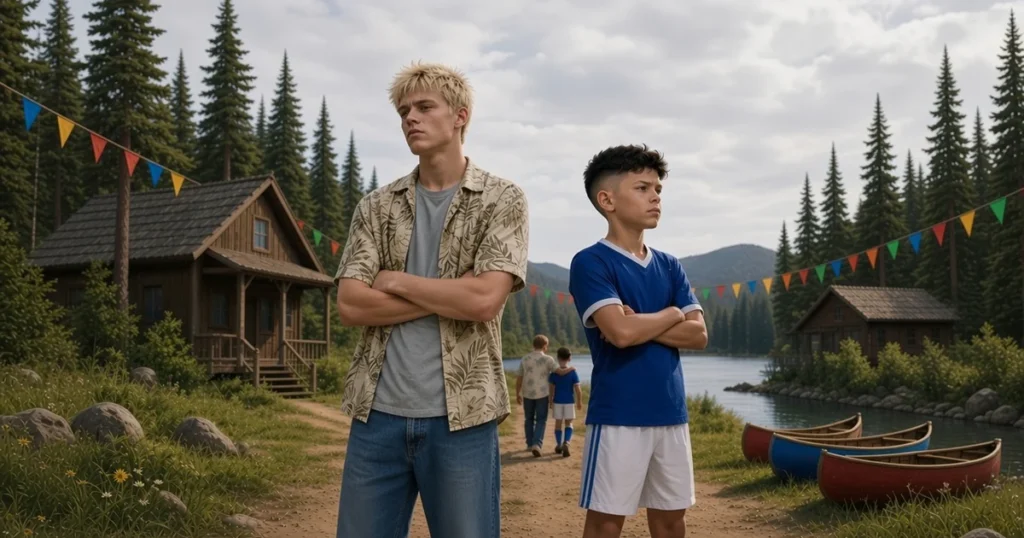
The infirmary at Camp Green Waves was a small white room behind the office, with two beds, a cupboard full of bandages and bottles of iodine, and a nurse called Ahuva, who was seventy years old, shorter than Zehava, and the only person at camp the Admiral was afraid of.
“Sit,” she told Omer.
Omer sat.
“Tongue out.”
Omer stuck out his tongue.
“Stop crying.”
“I’m not crying,” said Omer, crying. “It’s the lake. I swallowed too much of it and now it’s coming out of my eyes.”
Ahuva checked his pulse, his ears and his knee, which he had grazed on the ladder. She put a dinosaur-shaped Band-Aid on it, gave him a cup of very sweet tea, and said, “You’re perfectly fine. You need to eat, sleep, and not get into a kayak until you’re thirty.”
“Thirty?!”
“Twenty-nine,” said Ahuva. “I’m not unreasonable.”
Outside the window, the Admiral strolled past. He peered in, saw Ahuva, and immediately turned and walked off briskly in the opposite direction, like someone who had suddenly remembered an important meeting elsewhere.
Then Ahuva turned to the other bed, where Ben was sitting with his hands upturned on his knees like two pieces of evidence. Maya sat beside him. She had walked him all the way up from the dock, talking the entire time about nothing, about the Gull kids and a shy boy called Gal who had just learned to float, so that he wouldn’t have to talk at all.
“Hands,” said Ahuva.
Ben showed her. Both palms were striped with raw red lines where the rope had run through them.
“Rope burns,” said Ahuva, producing a tube of ointment. “Gone in a week. Meanwhile: no rowing, no potato peeling, no handshakes, and no goalkeeping.”
“I’m not a goalkeeper,” said Ben, offended despite everything. “I’m a striker.”
Ahuva considered this. “Strikers use their feet?”
“Yes.”
“Then you may continue striking,” said Ahuva, and wrapped his hands in white gauze until he looked like a very small boxer.
* * *
Daniel came in a few minutes later, still wearing the pineapple towel like a cape. He had a scrape on one elbow and lake water still running out of one ear, and Ahuva sat him down and dealt with both without being asked.
Maya stood up. She looked at Daniel for a long moment. Then she walked past him to the door, and stopped there, and said in a low voice, so that only he could hear:
“You shouldn’t have yelled at him.”
“I know,” said Daniel.
Maya blinked. Daniel could see it clearly: she had prepared a whole speech. She had expected him to argue, to say Ben had deserved it, to say he’s my brother, it’s none of your business. She had all her answers ready, lined up like boats on a start line. And he had simply said I know, and now the boats had nowhere to go.
“Okay,” she said finally, sounding almost annoyed about it. “Good.”
She went out. Through the window, Daniel saw her stop on the path and look back at the infirmary, with that small crease between her eyebrows. Then she shook her head, as if a fly had landed on a thought, and walked away toward the Gull cabin.
* * *
Zehava had called the parents. Of course she had. At Camp Green Waves, if a camper so much as sneezed, a phone rang somewhere in Israel.
So at five o’clock Daniel and Ben stood in Zehava’s office, which smelled of coffee and sunscreen and had a framed photo of a younger Zehava holding a fish bigger than herself, and looked at Zehava’s laptop, where Dad and Michal were squeezed together into one small square of screen.
Michal had been crying. Her eyes were red, and she kept leaning closer to the camera, as if she could climb through it.
“Show me your hands,” she said to Ben.
Ben held up two white boxing gloves.
“Oh, Benny.” She pressed her fingers to her mouth.
“It’s nothing,” said Ben. “It’s just rope.”
“Zehava told me you walked to the end of the dock,” said Michal. “You. The end of the dock.” Her voice wobbled. “I’ve been trying to get you onto a pedal boat in Eilat since you were five.”
“It wasn’t a pedal boat,” said Ben. “That’s why.”
Dad was looking at Daniel. He didn’t say anything for a while. His face did several things, one after another, and none of them was quite finished.
“Your mother,” he said at last, “would have been furious with you. And then incredibly proud of you. In that order.”
“I know, Dad.”
“I’m skipping straight to the second part,” said Dad, and his voice cracked, and he coughed to cover it, and failed.
Before they hung up, Ben leaned toward the screen. “Mom,” he said, quietly. “Did anybody tell Dad?”
Michal’s face changed, just slightly. “I sent him a message,” she said. “Right after Zehava called.”
Ben nodded, as if that was exactly what he’d expected, and stepped back out of the frame.
* * *
That evening, something strange happened at camp: everyone spoke quietly.
Not because of a punishment, and not because of Zehava. It’s just that after a storm people speak quietly, as if something huge has passed very close by without touching them. In the dining hall Shimon served Everything’s-Okay Soup, and nobody laughed at the name. Gili sang just one song, a quiet one about a rope, and nobody asked him to stop. At the Catfish table, Omer cut Ben’s schnitzel into small pieces, because Ben’s hands were wrapped up, and Ben let him, and didn’t say a single rude thing, which was how the Catfish knew he was really shaken.
At the Pelican table, the gang treated Daniel like a piece of fragile equipment. Lihi had printed a label that said OFF DUTY and stuck it on his chair. Shira had brought him two desserts and refused to explain where the second one came from. Nadav quietly moved the salt within reach of his good elbow. And Alon, who had been an anchor for twenty minutes that afternoon and had rope marks around his waist to prove it, looked across the table at Daniel for a long moment and said one word.
“Good.”
Nadav didn’t even write it down. Some words, he explained later, you don’t count.
At ten the lights went out.
At half past eleven, Daniel was still awake. Nadav had fallen asleep after explaining at length that most people can hold their breath for thirty to ninety seconds, “but you can probably do more, because you’re weird.” Alon slept the way he always slept, as if nothing had happened anywhere in the world since he was born.
Then Daniel heard a knock.
Not at the door. On the wall. Three knocks, faint, from the Catfish side. Then footsteps on the porch.
Daniel got up, went out, and quietly closed the door behind him.
* * *
Ben was sitting on the step in his black hoodie. He was holding something in his bandaged hands. As Daniel came closer, he saw what it was. Mr. Button.
“Omer lent him to me for tonight,” said Ben, without looking up. “He said Mr. Button should sleep with someone who was brave. Eli approved it. There were conditions.”
“You were brave,” said Daniel, and sat down one step below him.
“I wasn’t brave. I was scared to death.”
“That’s what brave is,” said Daniel. “If you’re not scared, it’s just walking on a dock.”
Ben was quiet. The night was warm and still, and the Kinneret below was smooth again and full of stars, as if it had never been angry with anyone. Ben’s phone lay on the step beside him, face up. On the screen was a chat. At the top it said Dad. Under Michal’s message, there were two gray ticks.
“He hasn’t read it,” said Ben. “He’ll read it tomorrow. And then he’ll call, and do you know what he’ll say?” He put on a deep, flat voice. “‘Ben. What were you doing at the end of the dock? You know you’re not allowed. Why can’t you ever just listen?'”
Daniel didn’t answer. He had learned that some sentences aren’t questions. They’re doors, and if you rush at them, they close.
“When something broke, it was always me,” said Ben. “Even when it wasn’t.”
He turned Mr. Button over in his gauze-wrapped hands.
“The window at school, in fourth grade. Tomer threw a tennis ball. The teacher saw me standing there and said it was probably me. Dad said, ‘If the teacher says you did it, you did it.’ I told him it was Tomer. He said, ‘Don’t make it worse.’ He didn’t even ask anything else. The mirror on his car. The remote. The vase at Grandma’s. Every time, he’d look at me first, before he even looked at what broke.” He shrugged, a small, tired shrug. “After a while, you stop explaining. It’s faster.”
“I believe you,” said Daniel.
Ben laughed, a short laugh with no fun in it. “You don’t even know what happened.”
“I believe you anyway.”
Ben looked at him then, properly, for the first time all summer. He looked as if Daniel had said something in a foreign language, and he understood every word, and couldn’t believe anyone had said it.
“That’s why I don’t do boats,” he said finally, very low. “If you’re on a boat and it capsizes, guess whose fault it is.”
* * *
They sat there for a long time without talking. Through the wall, Omer’s tractor started up, and this time, somehow, it sounded almost like a lullaby.
“Don’t tell Mom,” said Ben at last. “About Dad. She has enough.”
“I won’t.”
“Swear.”
“On the surfboard behind the Passover dishes,” said Daniel.
Ben almost smiled. He stood up, holding the bear against his chest, and stopped in the doorway of Catfish, and for a second Daniel thought he was going to say it, the word with the fishbone in it.
“Good night, Daniel,” said Ben, and went in.
It wasn’t the word. But he had never used Daniel’s name before, not once, not in a whole year of sharing a fridge.
Back in bed, Daniel took out the blue notebook and, by the light of his phone, found the line he had written on the night of Operation Goose: He thinks he’s always the one who gets blamed. Find out who taught him that.
Under it, slowly, he wrote: Found out.
Then, after a while, he added: Be the one who doesn’t.
* * *
In the morning, at six, the brass whistle blew as usual, and the sun rose over the Golan as usual, and Ben came out of Catfish with his hood up, as usual.
Daniel was waiting on the porch. “Morning,” he said. “How are the hands?”
Ben looked at him. Then he looked past his shoulder at Roy, who was coming out of the cabin behind him with perfect hair.
“What do you want?” said Ben. The voice was cold and flat, the voice of the first day. “Don’t talk to me.”
And he walked off with Roy toward the dining hall without looking back.
Daniel stood on the porch and didn’t move. It hurt, more than he’d expected.
But then he saw something. In the front pocket of Ben’s hoodie, half sticking out, was something brown and furry, with one eye sewn on in blue thread. Omer had lent Mr. Button out for one night. Somebody had clearly negotiated an extension.
The wall was back in place. But there was a crack in it now, exactly the size of a teddy bear.