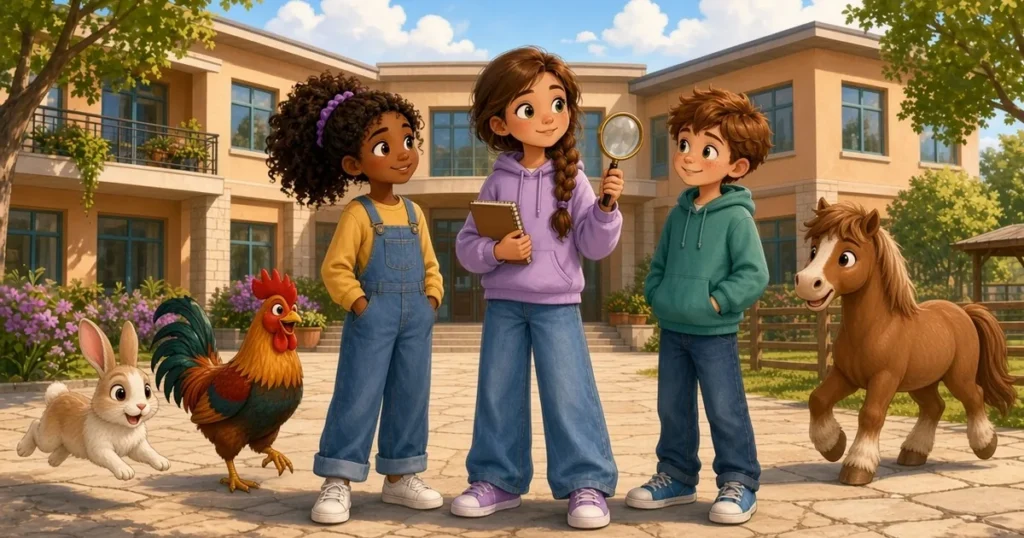
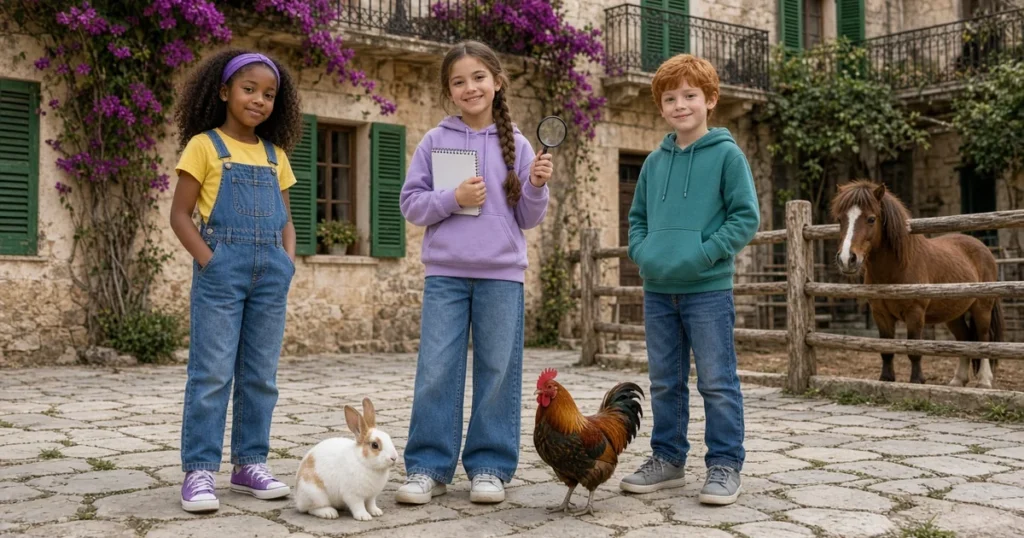
On Sunday, after lunch, they gathered in the workshop. Amy, Hutie, Maya, Ari and Benny, who insisted he had been “an official friend” since the Secret Helper case, and nobody argued. Only Leo wasn’t there. Leo hadn’t been there for several Sundays now.
“The couple again?” whispered Hutie.
“The couple again,” said Maya.
The couple were a man and a woman, quiet, in grey coats, with a thick book about birds. They had started coming a month ago. Every Sunday at two they sat with Leo on the bench by Sugar’s fence and talked to him. Mostly about birds. Leo came back from those visits quiet, confused and happy, and when anyone asked who they were, he only said, “Friends of Mrs Cohen’s,” and changed the subject. Amy, who understood changing the subject, stopped asking. But she wrote on a separate page of her notebook, a page with no case number: Leo. Sundays. Birds.
From the workshop window you could see them. The woman pointed at something in the carob tree, and Leo looked, raised his hand and showed her something else, another branch. Then he laughed. And Amy, who hadn’t seen Leo laugh like that for a long time, a laugh with no worry in it, felt happiness all at once, and something else as well, something small and cold in her tummy that had no name.
“We’ll tell him afterwards,” said Amy. “Everything. He’ll be cross if we don’t.”
David sat on his stool with the little wooden horse in his hands. He turned it over and round and said nothing for a long time. Then he began.
“You know I was a child here,” he said. “I told you, in the attic, with the violin. I came when I was eight. And I didn’t speak for half a year. But I never told you why it was here.”
He set the horse on the bench.
“Before there was a children’s home here, there was a farm. My grandmother’s farm. Cows, hens, two horses. I used to stay with her every summer when I was little. I slept in her kitchen on a mattress by the stove. And she made butter. By hand. Every morning. And she put it in the little pantry next to the kitchen to keep it cold.” He gave a small smile. “The whole pantry smelled of butter. So did her clothes. Her hands too. I think it’s the best smell in the world.”
“And then?” whispered Maya.
“Then my grandmother died, when I was six. And the farm was sold. To a young couple, Avraham and Tova, who wanted to build a home here. A home for children with nowhere to live. They built all the wings, and the stairs, and the attic. But they kept my grandmother’s old kitchen. It became the dining room. And the pantry stayed behind the wall.”
“And two years later,” said Amy quietly, because she had already understood, “you needed a home too.”
David nodded. He didn’t say why. Nobody asked. At Hilltop House you don’t ask that question. You wait until someone wants to tell, and if they don’t, that’s all right too.
“They brought me here by car,” he said. “And the first time I walked into the dining room, the smell hit me. Butter. Faint, very faint, through the wall. My grandmother’s smell. And I knew the pantry was still there. On the first night, when everyone was asleep, I crept down and found the little door. It wasn’t locked. I went in. I sat on the floor in the dark. And I cried.”
Nobody moved. Benny, who usually couldn’t sit still for a minute, sat without breathing.
“Every night,” said David. “For months. Everyone slept, and I went down to the pantry and cried quietly so nobody would hear. In the morning I went back up before anyone woke and kept quiet all day. Because if I kept quiet, nobody would know I was sad.” He ran a finger along the horse’s back. “And in the evenings, with a nail, I carved on the doorframe what I wanted to be true. ‘I’m not crying.’ A little every evening. It took me a month.”
Hutie was crying, quietly, into her sleeve. Maya held her hand. And Amy felt the blue button in the lining of her jumper without touching it.
“You could have told someone,” said Benny hoarsely. “Tova. Anyone.”
“I could have,” said David. “But I was eight, Benny. And I thought if I said I was sad, they’d send me back. Or call me a baby. Or laugh.” He looked at Benny for a long moment. “Do you know that thought?”
And Benny, who only a month ago had shouted at everyone so they wouldn’t see him quietly polishing shoes, looked down and said, “A bit.”
“We all know it a bit,” said Amy. And everyone nodded. Even Maya, the youngest.
“But that isn’t the story,” said David, looking up. “The story is what happened next.”
On the bench he laid out, side by side, everything that had been on the pantry shelves. The checked blanket. The horse with no tail. The three marbles in their jar. The shrivelled ball. And the pirate book with the torn cover.
“On the third night,” said David, “when I went down to the pantry, there was a blanket. Folded. In the corner. I hadn’t brought it. It hadn’t been there before. I wrapped myself in it, because it was cold. And I didn’t ask anyone. Because if I asked, they’d know I went down there.”
“And the next night?” asked Amy.
“The next night, a horse. This horse. No tail. On the shelf by the door, where I’d see it. The night after, marbles. Then a ball. Then the book.” David opened the pirate book. “Every night something small. Every night, for weeks. I never saw who. I tried. Once I stayed awake all night in the pantry to catch them. That night nothing came. The night after, I fell asleep, and in the morning I found a slice of cake beside me. With a note. ‘A good detective also knows when to sleep.'”
“That’s exactly an Amy sentence,” said Ari, surprised.
“I know,” whispered Amy. And a small shiver ran down her back.
“After a few months,” said David, “I started to talk. First to Tova, because of the violin. Then to everyone. I stopped going down to the pantry. Slowly I forgot it. Then, when I was twelve, they built the dresser and stood it against the wall, and nobody knew there was a door there any more. Except me. And even I thought it had been bricked up.”
“So who left the things?” asked Maya. “Tova?”
“That’s what I thought,” said David. “All these years I was sure it was Tova. When I was grown up, eighteen, on the day I left, I thanked her. For the blanket, the horse, all the nights.” He paused. “She looked at me and said, ‘It wasn’t me, Dudi. You had more family than you knew.’ And she wouldn’t say any more. She said it wasn’t her secret.”
“And you don’t know who?” asked Hutie, red-eyed.
“Forty years,” said David, “I haven’t known who.” He looked at Amy. “So I thought: there’s a detective in this house. A very good one. Maybe she can solve one case for me. The oldest in the house.”
Amy didn’t answer straight away. She opened her notebook at a new page and wrote slowly, in her very best letters: Case Number 35: The Boy in the Pantry. Then she looked up. “I need to examine the evidence,” she said. “All of it.”
“One more thing,” said David, as Amy picked up her pencil. “I don’t want you to find someone so I can be cross with them. I want to know so I can say thank you. For forty years I’ve owed someone a thank-you, and I don’t know who to pay.”
“That’s the best kind of debt,” said Hutie, still wiping her nose on her sleeve. “Better than a hundred puddings.”
“Please,” said David, raising his hands like someone handing everything over.
So they examined it.
First the blanket. It was old and faded, checked in blue and brown. But when Hutie, who knows more about thread than anyone in the house, spread it on the bench, she cried, “It’s not one blanket! Look! It’s sewn from pieces. Five pieces. From five different blankets. And the stitches…” She put her nose almost on the fabric. “A grown-up didn’t do these. They’re a child’s stitches. Crooked. All different sizes. I know, because that’s how I sewed when I was six.”
Amy wrote: Blanket. Five pieces. A child’s stitches.
Then the horse. Benny held it and turned it over. “Whoever carved this,” he said, “didn’t know how to carve. Look, the legs aren’t even. One ear’s bigger. But he tried really hard. You can tell from all the cuts.” Benny, whose hands always understood things before his head did, understood trying.
“And why hasn’t it got a tail?” asked Maya.
“Maybe the tail broke,” said Ari.
“There’s no sign of breaking,” said Benny. “Someone cut here and stopped. As if something interrupted them halfway.”
Amy wrote: Horse. Carved by a child. Stopped halfway. Why?
Hutie took the horse from Benny and held it to her ear as if it could tell her something. “It was made with love,” she declared. “And in a hurry. And with a sneeze.” Everyone looked at her. “What? That’s what it looks like. As if someone made a sudden jerk.” Amy smiled and said nothing. But she wrote the word sneeze in her notebook with a question mark, and didn’t yet know why.
The marbles were marbles. But Ari, who knew everyone’s handwriting in the house from the labels, noticed a small folded note wedged in the bottom of the jar under the last marble. Very yellow paper, almost crumbling. He drew it out with a doctor’s care. On it, in pencil, was just one thing: Tue.
“Tuesday,” said Ari. “Why write Tuesday on a note in a jar of marbles?”
“Because that was the day they came,” said Amy slowly. “Someone knew which day it was. Someone who needed to remember.”
That left the book. The last piece of evidence, the thickest and dustiest, which David had kept close to him all this time, as if afraid it might run away.
The pirate book was thick, with a torn red cover and a cellar smell. David said he’d read it twenty times, but Amy noticed that the last pages, after the story, were stuck together. The last page and the cover. They had stuck, probably from damp or old glue, and looked like one thick page.
“Did you read it to the end?” asked Amy.
“To the end of the story,” said David. “The pirates find the treasure and go home. What’s there to read after that?”
Amy held the cover up to the window. In the light, through the stuck paper, she saw shadows. Lines. Rows. Something written inside, between the page and the cover, where nobody had looked for forty years.
“David,” she said, and her voice shook, though she tried to stop it. “Have you got a kettle?”
“Why?”
“Because steam opens glue,” said Amy. “Leo taught me. And something’s written here. Something that’s been waiting forty years for you.”
And David stood up, for the first time that day, quickly. His hands shook as he filled the kettle.