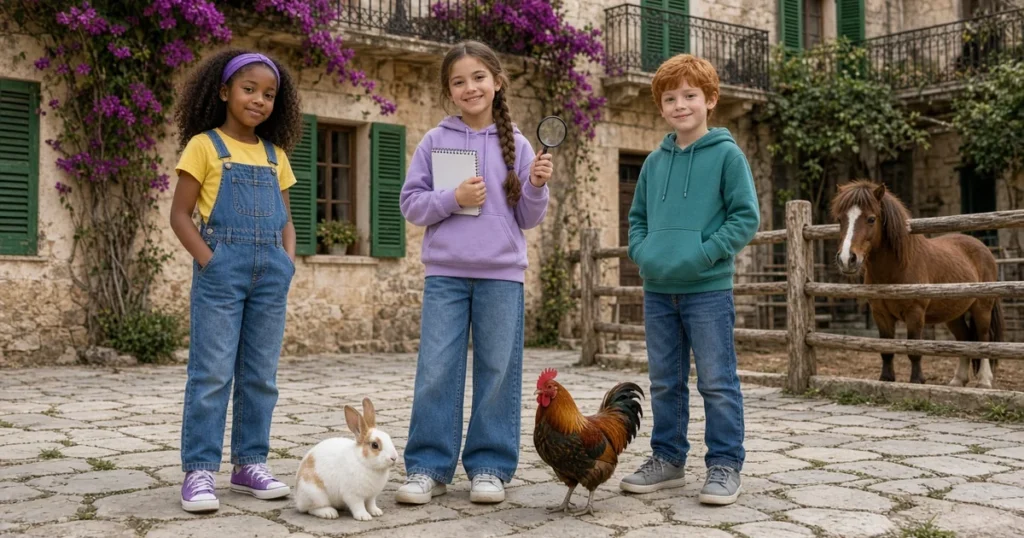
Tom was in charge. He told everyone so. Many times.
“I’m in charge of Pip,” he said at breakfast, before anyone asked. “I’m in charge of Pip,” he told Zehava, asking her for a lettuce leaf, a carrot and a thin slice of apple, “but no peel, because he’s small”. “I’m in charge of Pip,” he explained to Falafel, who stood in front of the cage with his nose pressed to the bars, gazing at the golden ball of fur with big, curious eyes. “So don’t come close, Falafel. You’re too big.”
And Falafel, who never listened to anyone, went on standing in front of the cage. All day. Every day.
The cage stood on Tom’s chest of drawers in the little ones’ room, by the window, where the sun came in in the morning. And Tom did everything the teacher had said. Fresh water in the morning. Seeds at lunchtime. Vegetables in the evening. And at night, before bed, he checked the little cage door was shut, put the catch on, and said “Good night” to Pip, and sometimes sang to him too, quietly, the Hilltop Song, but only the first verse, because he didn’t know the second.
Zehava, on hearing the first morning that there was a hamster in the house, said, “Just not in the kitchen.” Then at lunchtime she left a little bag of shelled sunflower seeds on Tom’s chest of drawers, “because small animals deserve good food, even if they’re not mine”.
For three days, everything was perfect.
On the fourth morning, Tom woke up and went to the cage as usual with a cup of fresh water. And the little door was open. The catch was hanging loose at the side. And the nest of wood shavings where Pip slept every night, curled up like a bread roll, was empty.
Tom’s scream was almost as loud as Zehava’s. Which, for a seven-year-old, is quite an achievement.
By the time Amy, Hutie and Leo arrived in their pyjamas, Tom was sitting on the floor by the chest of drawers with the empty cage in his arms, crying. Not the way Tom usually cried, loud and fast and over quickly. Quietly. With his face inside the cage. Which, Amy knew, was much worse.
“Miss is going to kill me,” Tom whispered.
“Miss isn’t going to kill anyone,” said Hutie, sitting down beside him.
“She said I was in charge,” said Tom. “She chose me. Out of the whole class. Twenty-three children, and she chose me. Because I’m the gentlest with animals. That’s what she said. In front of everyone.” He lifted his face, red and wet. “And now everyone’ll say Tom lost Pip. The whole class. Till Year Six. Till the army.”
“You haven’t lost him yet,” said Amy. “He just hasn’t been found. That isn’t the same thing.”
“What’s the difference?”
“The difference,” said Amy, taking out her notebook, “is us.”
And so Case Number 33 was opened.
“First,” said Amy, when Tom had calmed down enough to sit on the third stair, the empty cage on his lap because he refused to let go of it, “what do we know?”
“The door’s open,” said Leo. “The catch is undone. A hamster can’t open a catch like that from inside. I checked. You have to press down, then pull sideways. You need fingers for that. Or…” He thought. “Or something strong pushing from outside.”
“So someone opened it,” said Hutie. “Someone stole Pip!”
“Or Tom forgot to shut it,” said Benny, passing, without thinking. Then he saw Tom’s face, stopped, and added quickly, “But Tom never forgets. Tom’s the most responsible person in the house. Everyone knows that.” And he walked on fast, like someone who had just kicked the ball into his own goal.
“I did shut it,” whispered Tom. “I always shut it. I say good night and put the catch on and check twice. Like Miri with the laundry.”
Amy believed him. Tom never lied. Even when it would have helped.
David came to look. He turned the cage over, tested the catch, pressed it, pulled it, shut it, opened it. “Nothing wrong with the catch,” he said. “Strong. Not broken. Whoever opened it opened it from outside. By force. Or by patience.”
“Who goes into the little ones’ room at night?” Amy asked.
“Noam,” said Leo, “on his ten o’clock round. Then nobody. The door’s left open a crack because little Yonatan’s afraid of the dark.”
“So anyone could have got in,” said Amy, writing. “Or anything.”
Leo went to the window by the chest of drawers and put his hand on it. Then he took the little thermometer from the mouse house out of his pocket and laid it on the sill. After a minute he looked and raised an eyebrow. “Nine degrees,” he said. “Here, by the cage. The window doesn’t shut properly. There’s a draught coming in at the bottom. At night it’s probably even colder.”
“Is that bad?” asked Tom.
“For hamsters,” said Leo, leafing through the thick book, which he never put down now, “below ten degrees is cold. They get sleepy and slow and look for somewhere warm.” He closed the book. “At night, by this window, Pip was freezing.”
Amy wrote: Window. Cold. Nine degrees. Whoever’s cold looks for warmth.
Then they began to search.
They searched the whole of the little ones’ room. Under the beds, inside the shoes, in the laundry basket and behind the radiator, where, as Leo explained, “it’s warm, and hamsters like warm”. They found three socks, two dinosaurs, one very old waffle and a marble. But no hamster.
And while everyone searched, Tom sat on his bed with felt-tips, making posters. Lots of posters. With a drawing of a hamster that looked a bit like a potato with ears, and underneath, in big letters, some of them backwards: LOST! PIP! GOLDEN! WITH CHEEKS! Whoever finds him gets all my puddings until Purim. Tom.
“Until Purim?” said Benny, reading over his shoulder. “That’s loads of puddings.”
“Pip’s worth loads of puddings,” said Tom seriously, and stuck the first poster on the door with tape, crookedly.
And Benny, without a word, took three posters and stuck them up in the boys’ wing, straight, at eye level, where everyone would see.
Then Amy saw the first seed.
A sunflower seed. One. On the floor by the door. And then, in the corridor, another. And another. At uneven distances, like someone trying not to drop them and dropping them anyway.
“Cheeks,” said Leo at once. “Hamsters have pockets in their cheeks. They fill them with food and take it to their nest. It’s in the book. A hamster can carry half its own weight in its cheeks.”
“So he’s running away with a packed lunch,” said Hutie. “Like in stories. A boy running away from home with a stick and a bundle over his shoulder. Only with cheeks.”
Tom, hearing that, started crying all over again. “He’s running away from me,” he sobbed. “Because I wasn’t good enough.”
“Tom,” said Amy, kneeling in front of him. “Hamsters don’t run away because someone isn’t good. Hamsters run away because they’re curious. Like detectives. He saw an open door and wanted to know what was behind it. That’s all.”
Tom sniffed. “So he’s a detective?”
“Probably,” said Amy. “A small detective with cheeks.”
They followed the seeds. Along the boys’ corridor, past the laundry room, past the stairs. Then, exactly where the boys’ corridor met the main hall, the seeds stopped. One last one, by the wall. And after that, nothing.
“He ate them all,” said Benny, who had quietly come back because he wanted to help, and was now acting as though he just happened to be passing.
“Or someone picked him up,” said Amy slowly.
“Who?” asked Tom.
Amy didn’t answer. She was thinking. Who at Hilltop House wanders about at night, quietly, at floor level, and could pick up a hamster?
“Shoelace,” said Hutie in alarm. “Mr Ben-Ami’s cat! He was here yesterday! Mr Ben-Ami came for tea with David, and Shoelace wandered all over the house sniffing everything!”
Tom went so pale that Amy thought he might faint.
“Shoelace only sleeps,” Amy said quickly. “Everyone knows that. Shoelace doesn’t even scratch.” But in her notebook she quietly wrote: Shoelace. In the house yesterday. Check.
“And the jay,” added Leo. “The library window’s always open.”
“The jay likes shiny things,” said Hutie. “Pip isn’t shiny. Pip’s soft.”
“And Kuku,” said Benny. “Roosters eat all sorts.”
“Kuku’s in the coop,” said Leo. “Locked. Since the mice, David locks everything.”
Then Ari, who had joined them quietly as always and stood at the back as always, said, “And Falafel.”
Everyone turned round.
“Falafel doesn’t eat hamsters,” said Maya at once, offended on his behalf. “Falafel’s a vegetarian.”
“I didn’t say he ate him,” said Ari. “I said he’s been acting strangely.”
And he told them what he had seen, as always, when nobody else was looking. For three days Falafel had stood in front of the cage all day without moving. Everyone had seen that. But what nobody had seen was what happened next. “This morning,” said Ari, “Falafel didn’t come to breakfast. For the first time since I got here. He always comes to Zehava at ten past seven for the end of a carrot. Today he didn’t. And Maya, you looked for him last night before bed and couldn’t find him. Didn’t you?”
Maya blushed. “He wasn’t in his basket,” she admitted. “I thought he was with the little ones. He likes sleeping by Tom sometimes.”
“And the socks,” Ari went on. “Yesterday in Room Seven socks went missing again. Two. Hutie’s. One red and one with strawberries.”
“Yes!” cried Hutie. “I thought the mouse had come back!”
Amy looked at Ari. Then at her notebook. Then she turned the pages back, back, a long way back, to the first notebook. To Case Number 2. The Third Sock. The ghost in the girls’ wing, the scratching in the wall, the socks that vanished every night. The linen cupboard. And Falafel, who had built himself a nest of stolen socks behind the loose panel.
“The linen cupboard,” she whispered.
They ran. All of them. Amy first, Tom behind her with the empty cage swinging in his hand. Through the hall to the girls’ corridor, where Tom, Benny, Leo and Ari stopped automatically at the border, because boys weren’t allowed, until Amy shouted, “It’s a hamster emergency!” and Shira, standing there with a laundry basket, said, “Two minutes only,” and shut her eyes.
The linen cupboard was dark and warm and smelled of clean washing. In the bottom corner, by the wall, was the loose panel. The one David had fixed more than a year and a half ago. And since then, apparently, someone had opened it again.
Amy knelt down and put her ear to the panel.
And from inside, behind the wood, came two sounds.
One was a sniffing. Deep, calm, familiar, from a nose they knew very well. A rabbit’s nose.
The other was thin. Tiny. Like someone chewing very fast on something small and crunchy. And then, at the end, a squeak. One. A happy one.
Tom stopped breathing. Amy heard it. The whole corridor heard it.
Then something moved behind the panel. Two long white ears appeared in the gap. And beneath them, exactly between Falafel’s front paws, which were held round him like a wall, peeped a tiny pink nose. With whiskers. And cheeks so full that he looked like a ball with eyes.
When Falafel saw everyone, he didn’t move. He just laid his ears back and leaned forward a little over Pip, as if to say: don’t come any closer. He’s mine.