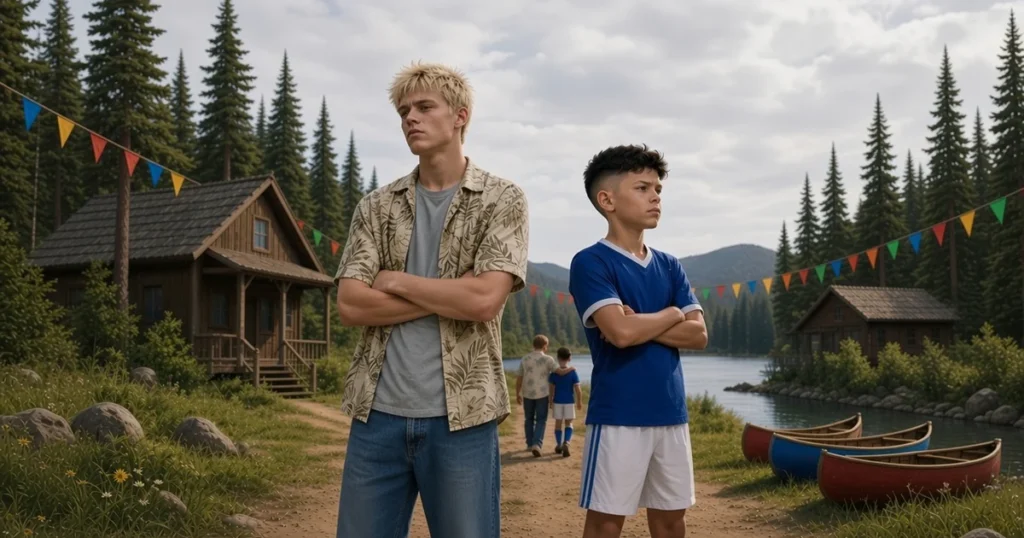
At three in the afternoon on the twenty-fifth day, Zehava blew the silver whistle.
The silver whistle meant “everyone come and help,” and it was usually used only when something was on fire, or when the Admiral had caught someone. So the whole camp ran to the main lawn in swimsuits and towels and one flip-flop, ready to fight a fire. Instead they found Zehava standing on a bench with a megaphone nobody had seen before and a smile nobody had seen before either.
The smile frightened them more than any fire.
“Dear families,” said Zehava into the megaphone, and the megaphone squealed, and three Flamingo kids jumped. “The time has come. Tonight, you sleep outside.”
Silence.
“In the grove,” Zehava went on. “The eucalyptus grove, over the hill. Every family gets a tent. Every family builds its own tent. Every family lights a campfire and cooks dinner on it, from ingredients Shimon will hand out. And in the morning, everyone comes back.” She raised a finger. “Most people.”
“Most?” whispered Nadav.
“In the Wave Cup,” said Zehava, not answering Nadav, “ten points for every family whose tent is standing at sunset. Five points for a fire that’s burning. Five points for a dinner that is edible by Shimon’s standards.”
“Those are low standards,” said someone from the Lemons.
Shimon, standing behind Zehava with a crate of potatoes, looked at him with narrowed eyes and wrote something in a notebook.
“And a bonus,” said Zehava, “of ten points for the family that…” She paused. She thought. “That surprises me. In a good way. Nobody has surprised me for thirty-one years. I’m not optimistic.”
* * *
The Wet Socks gathered in the shade of the carob tree, and Nadav was already calculating.
“Nine points,” he said. “That’s the gap to the Flying Fish. If all our families build a tent, light a fire and cook, that’s twenty points per family. We have five families on the team. Me and Shira. Alon and Noy. Lihi and Itamar. Gal and his sister. And Daniel and Ben.” He looked up. “If they all succeed, we overtake them.”
“If,” said Shira.
“If,” Nadav agreed. “That’s a very big word in mathematics.”
Lihi was already printing. Click, whirr. “The Ben-Ami family: tent, fire, food, victory.” She stuck it on the forehead of Itamar, her little brother from Cabin Gull, who looked at her with the resignation of someone used to it.
Alon chewed a seed and looked at Noy, his ten-year-old sister, who was exactly as quiet as he was. They both nodded at the same moment, with the same movement. That was, apparently, the entire planning meeting of the Peretz family.
And Daniel looked at Ben.
Ben was standing to one side, by the Catfish table, ball under his arm, with the face of someone who had just heard the worst news of the summer. He wasn’t looking at Daniel. He was looking at Zehava.
And then, in the middle of the lawn, in front of the whole camp, he raised his hand.
“Navon?” said Zehava into the megaphone.
“I’m not sleeping in a tent with him,” said Ben.
* * *
The lawn went silent. Even the Admiral stopped honking in the reeds.
Zehava lowered the megaphone. She looked at Ben over her glasses, with a look Ben already knew. The office look, the window look, the “I believe you” look.
“Families stay together,” she said. Without the megaphone. Quietly.
“Then I’ll sleep in a tree.”
“Which tree?”
Ben looked around. “A eucalyptus.”
“Eucalyptus is a smooth tree,” said Zehava. “And at night there are bats in it. They’re harmless. But they don’t like roommates.”
A few kids laughed. Ben went red but didn’t move. Daniel, across the lawn, stood without breathing. He felt the whole camp watching him, waiting for him to say something, the big brother, to shout, to argue, to say “Ben, enough.” He said nothing. His left shoulder went up. And down.
Then Omer stepped in.
“Ben,” said Omer, too loudly, as always, “if you don’t come, I don’t know how to build a tent with Eli. Eli’s seven. He’ll tell me to sleep on my left side. I need you in the grove. Nearby. So there’s someone I can shout to in the night.”
Ben looked at Omer. Omer looked at him with the face of a dog waiting for a walk.
“Fine,” Ben said at last, in the voice of someone giving up something big. “I’ll come.” He turned his head, for the first time, toward Daniel. “But I’m not touching anything. Not the tent. Not the fire. Not the food. I’ll be there. That’s it.”
“Fine,” said Daniel.
“And I’m not sleeping inside.”
“Fine.”
“And you don’t talk to me.”
Daniel thought for a moment. “Can I say ‘good night’?”
Ben looked at him like someone trying to spot a trap. “No,” he said. And walked off.
* * *
Shimon handed out the ingredients from the kitchen window, like a general handing out ammunition.
Each family got a cardboard box. In each box: six potatoes, a roll of foil, two onions, four eggs, a packet of pitas, a tub of white cheese, salt, and a small bag of chocolate, “for dessert, for whoever survives.” On each box Shimon had stuck a note in his own handwriting: Campfire potatoes, Shimon’s recipe. Don’t burn them. If you burn them, don’t tell me.
When Daniel reached the window, Shimon looked at him for a long moment. Then he looked at Ben, standing far off by the tree with his ball.
“How many potatoes does he eat?” asked Shimon.
Daniel was surprised. “A lot. He eats a lot when he’s angry.”
“And he’s angry a lot,” said Shimon. It wasn’t a question. He added four more potatoes to the box, another packet of pitas and another bag of chocolate. Then he leaned through the window and lowered his voice. “I was an angry kid too,” he said. “My father left when I was twelve. Nobody knew how to talk to me. Only how to eat with me.” He pushed the box into Daniel’s hands. “Eat together. It’s the closest thing to talking.”
Daniel stood there with the box and didn’t know what to say. Shimon was already shouting “Next!”, as if he hadn’t said anything.
* * *
In Cabin Catfish, Ben was packing a bag.
He didn’t pack much. A torch. A jacket. The pillow, with Lihi’s label, Champion’s pillow. He couldn’t find the Maccabi blanket, and then remembered it wasn’t his anymore, that he’d given it away, that it was in Cabin Pelican, on Daniel’s bed. He stood for a moment in front of the empty shelf.
“Mosquito’s going camping with his big brother,” Roy sang from the top bunk. “How cute. Take pictures for me.”
“I’m not going with him,” said Ben, without turning around. “I’m going near him.”
“What’s the difference?”
Ben thought about it. He thought about Omer’s question two days ago, under the eucalyptus. What’s the difference between a home and an apartment? There had been too many questions like that lately, and he didn’t have an answer to any of them.
“Three metres,” he said finally. And for a moment it sounded to him like a good answer.
* * *
The tents were handed out from the storeroom by the old well, by Kobi, who stood in the doorway with a list and orange sunscreen and the face of someone giving out presents he wasn’t sure about.
“New,” he said, and gave Nadav and Shira a shiny blue bag. “New. New.” Lihi. Alon. “New,” to Maya, who took the bag without looking up and walked toward the grove with Yuval the long way, round the lawn, as far from Daniel as possible.
Then Kobi reached Daniel, looked at the list, then at the empty shelf, then at the back corner of the storeroom.
“Wait,” he said.
He vanished into the dark. There was a sound of things falling, and of something being dragged, and of Kobi saying “Faith, faith” quietly to himself. Then he came out, dusty to the shoulders, dragging a bag.
It wasn’t a blue bag. It was a green one, the colour of an old army, made of thick canvas, with a rusty zip and a paper label on which someone had written in ballpoint, in crooked letters: Family tent. 1987. Do not open in rain. Do not open at all if possible.
“It’s the last one,” said Kobi apologetically. “It belonged to the camp before Zehava. I… I believe in it.”
Daniel took the bag. It weighed about as much as Nadav.
“Are there instructions?” he asked.
Kobi thought. “There used to be.”
* * *
Daniel opened the bag on the grass behind the storeroom, far from everyone.
Inside were: one sheet, enormous, green, smelling of cellar and of something that had died there in the nineties. Twelve poles, in eleven different lengths. A bag of pegs, some straight, some bent, and one shaped like a question mark. Rope. More rope. And a paper note, folded, yellow with age.
Daniel opened the note hopefully.
It wasn’t instructions. It was a drawing. Someone, in 1987, had drawn a triangle in pencil, and inside it four smiling stick figures: a dad, a mom, a kid and a smaller kid. Underneath, in the same crooked writing: Good luck. It’s not as hard as it looks.
Daniel looked at the triangle for a long time. At the four stick figures. At the little kid, whom someone had drawn holding the big kid’s hand.
“It is as hard as it looks,” said Nadav, appearing behind him with his shiny blue bag, which also contained an instruction booklet in seven languages. “It’s harder. Statistically, a 1987 tent without instructions is successfully pitched in…”
“Nadav.”
“I’m quiet.”
Lihi arrived after him, looked at the pile and sat down next to it without a word. She took out the label maker. And one by one, with the patience of someone who labels for a living, she stuck a number on each pole. 1. 2. 3. Up to 12. On the question-mark peg she stuck ?.
“Now at least they have names,” she said. “Things with names are less scary.”
Daniel looked at the twelve numbered poles, at the bent peg with the question mark, at the drawing of the triangle with the four stick figures. He thought this was, more or less, his whole summer in one bag: lots of parts, no instructions, and one question mark that wouldn’t straighten out.
* * *
At half past four, the families of Camp Green Waves marched to the grove. In a long line, along the path over the hill, with shiny blue bags and pots and crates of potatoes, and Gull kids singing Gili’s song about the clothespin.
At the end of the line walked two.
Daniel walked first. On his back, the green bag from 1987. In one hand, the bag of pegs. In the other, a pot. Under his arm, twelve numbered poles, one of which fell every few steps, so that he had to stop, bend down and pick it up.
Three metres behind him walked Ben. There was nothing in his hands. Just the ball under his arm and, in his pocket, a bag of Bamba he had taken from Shimon’s when nobody was looking.
He didn’t help. He’d said he wouldn’t help, and he didn’t. But when pole number seven fell for the fourth time, and Daniel stopped, arms full, unable to bend down, Ben walked past without looking and kicked the pole gently, with his toes, until it rolled to Daniel’s foot.
“That’s not help,” said Ben, without stopping. “That’s a kick.”
“Obviously,” said Daniel.
And they walked on, one behind the other, to the grove.