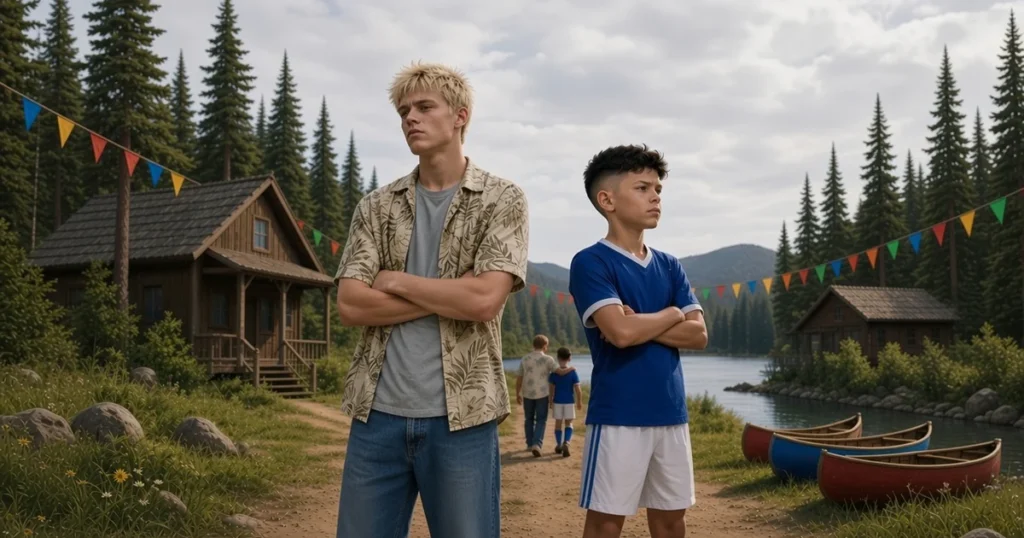
At five twenty in the morning, the world belonged to Ben.
Not the whole world. Just the dusty field behind the dining hall, with two rusty goals, one torn net, and an old sign of Zehava’s that said The field is open from four to seven. Ben had decided, on the fourth day of camp, that seven in the morning was also seven, and that nobody had said it only meant the evening. When Zehava heard this explanation she thought about it for a long time, and then said: “That’s a beautiful legal argument. Don’t wake the Admiral.”
So he didn’t wake the Admiral. He walked on tiptoe, with the ball under his arm, and with Omer, who walked on his whole foot, with his whole body, yawning yawns you could hear in Tiberias.
“Why,” said Omer, mid-yawn, “are we doing this?”
“Because you asked.”
“I asked at night. At night I’m a different person. I’m a person with dreams.” Omer lay down on the dry grass at the edge of the field. “At five in the morning I’m basically just a body.”
“You said you wanted to learn the Zidane turn,” said Ben. “You said if you could do the Zidane turn, Roy’s sister would look at you.”
Omer sat up at once. “I said that out loud?”
“You shouted it. In your sleep. Twice.”
Omer stood up.
* * *
The secret of the Zidane turn, Ben explained, is that it isn’t a turn at all.
“It looks like a turn,” he said, and demonstrated: ball under the right foot, drag it back, spin the body, and the ball passes to the left, and Ben already had his back to where the imaginary defender had been and his face to where the imaginary defender wasn’t. “But really it’s deciding where you’re going and letting the ball follow you. You don’t chase the ball. The ball chases you.”
“The ball chases me,” Omer repeated, like a mantra.
“Right.”
Omer put his foot on the ball, dragged, spun, and the ball did not chase him. The ball rolled off in the opposite direction entirely, slowly, with dignity, like someone who had decided he wasn’t part of this.
“It’s not chasing me,” said Omer.
“Again.”
Omer tried again. And again. On the seventh try he got tangled in his own legs and fell on his backside, and the ball stopped beside him and nudged him gently, like a dog comforting him.
And just then, like every morning, beyond the fence, on the path that led to the water, Daniel walked by.
* * *
Ben didn’t look.
That was his decision, and he was proud of it. Daniel walked past there every morning. Four days now. At about five thirty-five, with a towel over his shoulder, walking fast in that way of someone pretending to run, or pretending not to run; Ben hadn’t decided which. He always glanced toward the field. Just for a second. Then he kept going, down toward the boathouse.
Ben didn’t look back at him. Not once. He also didn’t check the time at five thirty, and didn’t move his practice to the side of the field closer to the path, and didn’t raise his voice when he was explaining something especially good. If he did any of those things, it was by chance.
“Your brother,” said Omer from the ground.
“Didn’t see him.”
“He’s there. With a towel.”
“Didn’t see him,” said Ben, and did, at that exact second, with no imaginary defender asking for it, a perfect Zidane turn, followed by a backheel, followed by flicking the ball up to his knee, his shoulder and back to his foot, and catching it on his instep without it falling.
Omer looked up at him. “Who was that for?”
“For you. So you can see how it’s done.”
“I didn’t ask to see that.”
“Then for science,” said Ben, and saw out of the corner of his eye, because one eye can see even when it isn’t looking, Daniel stop for a second by the fence, then keep going.
* * *
He didn’t know where Daniel was going.
That bothered him. He wouldn’t have admitted it in a court of law, in front of a judge with a gavel, but it bothered him. Daniel got up at five thirty, left with a towel, and came back at seven wet, and Nadav went with him, and Ben had seen them once, on the second morning, from far away, disappearing behind the boathouse. What do you do behind a boathouse at five thirty in the morning with Nadav Barak? Ben thought about the possibilities. None of them made sense. The one that made the most sense was that Daniel was training for something in secret, to win. To be the best again. Because that’s how they are, the big ones. They always have to be the best.
But then, yesterday, he had heard Nadav in the breakfast line telling Lihi something excitedly and using the word “float” four times in one sentence. And Lihi had said, “Daniel taught you?” and Nadav had said, “Shhhh,” but with a smile.
Ben didn’t know what to do with this information. So he put it aside, the way you leave a ball under your bed, and every time he moved his foot at night, he felt it there.
* * *
His father had come to one of his games, once. Once, in fifth grade, in Givatayim, a school league game on an artificial pitch that smelled of hot rubber. Ben scored one goal in that game and also missed a penalty. The whole drive home his father talked only about the penalty. How he’d looked toward the side he was going to kick. How he’d run up too slowly. How a goalkeeper who knows anything could read that from a kilometer away. “The goal was luck,” his father had said, when they stopped at a red light. “The penalty is you.”
Ben remembered the red light. It stayed red for a long time.
He had never told anyone about it. Not Mom, who had worked a double shift that day, and not Omer, who would probably have said something too nice. But sometimes, when he missed, he still heard that voice, low and certain: The penalty is you. And so, when he taught Omer, he had decided, without really deciding, that he would never tell him what he had done wrong. Only what to do next time.
“Okay,” he said to Omer. “I’ll explain it differently.”
He sat down on the grass beside Omer and set the ball between them.
“Forget the ball,” he said.
“It’s soccer practice.”
“Forget it for a second. Look at me. You’re too complicated. You’re thinking about your foot, and the ball, and Roy’s sister, and everyone watching. Nobody’s watching. There’s nobody here except the Admiral, and he’s asleep.” Ben breathed. “When I say ‘now,’ you turn. That’s all. You turn, and the ball does the rest.”
He only heard it after he’d said it.
When I say ‘now,’ you lean. That’s all. You lean, and the wind does the rest.
It was Daniel’s voice. In boat number four, the day before Family Day, when Ben’s hands were still wrapped in bandages and he was gripping the side so hard his knuckles went white. Daniel had said it quietly, without looking at him, the way you say something to a nervous horse. And Ben had leaned. And the boat had done that thing, the thing he hadn’t believed a boat could do, passed through the wind like a key through a door.
Now he had said it. In almost the same words. To Omer. On his own field.
Ben felt heat rising in his neck, like after chili.
“What?” asked Omer. “Why are you making a face?”
“I’m not making a face.”
“You’re making the Grumpy Brother face,” said Omer. “But without doing it on purpose.”
“Get up,” said Ben. “Do it. When I say ‘now.'”
Omer got up. He put his foot on the ball. He looked at Ben, and Ben looked at him.
“Now,” said Ben.
And Omer turned.
It wasn’t Zidane. It wasn’t even close to Zidane. It was the turn of a twelve-and-a-half-year-old in Hapoel pajamas, half of whose body was still asleep. But the ball passed from right to left. And Omer stayed on his feet. And at the end of the turn, when he looked down, the ball was there. Right by his foot. As if it had chased him.
Omer screamed. He screamed a scream so loud that, for the first time since they’d arrived at camp, the Admiral was woken up by somebody else.
“It chased me! Ben! It chased me!”
“I saw,” said Ben, and he laughed. He didn’t mean to. It just came out of him, like water out of a bottle someone squeezed. “I saw, I saw, don’t scream, there’s a goose here.”
“I will scream! I’ll scream all the way to the Kinneret!” Omer did a little dance, the victory dance of a kid who hadn’t done many victory dances in his life. “Roy’s sister will marry me!”
“She’s sixteen.”
“I’ll wait!”
“You won’t wait. You’ll forget her by lunch, the way you forgot the kayak counselor.”
“That was different,” said Omer with dignity. “That was a different period in my life.” He gazed at the ball by his foot with admiration. “And back then it didn’t chase me.”
* * *
Beyond the fence, the Admiral rose out of the bushes with his long neck stretched out, on his way to find out who had dared, and beside him, behind the big eucalyptus tree, stood someone Ben didn’t see.
That is, he did.
Daniel stood there, wet, with the towel on his head. He was already on his way back. He must have heard the scream. And he stood by the tree, not close enough for anyone to say he was watching, and not far enough for anyone to say he wasn’t. And he was smiling. Not the Grumpy Brother smile. A different smile, one Ben had seen on him only once, in the boat, when they came out of the Naama turn.
Ben didn’t look.
He turned his eyes back to Omer, who was still dancing, and shouted “Again! Do it again!” in an especially loud voice, the kind you can hear from behind a eucalyptus tree.
Omer did it again. This time the ball didn’t chase him. This time the ball rolled toward the fence, and onto the path, and rolled, and rolled, and stopped right at Daniel’s feet.
Daniel looked at the ball. Ben looked at the ball. Omer looked at both of them, and then, with the sudden wisdom of kids who know when to keep quiet, looked at the sky.
Daniel could have picked it up and thrown it back. Daniel could have said something, nice, or good morning, or any one of those grown-up sentences Ben would have had to decide what to do with.
Daniel didn’t say anything. He gave the ball a light tap with the side of his foot, at exactly the right strength, and the ball rolled back through the hole in the fence, across the grass, the whole length of the field, and stopped in front of Ben, like a dog coming home.
And then Daniel left.
Ben stopped the ball with his sole. He watched Daniel’s back going up the path, with the towel, without turning around.
“That was a good pass,” said Omer carefully.
“It was an ordinary pass.”
“It came right to you.”
“By chance,” said Ben. He set the ball down. He put his foot on it. He looked at it for a long time, as if the ball were supposed to answer something.
And then he said, without looking up: “Tomorrow. Five twenty. Same place.”
“Why?” asked Omer, in Shahar’s voice.
“Because we’re not finished yet,” said Ben. And that was true. Only he didn’t quite know what they hadn’t finished.