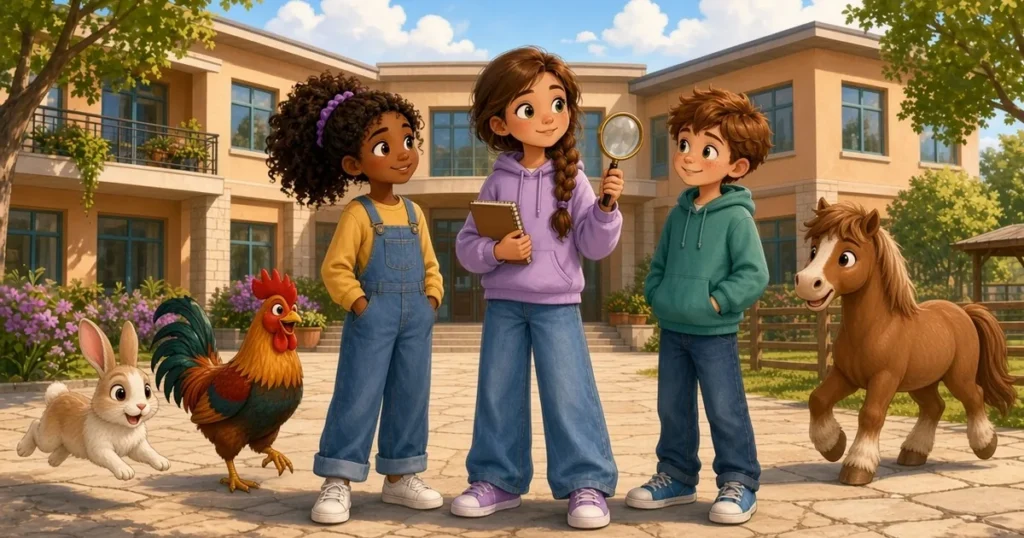
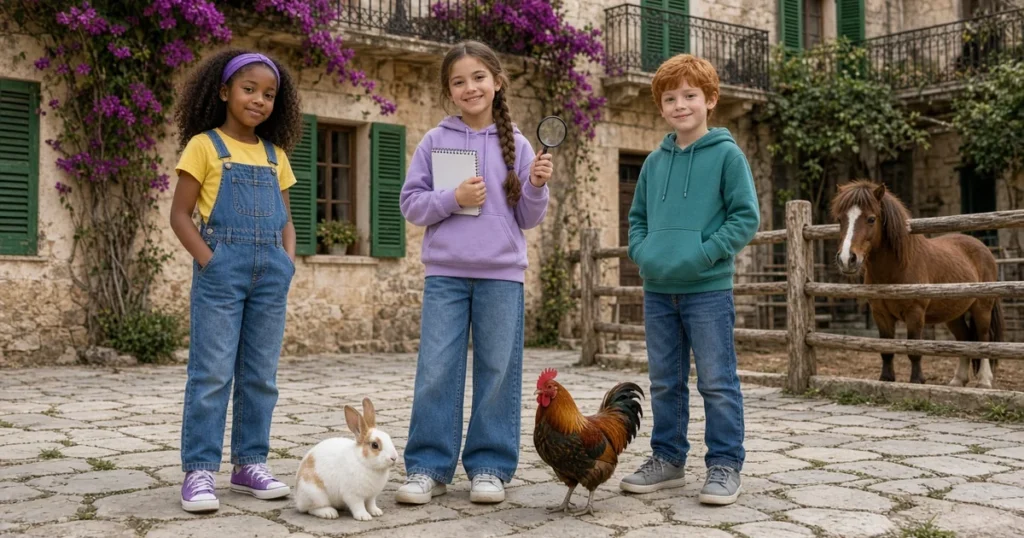
Amy didn’t move.
She had been planning this moment for two weeks. Every night in bed she planned it again. She would walk down the steps, slowly, like a lady. She would hold out her hand. She would say, “Hello, Noa, welcome to Hilltop House,” in a calm, grown-up, detective’s voice. She had even written it in her notebook so she wouldn’t forget.
But now, with the woman in the blue-buttoned coat standing at the gate, Amy’s legs simply wouldn’t move. Her mouth wouldn’t open. And the notebook in her hand was trembling.
Noa didn’t move either. She just stood there, suitcase in one hand, the furious cat carrier in the other, looking at Amy. And her face did something odd. It began to smile, and got stuck halfway, as if the smile had met something heavier on the way.
“You look exactly like her,” she said. Quietly. Almost to herself. “At your age. Exactly.”
Then Noa put the suitcase down on the grass. And the carrier, carefully, beside it. And opened her arms.
And Amy ran. Not slowly, like a lady. Not with a hand held out. She just ran, down the steps, plaits flying, dropping her notebook halfway so it stayed on the fourth step. Noa knelt, and Amy went into her arms, and into the coat, and into the smell. A smell of lemons, of cold aeroplane air, and of something else. Something Amy hadn’t smelt for so long she had nearly forgotten it existed. The smell of someone who is family.
They stayed like that for a long time. Nobody interrupted. Not Zehava, standing at the kitchen window with a tea towel over her face. Not Mrs Cohen, in the doorway, leaning on the frame as if she needed something to hold her up. And not the forty children of Hilltop House, squashed into the upstairs windows as on sunflower day, noses to the glass.
Only Mozart interrupted. From the carrier on the grass came a long, deep, terrible sound, like a ship’s horn with someone standing on its tail.
Noa laughed, her face in Amy’s hair. “That’s Mozart,” she said. “He’s cross. He’s been cross for twelve hours. Cross with the plane, the carrier and the world. He’ll get over it.”
“Does he bite?” asked Amy, face still in the coat.
“Only people he loves,” said Noa. “So don’t worry. He’ll be biting you by tomorrow.”
Only afterwards, when they stood up and Noa wiped Amy’s cheeks with her thumb the way Mum used to, did Amy notice the buttons. Five round blue buttons in a row down the light spring coat. And the middle one, the third, was different from the others. A little darker. A little older.
“I sewed them on last week,” said Noa, seeing where Amy was looking. “I searched every shop in Toronto for buttons like the ones on Grandma’s coat. I found four that were nearly the same. And the third…” She touched it. “The third is real. From the coat. I’ve kept it in a box all these years. It fell off when your mum and I quarrelled, back then, and lay on the floor. I never gave it back.” She looked at Amy. “I thought perhaps… You’ve got one, haven’t you? You wrote that you had.”
Amy put her hand into the lining of her jumper and took out her blue button. She held it beside the third button on Noa’s coat. They were the same. Exactly. The same blue. The same four little holes. The same tiny thin scratch on the rim.
“Two buttons from the same coat,” whispered Noa. “In the same place at last.”
The first evening was a noisy one.
All of Hilltop House wanted to meet Noa. Benny showed her how he saves a penalty, three times, once on his elbow. Oliver showed her the shed and the afikoman, which was still in the freezer. Maya introduced her to Falafel, who sniffed the coat and decided he approved. And Hutie plaited her a bracelet during supper without looking at her hands, blue and gold. “For Amy’s family,” she explained. And Noa, who didn’t know this was the most serious thing Hutie can give anyone, put it on at once and didn’t take it off.
When they opened the carrier, Mozart came out slowly, tail in the air, with the face of a king arriving somewhere beneath him. He was a big orange tabby with one ear slightly torn at the tip, “from a fight with a moose”, Noa claimed, though Amy thought she was joking. He looked at the dining room. At the forty children. At Falafel, whose ears froze. Then he walked, quietly, without hurrying, jumped onto Mrs Cohen’s chair at the head of the table, sat down and began to lick his paw.
Falafel, who had frozen until then, looked at the cat, and the cat looked at him, and both of them apparently decided they weren’t remotely interested in each other, and turned round at the same moment.
“Well,” said Mrs Cohen after a long silence. “I suppose he’s in charge now.”
After supper Amy took Noa on a tour. Just the two of them. She showed her the third stair, and the seventh stair, which creaks, and the Quiet Room behind the green door, where Noa didn’t speak, only went in, sat for a moment on the cushion and came out. Last of all she showed her the library. And the cupboard. The detectives’ archive, with the key David gave them and all the notebooks in a row. The first notebook, from Ruti, from the very first night. The second. And the third, from Purim, already nearly half full.
Noa opened the first at page one and read aloud, slowly: “Case No. 1: The Vanishing Spoon. Culprit: Sugar, because of the bananas.” And she laughed so much that Mozart, who had followed them, fled under the table, offended, as only a cat can be offended. Then she read the second, and the third, and didn’t stop until the dining-room clock struck nine, meaning seven minutes past nine. When she closed the notebook she looked at Amy with the face of someone who has found something she’s been looking for a long time. “Forty-six cases,” she said. “In a year and a bit. Your mum solved about three a year. And they were all about chocolate.”
“And who took the chocolate?” asked Amy.
“Me,” said Noa. “Always me. And she always knew.” She put the notebook back carefully, the way you put back something precious. “You know, she’d have been proud of you. I’m sure of it. Wherever she is.”
That night Noa slept in the little guest room by the office, with its window onto Sugar’s hillock. But before she went to bed she came to Room Seven, with Ruti’s permission, and sat on the end of Amy’s bed. Every girl in Room Seven pretended to be asleep, and every one of them listened.
And Noa sang. Softly. The song. The bedtime song. Mum’s song, and the song of the grandmother who sewed on the buttons. The same tune, the same words. But in a different voice. Lower, a little husky, a little off-key on the third line. And Amy, eyes shut, thought that was all right. Better, even. Because if it had been exactly the same voice, she would have cried all night. As it was, she only cried a little, and fell asleep in the middle of the second verse.
In the morning, the mystery began.
It was the day of the grand welcome. Oliver had been planning it for two weeks, since the day Noa’s letter came. Not an ordinary welcome, with a cake and a banner. Oliver doesn’t do ordinary. He had planned a machine. “The Welcome Machine,” he called it, in a whisper, like someone naming an invention that will change the world. A giant machine that would start with one small ball rolling, knocking something over, which knocked something else over, which pulled a string, which rang a bell, which woke Kuku, who crowed, who… And at the end, after thirty-seven stages, a huge banner would unroll, “WELCOME NOA”, over the dining-room door, and confetti would fall on her head from the ceiling.
And the whole plan, all thirty-seven stages, with drawings and arrows and measurements and a list of everything needed, was in one notebook. Oliver’s invention notebook. A fat one with a green cover, a rocket sticker and stains of cocoa, jam and paint, holding every invention Oliver had ever invented, from the play-dough earplugs to the glow-in-the-dark eggs.
At half past six that morning, when Oliver opened the bag he had left the night before on the bench in the hall, by the stage, the notebook wasn’t there.
Oliver had run to the hall at half past six, before the bell, with the face of an inventor on the big day, to start building. He hadn’t eaten. He hadn’t brushed his teeth. He hadn’t even played a morning prank, which, Ruti said later, hadn’t happened since he was four.
“It’s gone,” he said. And Amy, hearing him from the corridor, stopped. Because she had never heard Oliver speak like that. No shouting. No drama. No “curse of the play”. Just three quiet, empty words. “It’s gone. Everything.”
He sat down on the floor in the middle of the hall, bag open, and said nothing more.
Amy stood in the doorway. Behind her in the corridor stood Noa, with a cup of coffee and Hutie’s bracelet and a face asking whether to come closer. And Amy felt it in her tummy, a pull in two directions. On one side, Noa. Who only arrived yesterday. Who was staying only ten days. Whom Amy wanted to be with every minute, to ask a million questions, and from whom she wanted, at last, to hear the news. On the other side, Oliver. On the floor. Oliver, who always laughs, and now didn’t.
And Noa, as if reading her mind, came and put a hand on her shoulder. “Your mum was a detective,” she said quietly. “At home. I told you. And she’d never have left a friend on the floor.” She sipped her coffee. “And if I may, I’d love to be your assistant. I’m a nurse. I’m good at finding things that hurt.”
So Amy opened her notebook. Case No. 47: Oliver’s Notebook. And went into the hall.
The clues were odd. Oliver’s bag wasn’t torn or cut, and the zip was shut, as Oliver had left it. But on the zip, on the bench and on the floor around it were hairs. Short, fine, orange hairs. And in the dust on the stage, which nobody had swept since Purim, there were marks. Not tiny paired feet, like Falafel’s. Soft round marks, one after another, in a perfectly straight line, like someone walking a tightrope.
“Orange,” said Hutie, who had come running in her scarves. “Orange hairs.”
“Who at Hilltop House is orange?” asked Leo.
Everyone looked at Oliver. Because Oliver loves orange more than anyone in the world, and once painted every stone on the path orange. But Oliver, on the floor, didn’t even smile.
Then Noa looked round the hall, the corridor and the stage. And her face changed. “Hang on,” she said. “Where’s Mozart?”
Nobody knew. Because Mozart, the orange cat, who had slept the evening before on Mrs Cohen’s chair, then on Noa’s pillow, and then, at two in the morning, according to Ruti, had gone for a stroll along the corridors, tail in the air, inspecting his new kingdom, had vanished.