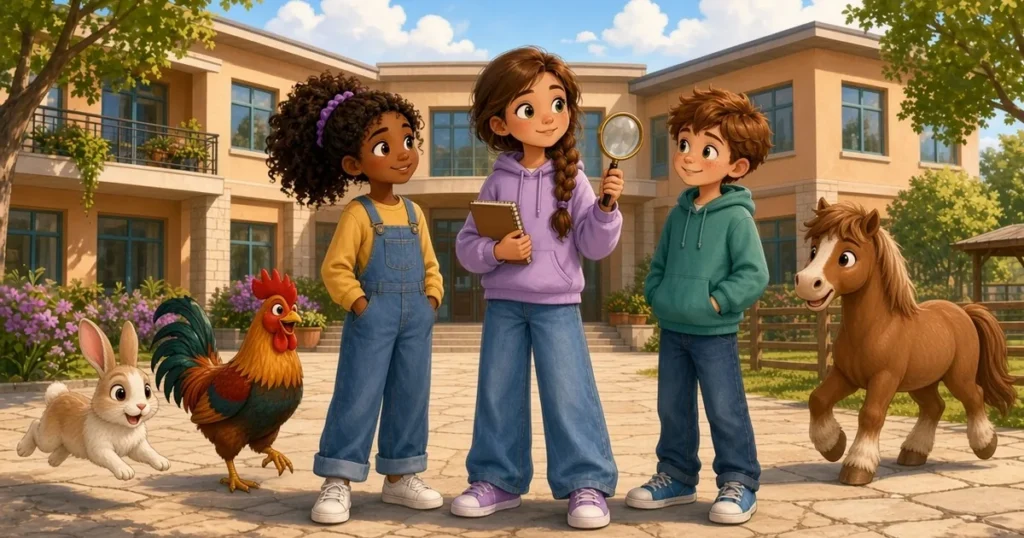
Amy ran. The nibbled piece in one hand, her notebook in the other, Maya and Falafel behind her, down the corridor and up the stairs, skipping the seventh stair, the creaky one, without even thinking. All the way to Room Seven, where Leo was still sitting with the sticky tape and the other two pieces, Hutie was plaiting a grey bracelet, and Benny was standing outside the window, because he had tied himself to the fence again, this time with a proper knot Hutie had taught him.
“Found it,” Amy gasped. “The last third. It was in Falafel’s nest.”
Leo laid it beside the other two. It fitted. Like the last piece of a jigsaw, the one that always turns up under the sofa. He taped it, slowly. Then he read the whole letter aloud from the beginning, while all of Room Seven, and Benny at the window, held their breath.
Dear Mrs Rina Cohen, Head of Hilltop House. We are pleased to inform you that after review and discussion, it has been decided that Hilltop House will close for renovation, for two weeks, in August. During this period all the children will be moved to the “Seashell” summer camp by the sea, together with the staff. In accordance with the request of the Tova and Avraham Fund, the grant will cover: a new roof, heating in every room, a new kitchen oven, repairs to the stairs, new paint for the whole house, and a new library room with space for the archive. Yours sincerely, the Council’s Support Committee.
There was silence.
Then Maya shrieked. And Hutie. And Alice and Penny, at the same speed, for the first time in their lives. Outside, Benny jumped so high that the rope snapped tight, the fence shook, Sugar took fright and bolted to the other side of the paddock, dragging Benny three metres through the mud, until Benny got the knot undone and lay on his back, covered in mud, laughing like a lunatic.
“Renovation!” he shouted at the sky. “Renovation! I love renovation!”
But Amy didn’t shriek. She stood with her notebook and read one line again. In accordance with the request of the Tova and Avraham Fund. And she understood. All the pieces of the whole week joined up in her head at once, the way the letter had joined up on the table. Twenty people. Fifty years. Rachel. “I don’t know how to thank you.”
“It’s them,” she whispered. “The first children.”
Just then, from the yard below, came a hoot. A small white minibus was climbing the hill road, slowly, and stopped by the gate. And people began to climb out.
Old people. Or, as Tom put it later, “people who were children a long time ago”. First came Grandma Rachel in her green scarf, with a basket of paper birds. Then a tall man with a walking stick. A small woman in a straw hat. A man with a white beard and a guitar. And more. And more. Twenty of them. Amy counted. Exactly twenty. The same twenty names written on the back of the old album photograph. The first children of Hilltop House. The ones who buried the time capsule and met here again after fifty years, on the day Amy, Hutie and Leo dug it up.
Mrs Cohen came out of the front door to meet them, glasses in hand, with the face of someone who couldn’t keep the cake behind her back a second longer.
All of Hilltop House went down to the yard. Forty children, twenty former children, David, Zehava, Ruti, Noam, Shira, and Sugar, standing by the fence with Benny’s rope in his mouth like a souvenir. Mrs Cohen climbed onto Zehava’s tomato crate, which had been in three cases and was now a stage as well, and spoke.
“I gather,” she said, looking straight at Amy, “that someone has already read the letter.”
“Falafel,” said Maya. “He read it first. And ate a bit.”
Everyone laughed, Mrs Cohen too. “Then I’ll tell you what isn’t in the letter,” she said. “Six months ago, after you found the time capsule, the first children of Hilltop House met again, for the first time in fifty years. They saw the house. The leaking roof. The seventh stair. Zehava’s smoking oven. The rooms so cold in winter that at Hanukkah you slept under three blankets.” She looked at Grandma Rachel. “And they decided to do something. They set up a fund. They raised money from their savings, their children, their grandchildren, and everyone who ever passed through this house or heard of it. For six months. Without telling you a word. And they named it after the two people who built this house for them. Tova and Avraham.”
“And for you,” said Grandma Rachel quietly, from the front row. “Tova always said Hilltop House wasn’t built for one child. It was built for all the children still to come. So we came to give something back.”
“The Council’s committee had to approve it,” Mrs Cohen went on. “And I didn’t want to tell you before it was settled, because if they’d said no, I didn’t want you disappointed. The approval came last Friday. In the morning. I opened the letter, sat down and cried a little, and then someone white with long ears jumped on my desk and grabbed the letter in his teeth.” She looked at Falafel. “When I got him out from under the armchair I had two pieces left in my hand. I threw them away and printed the letter again from the computer. I never thought…” She took off her glasses. “I never thought that in this house, even a bin isn’t safe for secrets.”
And Amy understood something else: why Mrs Cohen had been in town at meetings on sunflower day. She hadn’t gone to look for another job, as Oliver had whispered that evening. She had gone to sit in front of a committee, in her glasses and her lucky red socks, and explain why an old house on a hill needs a new roof.
“That’s because of Oliver,” said Benny.
“That’s because of Oliver,” Mrs Cohen agreed.
“I was looking for somewhere to put the afikoman!” said Oliver, deeply offended.
Then everyone began asking questions at once, and Mrs Cohen answered them all, one by one, like an especially patient teacher. Yes, the rooms would have heating, and no, nobody would need three blankets any more, unless they wanted them for fun. Yes, Zehava’s oven would be replaced. “And the Dragon?” asked Zehava, alarmed. “The Dragon,” said David, “is moving to the yard. We’ll plant flowers in it. Sunflowers, if Maya agrees.” Maya agreed. And Zehava patted David’s cheek as though he were an oven. Yes, there would be a new library room, with a big window, shelves to the ceiling, and a special locked cupboard for the detectives’ archive. “That’s why I measured the wall,” Mrs Cohen told Amy. “You saw me. I know you did.”
“I did,” Amy admitted.
“And the camp?” asked Danny. “Seashell? Where’s that?”
“On the beach,” said Ruti. “Two weeks. Tents, a campfire, swimming in the morning. In a little town by the sea, with a lighthouse.”
Leo, beside Amy, turned to her slowly with the face of someone who can’t believe it. “With a lighthouse?”
“A red-and-white lighthouse,” said Ruti. “On a rock.”
“That’s… that’s my lighthouse,” whispered Leo. “From the window. Yael and Uri’s.”
And Amy, who hadn’t cried all week, not when the letter was only a third, not when the house had nearly closed inside her head, suddenly found her eyes were wet. Because sometimes something in the world fits exactly like a jigsaw. The last piece, under the sofa.
“And you?” Tom asked Mrs Cohen loudly, because Tom always asks loudly. “Are you coming to the seaside too? Or is that your holiday?”
“That’s my holiday,” said Mrs Cohen. “One week. At my sister’s in Galilee, with a book, a hammock and zero children.” She raised an eyebrow. “And in the second week I’m coming to you. To check nobody has drifted off to Cyprus.”
“Can we bring Sugar?” asked Shaked.
“No,” said Mrs Cohen, David, Ruti and Noam together, at the same speed, like Alice and Penny.
“And the seventh stair?” asked Hutie. “Are they mending it?”
Mrs Cohen smiled a small, crafty smile Amy had seen only once before, in the case of the clock. “They’re mending every stair,” she said. “Except one. I’ve asked the builder to leave one creak. A little one. In the seventh stair.” She put her glasses back on. “So that even in fifty years I’ll know who’s creeping down to the kitchen at night.”
And Hilltop House laughed. Then Zehava brought out three cakes, six pots of soup and the Purim leftovers from Oliver’s attic hideout. That lunchtime the first children and today’s children ate together in the dining room, under the clock that is seven minutes slow.
After lunch, today’s children gave the first children a tour. Every room took a guest or two, and every guest was looking for something. The tall man with the stick, whose name was Shmuel, went into the boys’ room, knelt slowly beside the door frame and found there, under layers of paint, the letters S and H carved into the wood with a penknife. “Shmuel,” he said. “Aged nine. I washed up for a week as punishment.” Benny gazed at the carving with such admiration that Noam said at once, before anyone asked: “No.”
The small woman in the straw hat, Malka, asked to see the kitchen, stood in front of the Dragon, laid a hand on it and said she remembered it new. “Tova baked the first loaf in it,” she told Zehava. “And burnt it. Black. And we all ate it and said it was the best bread we’d ever had. Because it was the first bread in our home.” And Zehava, who never cries except when chopping onions, and then only in one eye, wiped both eyes on her apron.
Grandma Rachel went up to Room Seven and sat on Maya’s bed by the window, the window where she once stood, a little girl with measles, when the photo was taken. She looked out for a long time. Maya sat beside her with her head on her shoulder, saying nothing. And Amy, in the doorway, thought it was just like the Quiet Room. Sometimes the most important thing is just to sit beside someone.
Later the man with the white beard played the Hilltop Song on his guitar and sang it in a cracked voice, first verse to last, including one verse none of today’s children knew, because Tova wrote it only for the first children. A verse about a key, and a heart, and how every house needs someone who remembers.
Amy didn’t catch all the words. But she quickly wrote three of them in the margin: Key. Heart. Remembers. And underlined them.
That night she wrote: Case No. 44: The Council Letter. Solved. “Close”: for two weeks, for renovation. “T Fund”: Tova and Avraham. Who: the twenty first children. Who tore it: Falafel. What I learned: never read only a third of a letter. And: people who were given something remember to give back. Even after fifty years.
She had nearly shut the notebook when there was a soft knock on the door of Room Seven. Leo, with Noam’s permission, for two minutes. He didn’t come in. He stood in the doorway with his compass.
“Amy,” he said. “Yael and Uri. At Passover, on the last day. They asked me something.” He took a breath. “They asked whether I’d like to be their son. Really. For always. Adopted, it’s called. And I have to answer by the summer.”
“What did you say?”
Leo opened the compass. The needle, as always, pointed north. “That I don’t know,” he said. “That I’m still counting.”