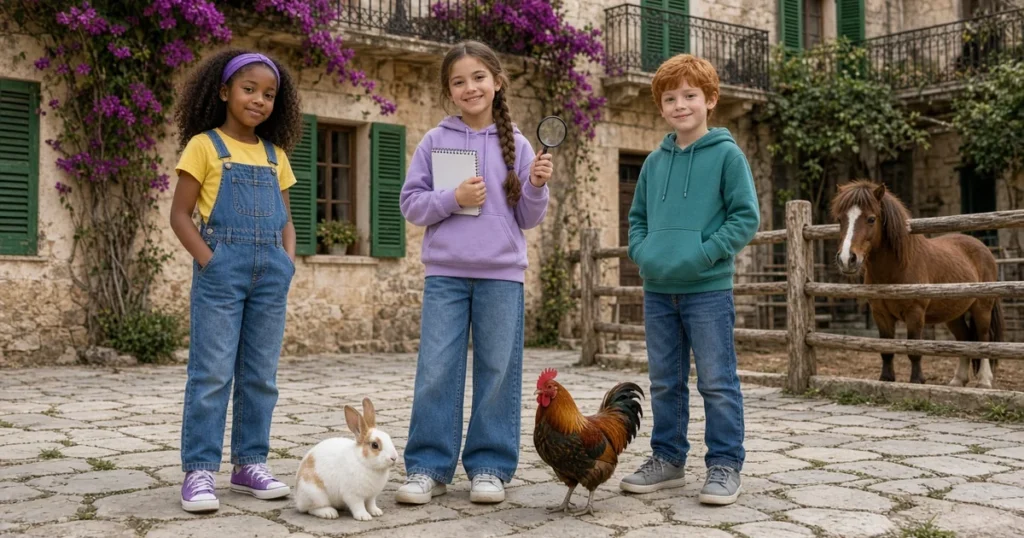
By morning, the whole of Hilltop House knew.
Amy wasn’t the only one who had heard. Leo had heard, because he sleeps lightly, like a bird. Omer had heard, decided it was a dream, gone back to sleep and dreamt about a piano. And Tom had heard, run in the middle of the night to Benny’s bed and crawled under the duvet, so Benny woke with Tom on his head and a biscuit mark on his forehead, and said it was the worst week of his life, head-wise.
“It’s a ghost,” Oliver announced at breakfast, planting his spoon in his porridge like a flag. “A piano ghost. I’ve heard about them. Some old houses have a ghost that plays at night, because it never finished its song while it was alive.”
“What song?” asked Danny, spoon in mid-air.
“A sad one,” said Oliver. “About something lost. A sock, maybe.”
“Ghosts can’t play the piano,” said Maya. “They haven’t got fingers. They’re see-through.”
“Then they play with their noses,” said Oliver, and refused to discuss it further.
Then Eli from Room Two, the one who always asks “why”, asked the question everyone was afraid to ask. “What if it’s Tova?”
The whole table went quiet. Everyone knew who Tova was. Avraham’s wife, who built Hilltop House with him fifty years ago. Who wrote the Hilltop Song. Whose violin still lies in the shed in a black case. Whose heart-headed key still hangs on a nail in the Quiet Room, waiting, as she wrote, “for when the house needs it”.
“Tova played the violin,” said David, passing with a teapot. “Not the piano. And if she came back, she wouldn’t play in the middle of the night and wake forty children. She’d play at seven in the morning and wake forty children.” Off he went, and everyone laughed, but Amy saw that on his way out he too glanced towards the hall.
After school, the three detectives went into the hall.
The piano stood in its corner as always. Brown, tall and old, with curly legs like an elderly dog’s and a lid over the keys. It had belonged to Avraham’s mother, Zehava once said. She brought it to Hilltop House on opening day, on a cart pulled by two horses, and said a house without music is only walls. It had stood there ever since, gathering dust, played once a year.
“Facts first,” said Leo. He took out his notebook, in which he had written down every note he heard, under the duvet with a torch. “Eight notes. At exactly seven minutes past two. The first low and long. A pause. The same note again. Then suddenly four quick, mad notes with nothing to do with each other, like somebody falling on the keys. Then the first note again. And silence.”
“Like somebody falling on the keys,” Amy repeated, and wrote it down.
They began to search. At Hilltop House, when you search, you always find something, even if it isn’t what you were looking for. Under the piano they found three marbles, half a pencil and an old note saying “Oliver was here” in a six-year-old’s handwriting, which Oliver insisted was a forgery. On the lid, in the dust, were marks. Not fingerprints. Small round marks, two by two, as though someone had set tiny feet down in the dust. And on the keys, between a white and a black, was a crumb. An orange one.
“Carrot,” said Leo, sniffing it like a scientist. “No doubt about it.”
“A ghost that eats carrots,” whispered Hutie, who had followed them in, scarves and all. She was looking at the piano with an odd expression. Amy noticed. But said nothing.
Then Amy saw the most important clue of all. On the piano stool, caught in a little crack in the wood, was a thread. Short and shiny. Gold. With a thin blue stripe down the middle.
Amy held it up to the light. And all three of them looked at Amy’s wrist. And Leo’s. And Hutie’s. At the bracelets. Gold, with one blue thread down the middle. The colour of courage, with a bit of fear inside.
“Oh,” said Leo.
“Oh,” Amy agreed.
Because the bracelets weren’t only theirs. Hutie had plaited them every evening that week after the secret rehearsal. One for Amy, one for Leo, one for Shira, one for Oliver, and one for Falafel, who ate it, and another for Falafel, who ate that too. Then on Tuesday, when the cast saw them, everyone wanted one, and Hutie made more. For Benny, the King. For Maya, Vashti. For Omer, the horse. For Alice and Penny, the guards. In the end, Amy counted in her head, there were seventeen gold bracelets with a blue stripe at Hilltop House. Including two inside a rabbit.
Then Leo did something nobody had thought of. He opened the lid. The yellow keys grinned at them like a grandad’s teeth, and Leo began pressing them, one by one, from the low end, slowly, his ear against the wood. “Not that,” he muttered. “Not that. Not that either.” On the eighteenth key from the bottom he stopped. “That one,” he said. “The first note. The long low one. I’m certain.”
“What does that mean?” asked Benny, who had joined them because he’d heard there was an investigation, and Benny never misses an investigation.
“Don’t know yet,” said Leo. “But I know it. I’ve heard it this week. Lots of times.” He frowned the way he frowns at a hard sum. “I can’t remember where.”
But Amy remembered. Because at that very moment, from the veranda outside, came Shira’s guitar. Shira was sitting there with Maya and the twins, going through the songs from the play. And before every song she plucked one low note on the thick string, so everyone knew where to start. Before Esther’s song she plucked one particular note. Long. Low. Exactly the note Leo had just pressed.
Leo looked at Amy. Amy looked at Leo. Neither said it aloud. Hutie was standing three steps away in her scarves, staring at the floor, as if she had heard it too.
“Seventeen suspects,” said Leo after a moment, in a voice that was far too ordinary. “Plus a rabbit.”
“Plus Hutie,” said Hutie quietly, with a small nervous laugh. “Because I’ve got one too.”
They investigated all day. At Hilltop House an investigation is something everyone wants to join, suspects included. Benny declared himself innocent because he slept in a crown, and you can’t go downstairs in a crown, it falls over your nose. Oliver declared himself innocent because if he played at night, he’d play something much scarier. Maya declared herself innocent and said she’d slept all night with Falafel beside her, “except in the morning he wasn’t beside me. He was by the door. But he always goes to the door. He likes doors.” Amy wrote that down too, and underlined it.
Shira laughed and said that at two in the morning she sleeps like a bear, and everyone knows not even an earthquake wakes her, only the smell of coffee.
And Zehava, when asked, said she knew nothing about ghosts but a great deal about carrots. “Every morning this week,” she said, wiping her hands on her apron, “three carrots have gone from the basket by the door. Not two. Not four. Three. And whoever’s taking them takes the small sweet ones and leaves me the crooked ones. Whoever it is has good taste. That’s what worries me.”
“A ghost with good taste,” Leo noted, very seriously.
And Amy wrote one small line in the corner of her notebook and underlined it twice: Three carrots. Who eats exactly three carrots every night? She knew the answer. Every child at Hilltop House knew it. But a rabbit can’t open doors on his own.
“We need to see it,” said Leo that evening in Room Seven. “We can’t solve this without seeing it. We need a stakeout.”
“At night?” asked Hutie, and Amy noticed her voice go up a little. “Really? Maybe… maybe it’s not that important? It’s only a few notes. It isn’t hurting anybody.”
“It wakes Tom,” said Amy. “And Tom gets into Benny’s bed. And Benny wakes up with Tom on his head.”
“True,” said Hutie, looking down. “That really isn’t fair on Benny.”
Hilltop House has a rule: no child wanders the corridors at night without a grown-up. Not after the case of the bell, and certainly not after snow day, when five little ones went out at four in the morning to build a ramp. So Amy went to Noam, the boys’ counsellor, and told him the plan. Noam, who loves a stakeout almost as much as football, said yes, on one condition. “I’m bringing a blanket. And a flask. And if anyone shouts ‘ghost’, everyone goes back to bed. No arguing.”
At a quarter to two they were sitting behind the red curtain on the stage in the dark: Amy, Leo, Benny, who insisted on coming “because he had the most to lose, head-wise”, and Noam with the blanket and the flask of hot chocolate. Through a gap in the curtain they could see the whole hall. Rows of empty chairs, gleaming in the moonlight. And the piano in its corner, almost black, lid shut.
Hutie didn’t come. She said she was tired. She had a headache. She needed to sleep, because step five was the day after tomorrow. And Amy, who had known Hutie for nearly a year and knew exactly how her voice sounded when she was telling the truth and when she wasn’t, just nodded, said “Night night”, kissed her cheek, and said nothing.
“Whatever it is,” Noam whispered, pouring everyone half a cup of hot chocolate, “nobody shouts, nobody jumps, and nobody frightens anybody. Whoever comes here in the middle of the night comes because they need something. We work out what first, and only then do we talk.” Amy thought that was exactly what a good detective would say, and that Noam could have been rather a good detective, if only he’d stop loving football.
They waited. Through the wall, the clock in the dining room ticked. Ten to two. Five to two. Benny fell asleep, woke up and fell asleep again, and Noam nudged him gently when he started to snore. Leo counted the chairs, then the light bulbs, then the holes in the curtain. Amy counted nothing. She just watched the door.
Two o’clock. Three minutes past. Five past. And at six minutes past two, the hall door moved.
It opened slowly. An inch. Another inch. Without a creak, because someone, Amy suddenly realised, had oiled the hinge. A figure appeared in the doorway. Small. In pyjamas. With something long round its neck, trailing behind it on the floor like the train of a gown.
And behind it, in small, quiet hops, came something else. Something white. And soft. With long ears.
Benny, waking at that exact second, opened his mouth, and Noam put a hand over it. Behind the curtain, Amy stopped breathing. She already knew who it was. She had known since the morning. She had only hoped, all day, that she was wrong.