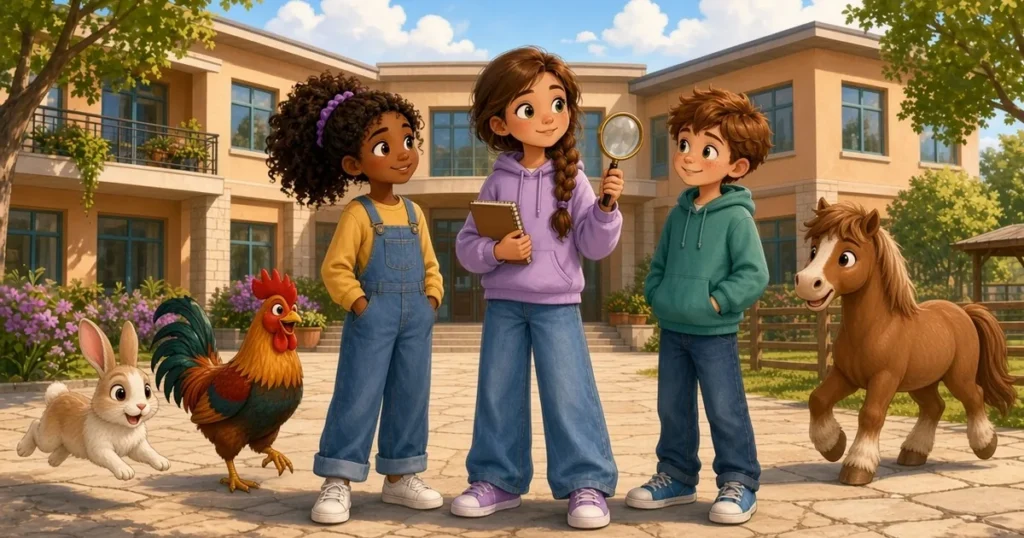
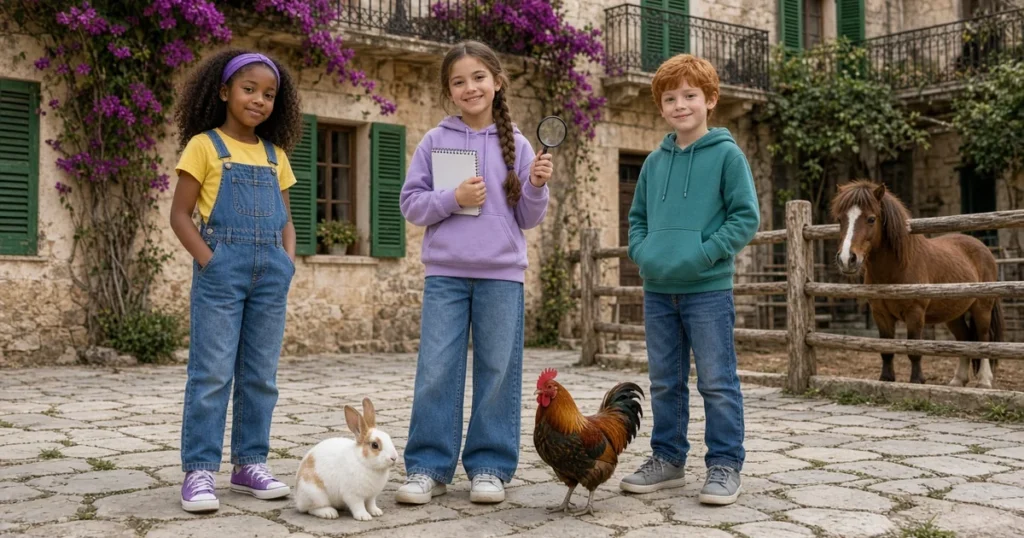
At Hilltop House it snows once every few years. And when it snows, it means it. Not delicate flakes that melt on your nose, but real snow, deep, up to your knees, covering the lawn, the fence and Sugar’s bench, and leaving a thick white hat on the coop roof, like a chef’s.
And this morning, it meant it.
“No school!” shouted Noam, running down the corridors and banging on every door, the first time in the history of Hilltop House that anyone had woken children to tell them they didn’t need to get up. “The roads are closed! No bus! Snow day!”
And the house exploded. With joy.
Forty children leapt out of bed in the same second and ran to the windows, the wardrobes, the glove drawers, the hat shelves and the wellies, and got dressed in six layers, in other people’s jumpers and in two socks on each foot. Hutie wore three scarves, each a different colour, “because I didn’t know which one goes with snow”. Benny wore his goalkeeper’s gloves. And Tom, the smallest and most excited, wore somebody else’s big wellies, Benny’s hat and three jumpers, and looked like a ball of wool with eyes.
At breakfast Mrs Cohen stood up in her fur-collared coat and laid down the Snow Day rules. “One,” she said. “Nobody goes out alone. Two. Every hour, everybody comes in to warm up, drink cocoa and change socks. Three.” She looked at them all over her glasses. “Nobody goes near the duck pond. It’s frozen, but not enough. One night’s ice is like one of Oliver’s promises. It looks strong, and it breaks.” Oliver said that was hurtful, but fair. And Zehava announced that lunch was lentil soup and fritters, and in the evening, if everyone came back with all their fingers, snow cake, which is ordinary cake with a great deal of icing sugar.
Through the windows you could see Kuku standing on the fence with one foot tucked up in his feathers, looking at the snow in deep offence, as if someone had tipped it on him on purpose. And Sugar, with the orange bandage on his hoof, stood by his tied-up manger chewing and puffing little clouds of steam, looking perfectly happy. Sugar likes snow. As far as he is concerned, snow is food that falls from the sky.
But everyone knew the first thing you do on a snow day at Hilltop House. Because David had told them about it in the autumn, when it was only just turning cold, with shining eyes. The sled.
The big Hilltop House sled was the oldest thing in the shed, after Tova’s violin. Avraham had built it fifty years ago from oak, with long iron runners, room for six children one behind the other, and a thick rope at the front for pulling it uphill. It was as heavy as a small piano and as fast as a train. David looked after it all year in the corner of the shed under a tarpaulin, sanded its runners every autumn and waxed them, just in case.
“When I was a boy,” David told them, “it snowed here once. Six children sat on that sled and rode from the top of the hill all the way to the gate. I was first, at the front. And I remember it better than any birthday I’ve ever had.”
So this morning, after a very fast breakfast in which nobody finished their porridge, all forty children stood in the snow in front of the shed, waiting. And David, with the grin of an eight-year-old, drew back the bolt, opened the door and switched on the light.
And the grin vanished. Not all at once. Slowly, like snow melting on a window, until nothing was left of it but an open mouth, eyes that couldn’t believe what they saw, and two hands left hanging in the air.
In the corner of the shed lay the tarpaulin. Folded. Empty. And underneath it, on the floor, just two long strips clean of dust where the runners had been.
“The sled,” said David, in a voice nobody recognised. “The sled! Has anyone seen the sled? It’s not here!”
Everyone started talking at once. Benny said it must be burglars. Yonatan said burglars don’t come out in snow. Hutie said it was a winter ghost that takes sleds to ride at night, and that if they listened carefully they might hear it laughing. And Oliver raised both hands before anyone had even looked at him and said, “Retired. I’m retired. I don’t touch sleds. Also, I can’t lift it. I tried in the autumn.”
“You tried in the autumn?” asked David.
“Just to see,” said Oliver. “Scientifically.”
But Amy wasn’t listening any more. She stood in the shed doorway looking down. At the snow.
A lot of snow had fallen in the night. So much that all of yesterday’s tracks had long gone, and the whole yard had been smooth and white and clean, like a new page in a notebook. Every track in the yard now was from this morning. Forty children running from the house to the shed. Hundreds of prints in every direction, a jumble, like one of Tom’s drawings.
But to one side, behind the shed, where none of the forty had trodden yet, Amy saw something else.
Two straight parallel lines in the snow. Exactly as far apart as the sled’s runners. And they were covered by a thin layer of new snow, soft as icing sugar. Not as deep as this morning’s prints. But not completely buried like yesterday’s.
“Leo,” she called. “When did it stop snowing?”
Leo, who had just written it in his notebook, because he writes everything down, said, “Half past five. I woke up for the loo and saw from the window. At half past five a few more flakes were falling, and by six it had stopped.”
“So the sled left here just before six,” said Amy. “While a little snow was still falling, enough to cover the lines, but not much. Before everyone got up. But after there was enough snow to pull it.”
“Before six?” said Benny. “Who gets up before six? On a snow day? For a sled?”
“And who opened the shed?” asked Ari. “The bolt’s high up. Even I have to stand on tiptoe.”
Amy looked at the shed door. Then at the snow beside it. Up against the wall stood a crate. A blue plastic crate, upside down, the kind Zehava brings vegetables home from the market in. And on it, in the thin snow, a small boot print. One. And half another.
“Someone who needs to stand on a crate,” said Amy, “to reach the bolt.”
“That’s my tomato crate,” said Zehava, arriving behind them with a tray of cocoa, because she didn’t trust anyone to remember to drink. “I looked for it last night. I thought the snow had taken it.”
“Someone who wanted it most,” said Amy.
They followed the lines. Amy, Leo, Hutie, Ari, Benny, and Maya with Falafel, who was frightened of the snow and had climbed inside her coat with only his ears showing. David came behind them, quietly, hands in his pockets.
Beside the lines Amy saw something else. Footprints. Small ones. Lots of small ones. Not forty children’s. Four or five, perhaps. She crouched and compared them with her own foot. They were much smaller. Size ten or eleven, perhaps. The feet of six- or seven-year-olds.
“The little ones,” whispered Hutie. “The little ones from Room Two.”
There were five little ones in Room Two. Tom; Gil with the bobble hat; Eli, who always asks “why”; Shaked, who isn’t afraid of anything except spiders; and Danny, the smallest, six and a half, who follows Tom everywhere like a duckling. On a day like this they would normally have been first at the shed, jumping and shouting. But now that she thought about it, Amy couldn’t remember seeing any of them at the shed this morning. Except Tom, who came last.
“They can’t lift a sled like that,” said Leo. “It weighs as much as three children.”
“Lift, no,” said Amy. “But pull it through snow, four together, with the rope, yes. Snow’s like oil for waxed runners. David waxed them in the autumn. Didn’t you, David?”
David, behind them, nodded slowly. And for the first time that morning he looked less worried and more curious.
Then, halfway along, by the corner of the coop, Ari stopped. He crouched and picked something out of the snow. Something small, red and wet. A mitten. A small red mitten with a wool string meant to tie it to a sleeve, but the string had snapped. And inside, on a small white label, in handwriting Ari knew better than anyone in the house because he had written it himself, was: T.
“That’s my label,” said Ari quietly. “I wrote labels for all the little ones’ mittens. In the winter. So they wouldn’t get mixed up. T is…”
Everyone knew who T was.
And Amy remembered. At breakfast everyone had shouted, eaten fast and spilled cocoa. But not Tom. Tom had sat in the corner, a ball of wool with eyes, eating almost nothing, looking at the window the whole time. And at the clock. And at David. When everyone ran to the shed, he ran last. And his left hand had been in his pocket the whole time. Like someone hiding that he’s lost a mitten.
And something else came back to her. Last night, after the cocoa, while everyone was still talking about Sugar, Tom had sat by David and asked him questions. Lots of questions. How fast the sled goes. How many children fit on it. Whether you can jump with it. And David, tired and happy, had laughed and said that when he was eight he had jumped it over a snowdrift, flown a metre into the air and landed on his head, and it was the best moment of his life. Tom had listened with the biggest eyes in the world.
They turned round. Tom was standing behind them in the snow, a little way off. He had been following them all along, Amy realised, without a word. And his face under Benny’s big hat was red. Not only from the cold.
“Tom,” said Amy gently. “Where’s your other mitten?”
Tom looked at her, at the red mitten in Ari’s hand, at David and at the snow. His mouth trembled. Then he did the only thing a seven-year-old can do when he’s been caught and still thinks his plan is a good one. He turned and ran.
He ran through the snow in his big wellies, which stuck at every step, fell over, got up and ran on, towards the back of the hill. Behind the coop. Behind the carob tree. To the place none of the big ones go in winter, because the slope is steepest there, and because at the bottom is the little duck pond, which had frozen in the night.
They ran after him. They climbed the little rise behind the carob. And stopped.
Because in front of them, on the slope, stood the biggest thing anyone at Hilltop House had ever seen made of snow. A ramp. A huge, curving ramp glazed with ice, as tall as two children, with a wall along one side and a jump at the end that finished in mid-air. Right above the frozen pond.
And at the top of the ramp, covered in a blanket of snow like a present nobody had opened yet, stood Avraham’s sled. On it, already sitting in a row, with hats and frightened faces, were four little children. And Tom, reaching them at a run, climbed up and sat at the front. And took hold of the rope.
“One,” he shouted. “Two…”