Amy sat in the green armchair with the blue book on her knees, holding the note between two fingers, the way you’d hold a butterfly’s wing.
Outside it was raining. Not ordinary rain, but spring rain, the kind that comes suddenly, knocks on the windows like someone who’s late, and vanishes an hour later. In the little library of Hilltop House it was warm and quiet. It smelled of dust, old paper and the green armchair, which David said was older than he was, “and I’m very old.”
Amy unfolded the note slowly. The paper was yellow and soft, and its folds had nearly torn through. The handwriting was round, a girl’s, with little circles instead of dots.
To whoever finds this note,
My name is Naama. I’m ten, and I live at Hilltop House. I sleep in Room Seven, in the bed by the window. I came two weeks ago, and I don’t know anyone here yet. Everyone is already somebody’s friend. I’m only friends with this book.
If you’re a boy or a girl from Hilltop House and you’ve found this note, maybe you’ll write back? Leave your answer on page 88. I check every Sunday.
Naama.
P.S. If you’re one of the boys, that’s fine too. Sort of.
Amy read the note once, then again, then again, and felt her heart do something strange. Because Room Seven, the bed by the window, was her bed. The bed she had sat on a year ago with one small bag, not knowing anyone. Everyone was already somebody’s friend. And she had only been friends with her notebook.
She turned the book over and found, inside the back cover, a little paper pocket with a card in it. An old library card, with rows of dates, who borrowed it and when it was returned. The dates were faded purple stamps. And the last one, on the bottom line, was exactly thirty years ago. Since then, nobody had borrowed the book.
For thirty years the book had stood on the top shelf, with the note waiting inside it.
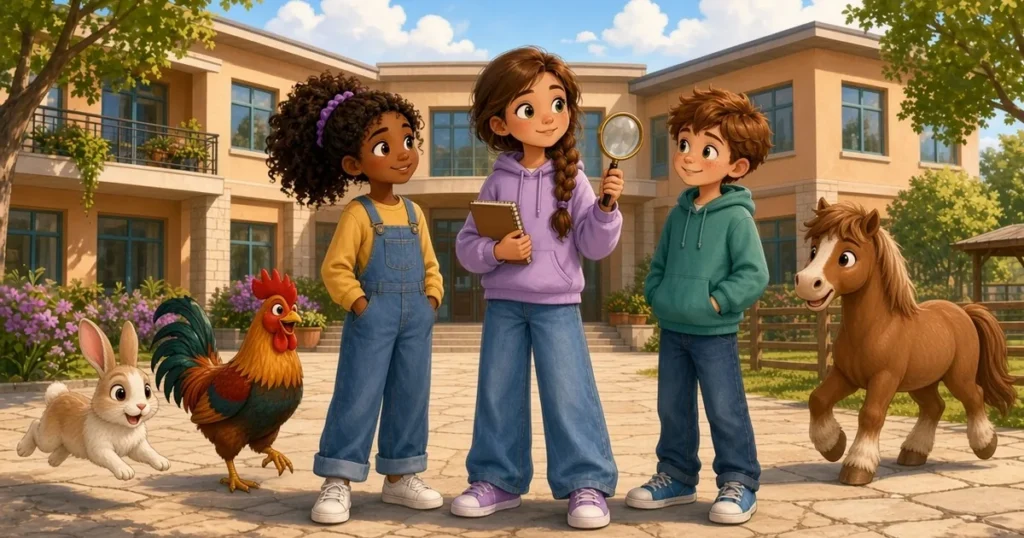
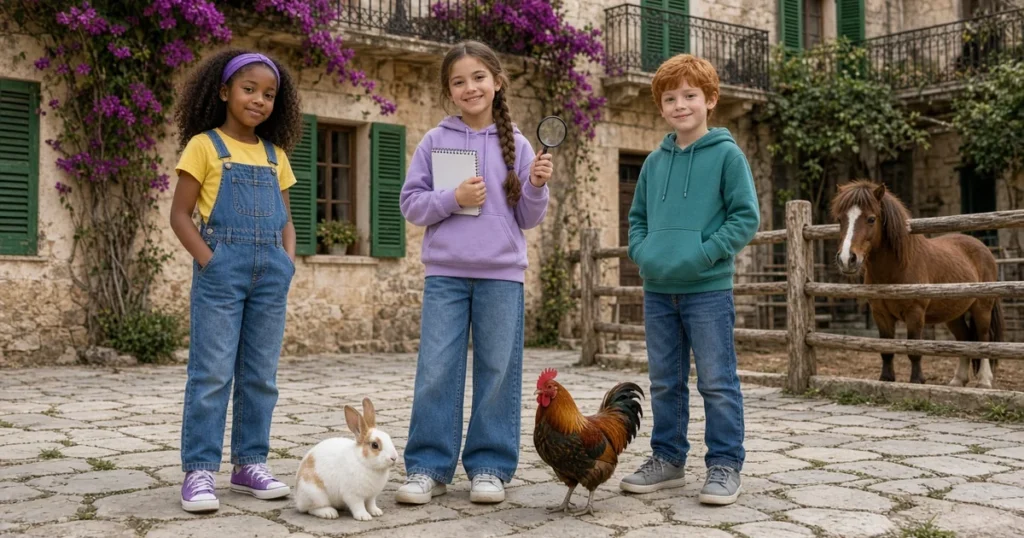
“Thirty years,” said Leo, when she showed him and Hutie after supper on the windowsill of Room Seven. He examined the card closely with his magnifying glass. “She must be forty by now. Maybe she’s got children. Maybe she lives abroad. Maybe she’s an astronaut.”
“Maybe she’s a ghost,” said Hutie, taking a step back from the note. “The ghost of a girl with no friends, who drifts round the library looking for someone to answer her. And whoever answers, she takes into the book with her.” She lowered her voice. “Forever.”
“Hutie,” said Amy.
“What? It could happen.”
“There are no ghosts,” said Maya from her bed, without looking up from her drawing. Then, after a moment: “But if there are, don’t answer her.”
Amy looked at the note for a long time. Then she did something she hadn’t planned. She tore a page from the back of her old brown notebook, which now lived in her drawer next to the blue button. And she began to write.
Dear Naama,
I found your note. My name is Amy, I’m nine, and I live at Hilltop House too. And you won’t believe this: I also sleep in Room Seven, in the bed by the window. I know it’s been loads of years, and you probably don’t check on Sundays any more. But I wanted you to know something.
I also came here not knowing anyone. I was also only friends with something small made of paper. And in the end, you get to know everybody here. Even the boys. Sort of.
I hope you had friends in the end too.
Amy.
P.S. There’s a rabbit here called Falafel. He eats notes, so I’m putting this on page 88 and hoping for the best.
“You’re answering a ghost,” said Hutie in despair. “You’re answering a ghost, and now she’ll take you into the book, and I’ll need a new best friend, and I don’t want a new best friend.”
“It isn’t so she’ll answer,” said Amy, folding the page in four, exactly like Naama’s note. “It’s so somebody answers her. Even if it’s thirty years later.”
Leo nodded slowly, as if that were the most logical scientific explanation he’d ever heard.
The next morning, before school, Amy went up to the library, opened the blue book at page 88 and put her letter inside. She left Naama’s original note there too, in the place where she’d found it, because taking it felt wrong. Then she put the book back on the top shelf, stood for a moment, and said quietly, to nobody, “Good luck.”
And she nearly forgot about it.
Nearly. Because on Sunday, after lunch, something made her go up to the library again. Maybe it was the rain, which had come back. Maybe it was the line “I check every Sunday”, which had been rolling round her head all week like a marble in a box. She went in, walked to the top shelf and reached up.
The blue book wasn’t there.
Her heart jumped. She looked right, and left, and down. And there it was. On the middle shelf, between a book about birds and a book about the sea. Someone had taken it down. And someone had put it back, but not in its place.
Amy took it with trembling hands and opened it at page 88.
Her letter wasn’t there.
In its place was a different page. A new white page, folded in four. And when she opened it, she saw round handwriting. A girl’s handwriting, with little circles instead of dots. Exactly the same handwriting. Only the ink, the blue ink, was so fresh that when Amy touched it, it left a little smudge on her finger.
Dear Amy,
I couldn’t believe it. Thirty years I waited for someone to answer, and the one who answered is a girl who sleeps in my bed. The bed by the window! Tell me, can you still see the carob tree from there? Is the broken stair still there, the third from the bottom, the one that creaks like a cat? And is there still a shake on Tuesdays?
Yes, I did have friends in the end. Lots. And thank you for asking. Nobody has asked me that in a long time.
If you write again, I’ll answer. Page 88. I still check every Sunday.
Naama.
P.S. Keep this note away from Falafel.
Amy sat on the library floor with the letter in her hand and the blue on her finger, and didn’t move. Outside, the rain drummed on the window. And in her stomach, something began to drum too. Very fast.
When Hutie saw the letter, she sat on her bed and covered her face with a pillow.
“I told you,” she said from inside the pillow. “A ghost. A ghost who answers in ink. That’s the worst kind.”
“Ghosts don’t write in fresh ink,” said Leo, who had examined the page with his magnifying glass from every angle and had even sniffed it. “Ink from thirty years ago would be completely dry by now. And the paper. This paper is new. It’s perfectly white, and look at the corner.” He pointed. In the top corner, someone had torn something off, but not completely. Two printed blue letters were left, and half of another. “…ary.”
“Ary?” asked Hutie, peeping out with one eye. “What’s ary?”
“It’s the end of a word,” said Amy. “Someone wrote on a page from a notepad with a logo on it. And tore the logo off, so we wouldn’t know where it came from.”
She wrote in her notebook: Fresh ink. New paper. Torn logo: “…ary”. Exactly the same handwriting as thirty years ago.
Then she sniffed the page, the way Leo had. And it had a smell. A warm, sweet, very familiar smell.
“Cinnamon,” she said.
Hutie took her whole head out of the pillow. “Cinnamon?”
“And this.” Amy turned the page over. On the back, in the corner, was a very faint fingerprint. White. Powdery. Amy touched it, and the powder stuck to her finger, soft and fine.
“Flour,” she said.
They looked at each other. Cinnamon. Flour. On a Sunday afternoon, like every Sunday, there was only one place at Hilltop House with both cinnamon and flour. Zehava’s kitchen, where the week’s cinnamon biscuits were baked.
“Zehava?” whispered Hutie. “Zehava is Naama?”
“Zehava doesn’t write like that,” said Leo. “We saw her handwriting in Amy’s new notebook. ‘Eat something.’ She writes in big square letters, like a sign. This is round handwriting. A girl’s.”
“And Zehava isn’t forty,” added Amy. “And Zehava didn’t live here as a child. She came here as the cook. Thirty years ago.”
She stopped. Thirty years ago. Exactly like the last stamp on the card.
She wrote that down and circled it twice.
Before bed, the three of them went down to the kitchen, as if by chance, “for a drink of water.” Zehava was standing at the sink with her back to them, washing baking trays. On the counter stood three tins of cinnamon biscuits, and the whole kitchen smelled like a hug.
“Zehava,” said Amy, in the most ordinary voice she could manage, “do you like reading?”
“Reading?” Zehava didn’t turn round. “I read recipes. And the greengrocer’s bills, because he always adds a bit extra. Why?”
“No reason,” said Amy. “Was anyone in the library today?”
There was a very short silence. So short that only a detective would have noticed it. Then a tray slipped from Zehava’s hand and crashed into the sink with an enormous clatter.
“I don’t know who wanders round the library,” said Zehava, picking up the tray, still not turning round. “I cook. Take a biscuit and off to bed. One each. Hutie, one, I saw that.”
Hutie sadly put two biscuits back in the tin.
On the way upstairs, Leo whispered, “She didn’t turn round once. Someone who doesn’t turn round doesn’t want you to see their face.”
“And she said ‘off to bed’,” added Hutie. “Zehava never sends us to bed. She always asks if we’ve eaten enough.”
That night, after everyone else was asleep, Amy couldn’t sleep. Something was bothering her, like a little stone in a shoe. Something she had seen and not noticed. She shut her eyes and tried to remember, the way she’d learned in the week when she had no notebook.
And then she remembered.
She got up quietly, took a torch and went downstairs, skipping the third stair, the one that creaks like a cat. In the long corridor by the dining hall hung the photographs. The old photographs Mrs. Cohen had put up for the house’s fiftieth anniversary. Hundreds of children, in black and white and then in faded colours, smiling in front of the carob tree, the chicken coop, the gate.
Amy walked along the wall with her torch until she reached the photo she had seen a week ago without noticing.
In the photo, beside the carob tree, stood a girl. Ten, perhaps. With two long braids. And she was holding a book pressed to her chest. A thick book with a dark cover.
Amy brought the torch closer. In a black-and-white photo you couldn’t tell if the book was blue. But under the photo, in faded handwriting, something was written. Most of the words had disappeared behind the frame. Only the first word was left.
Naama.
And beside the girl, half out of the picture, as if whoever took it hadn’t managed to fit her in, stood someone else. You could see only a shoulder, and an apron. And one hand. And that one hand, Amy now saw, and her heart stopped, was holding a spoon. A wooden spoon. A giant one.