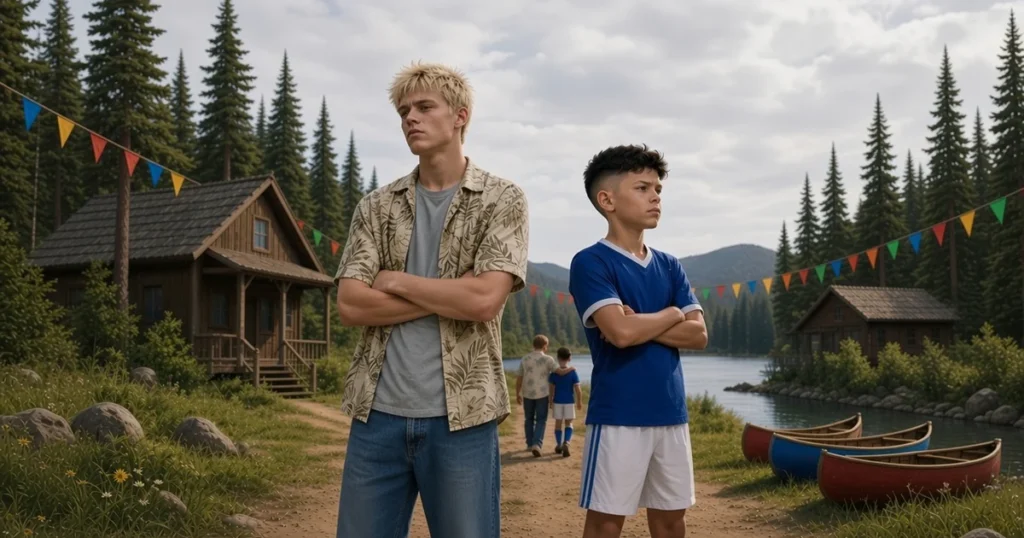
The soccer field at Camp Green Waves was not, strictly speaking, a field. It was a large rectangle of dust with a goal at each end. One goal leaned slightly to the left, and the other leaned slightly to the right, so that from above, Ben thought, the whole thing probably looked like it was dancing.
Ben loved it immediately.
At four o’clock exactly, about twenty boys and three girls stood in the dust while Roy and a tall girl from Cabin Flamingo picked teams. Ben stood at the end of the line, where he always ended up, because he was the shortest person there who wasn’t eleven.
He knew how this went. He’d known since second grade. First the tall kids got picked, then the loud kids, then the kids whose friends were captains. Then came a long, terrible pause, and then someone said, “Fine, the small one,” as if they were choosing the last, slightly squashed banana in the bowl.
“Shahar,” said Roy. Shahar, the small refrigerator, lumbered over.
“Asaf.” “Elad.” “Omer,” said Roy, and Omer did a little dance of joy that involved most of his body. Then Roy looked down the line until his eyes reached Ben.
“Fine,” he said. “The small one.”
Ben jogged over. He didn’t mind. He’d heard it a hundred times. And he knew something Roy didn’t know yet, something nobody ever knew at the beginning: that being small and fast and close to the ground was like having a secret door in a wall that everyone else thought was solid.
* * *
Six minutes into the game, Ben found the door.
The ball came bouncing toward him off Shahar’s knee. A huge boy from the other team, a fifteen-year-old with legs like tree trunks, came thundering in to take it. Ben didn’t run away from him. He ran straight at him, dropped his shoulder, flicked the ball between the tree trunks, and was past him before the boy had finished turning around.
“Whoa,” said someone.
Ben didn’t hear. When he played, he didn’t hear anything. The noise in his head, the noise that was always there, at home, at school, in the car, just switched off, like someone had finally found the remote. There was only the ball, and the dust, and the space opening up in front of him.
Two defenders. He went left. They went left. He went right, and they were still going left. The goalkeeper came out, arms spread wide like a giant crab.
Ben chipped the ball over him. It floated, lazily, beautifully, and dropped into the goal that leaned to the right.
For one second there was silence. Then Omer screamed so loudly that a flock of birds took off from the eucalyptus trees.
“GOAAAAL! Did you see that? Did you SEE that? He’s like a mosquito! A mosquito with a rocket! I’m going to cry! I’m crying! Hapoel would never!”
Roy jogged over, looking at Ben as if seeing him for the first time. “Where’ve you been hiding?”
“Ramat Gan,” said Ben.
Roy laughed and slapped him on the back. It was the second time that day Roy had slapped him on the back, and Ben noticed, with some surprise, that it felt different from the first time. The first time it had been a pat for a joke. This was a pat for a player.
Ben scored again fifteen minutes later, a low shot off the leg of a defender that rolled in so slowly the goalkeeper could have made himself a sandwich first. But it counted. Catfish won five–three. By the end of the game everyone was calling him “Mosquito,” and he decided he didn’t mind that either, because nobody gives a nickname to someone they don’t plan to talk to again.
* * *
They were sitting in the dust afterward, drinking warm water from a shared bottle and arguing about the Champions League, when Ben saw Daniel.
Daniel was walking along the edge of the field with his new friends: the skinny kid with the binoculars, the big silent one, the girl who read books in the middle of everything, and the small one with the label machine. They were heading toward the reeds, probably to look at birds, because of course they were. Daniel was laughing at something the skinny kid said. He had his perfect smile on. The smile that had made Ben’s math teacher, at the one parent-teacher meeting Amir had come to, say, “What a lovely family.”
Ben looked at that smile and felt the old, familiar heat rise in his chest.
Everyone liked Daniel. That was the whole problem. Teachers liked him. Neighbors liked him. Amir liked him, obviously, he was his son, and Mom liked him too, and that was the part Ben couldn’t stand. At home, at dinner, Daniel said something about sailing, and everyone listened. Ben said something about soccer, and Amir nodded the way people nod at the weather. Ben was there, at the table, eating the same rice. But it was like being a lamp in the corner. Useful, maybe. Nobody looked at it.
Except when he was annoying Daniel. Then everyone looked.
Ben stood up, took the ball from Omer, put it down in the dust, and kicked it. Not hard. Just perfectly. It curved through the air and bounced right off the middle of Daniel’s back.
Daniel stopped and turned. The bird-watchers turned with him.
“Sorry!” Ben called, in a voice that was not sorry at all. “It slipped!”
“It slipped,” said Roy, delighted. “Off your foot. In a curve.”
Daniel looked at Ben for a long moment. Then he walked over to the ball, set it on the grass at the edge of the field, took a short run-up, and kicked it back.
The ball flew high, very high, curved hard to the left, cleared the fence, crossed the path, bounced twice on the rocky beach and landed in the Kinneret with a gentle plop.
There was a silence of deep respect.
“My brother,” Ben announced to the Catfish boys, spreading his arms. “Ladies and gentlemen. He can’t kick. He can only sail.”
The Catfish boys collapsed into the dust laughing. Daniel shrugged, said, “I’ll get it,” and went down to the beach, took off his shoes, waded in up to his knees and fished the ball out. Then he carried it back, dripping, and handed it to Omer.
“Thanks!” said Omer.
“Anytime,” said Daniel, and walked back to his nerds.
Roy watched him go. “Your brother’s actually okay,” he said.
Ben felt the heat in his chest go up a few degrees. “He’s not,” he said. “Trust me.”
* * *
At dinner, news of the mosquito with a rocket had already spread to every table, mostly because Omer had personally visited every table to spread it. On her way to the drinks, Maya Maybe stopped beside the Catfish bench.
“I heard there’s a new striker on the hill,” she said.
“Two goals,” said Omer, before Ben could open his mouth. “One with a chip. A chip! Like on TV!”
Maya held up her hand, and Ben high-fived it, and the Catfish boys looked at him as if he had just been knighted. “Nice,” said Maya. “Somebody in your family should be good at something.” She glanced across the hall at Daniel, and walked away.
Ben grinned at his plate for a full minute.
That evening, after dinner, Ben sat on the top bunk with his phone.
The chat was still open. It was always open. Dad. And under it, his own message from five days ago, and the two gray ticks, which hadn’t changed color. Ben knew that the ticks had a whole language. One gray tick meant sent. Two gray ticks meant delivered. Two blue ticks meant read. He wondered sometimes what color they would be if there were a tick for “read and decided not to answer.” Probably no color at all.
He looked at the little round profile picture. The baby in the striped hat. His name was Leon. Ben had never met him. He had seen him exactly four times, all of them in that tiny circle, getting slightly bigger each time, like a moon.
Ben typed: I scored two goals today.
He looked at it. Then he deleted it, one letter at a time, until the box was empty again.
He thought about his father. Not the father in Berlin. The one before. The one who used to come to the parent-teacher meetings and sit with his arms folded while the teacher talked, and never once looked at Ben while she did it. In fourth grade a window had been broken in the classroom, and the teacher had said it was probably Ben, and his father had said, “If the teacher says you did it, you did it,” and Ben hadn’t done it. It had been a boy named Tomer and a tennis ball. Ben had said so. His father had said, “Don’t make it worse.”
When something broke, it was always Ben. Even when it wasn’t.
Ben put the phone face-down on the mattress.
* * *
Below him, Omer was getting ready for bed in a process that seemed to involve a lot of rustling. Then he climbed up the ladder, poked his round face over the edge of Ben’s bunk, and held something up.
It was a teddy bear. It was small and brown and very old. It had no nose, only a little worn patch where a nose had once been, and one of its eyes had been sewn back on with bright blue thread, so that it looked permanently surprised in one direction only.
“This is Mr. Button,” said Omer.
Ben stared at it. “Okay.”
“He belongs to my little brother, Eli. He’s in Gull. He’s seven.” Omer looked at the bear with great respect. “He lent him to me for camp. He said I’d need him more than he would. Because sometimes I cry at night when I miss my mom. Eli doesn’t. He’s very mature.”
Ben didn’t know what to say to this, so he said, “Why are you showing me?”
Omer shrugged. “Because your face looked like you needed Mr. Button.”
“I’m thirteen.”
“Mr. Button doesn’t care how old you are,” said Omer. “He’s been with my family since my dad was little. He’s seen everything. He lost his nose in a war with a dog.” He held the bear out. “Just for tonight. I’ll take him back tomorrow. Eli will check.”
Ben looked at the bear. The bear looked back at him with its one surprised blue eye.
“This is the dumbest thing that’s ever happened to me,” said Ben.
“Okay,” said Omer cheerfully, still holding out the bear.
Ben took it. He held it like you’d hold a sandwich someone else had already bitten. Omer nodded with satisfaction, climbed down the ladder and, within ninety seconds, began snoring like a tractor arguing with itself.
Ben lay on his back with Mr. Button on his chest. Through the window, he could see the dark lake and one small red light blinking on the water. Through the wall, he could hear Nadav telling someone in Pelican a fact about frogs, and a low voice, Daniel’s, saying, “Nadav. Please. It’s midnight.”
Ben scored two goals today. Nobody in Berlin knew.
But a mosquito with a rocket had a nickname now, and a team, and a whole camp that had seen. And on his chest, a noseless bear with one blue eye kept watch over him, as if it had been doing this kind of job for a very long time.
Ben fell asleep before he remembered to put it down.