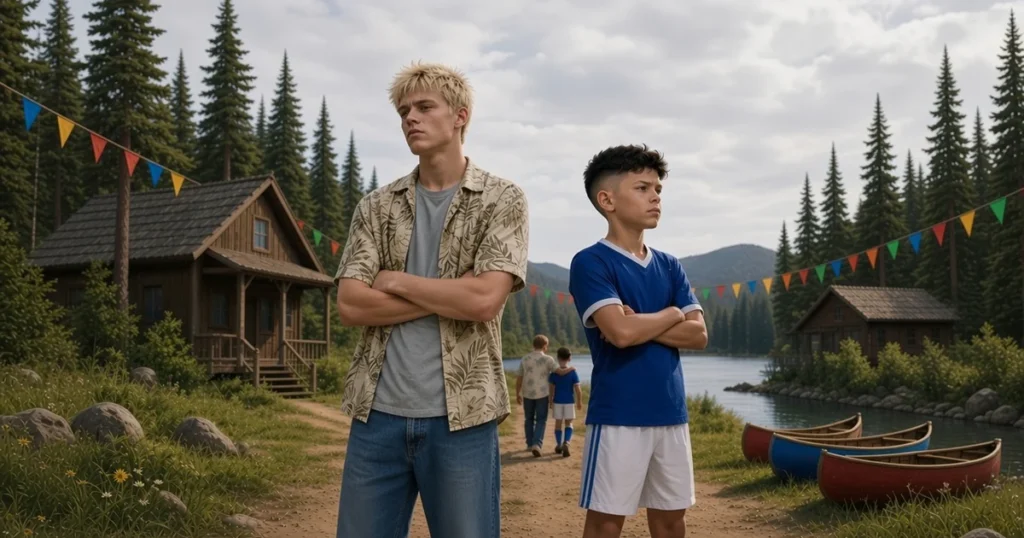
At a quarter past eight, Zehava blew the silver whistle, the one that means “Come and help,” and the whole camp gathered on the lawn.
“We have an hour and a quarter,” she said. “At nine the karaoke party starts, on the beach, by the dock. I need lanterns, I need chairs, I need a stage, and I need someone to explain to the Admiral that it isn’t her stage.”
“Nobody can explain anything to her,” said Kobi.
“Then someone explain it gently,” said Zehava. Then, in a different voice, a little lower: “It’s the last night. I want it to be beautiful.”
For a moment nobody moved. The word “last” landed on the lawn like a water balloon that hadn’t burst, and stayed there, wobbling.
Then Lihi raised the label maker.
Click. Whirr.
* * *
She started with the lamppost by the dining hall. Lamppost (Last). Then the bench. Bench (Last). Then Kobi’s bucket, Kobi’s hat, and very nearly Kobi himself, but he ran.
“Lihi,” said Shira. “Are you okay?”
“I’m excellent,” said Lihi, sticking a label on a tree. Eucalyptus (Last). “I just want everyone to know.”
“The tree isn’t going anywhere.”
“But we are,” said Lihi, and her voice shook a little, and she stuck on another label, quickly, on a stone. Stone (Last).
Shira looked at her for a moment. Then, without a word, she took the label maker from her, typed something, and stuck it on Lihi’s back.
Lihi couldn’t see what it said. She spun round like a dog trying to catch its tail.
“What did you write?”
“Lihi (Not Last),” said Shira. “You’re coming to my place at Hanukkah. That’s not a question. That’s Shira Barak talking.”
Lihi stopped. Then she hugged Shira, hard, and Shira, who did not like hugs, let her. She even hugged back. A bit. Behind them, Nadav wrote something in his notebook, crossed it out, and wrote it again. Ben peeked. It said: Shira hugged. Last night. Don’t tell her I saw.
* * *
On the beach, Nadav and Kobi were hanging lanterns.
That is, Nadav was calculating where to hang lanterns, and Kobi was standing on a ladder, trembling.
“The optimal angle is thirty-seven degrees,” said Nadav, holding his protractor. “That way the light spreads best over the stage and over the water, creating a double reflection, which raises the romance level by thirty percent.”
“How do you know that?” asked Kobi from above.
“I made it up,” said Nadav. “But it sounds right, doesn’t it?”
“Faith,” said Kobi, and hung the lantern at roughly ninety degrees, because the ladder moved.
Alon and Yuval, Maya’s little brother, were spreading blankets on the sand in remarkably straight rows. Alon didn’t talk, and Yuval talked for both of them, nonstop, about agamas, about stars, and about how Nadav the Second, his agama, would probably miss him. Alon nodded every few seconds, and once, when Yuval stopped to breathe, said: “Me too.”
Yuval stopped. “You too what?”
“Miss,” said Alon. And spread another blanket.
Then the Admiral came out of the reeds, walked with measured steps to the ladder, took the nearest lantern in her beak, and walked back with it. Slowly. Unhurried. Like someone who had reserved it in advance.
“She took a lantern,” said Kobi quietly.
“She takes everything,” said Nadav. “Blue rope. A shoelace. A label. Maya’s whistle. Now a lantern.” He made a note. “She’s building something. I’m telling you, one day we’ll find out she has a flat in those reeds.”
A soft orange light rose from the reeds. The lantern was on. And the Admiral, beside her egg, sat in her own light, extremely pleased with herself.
* * *
By the dock, Gili stood with his guitar and with Noga, and they were arguing quietly.
“It doesn’t rhyme,” said Noga.
“It doesn’t need to rhyme,” said Gili. “It’s a goodbye song. Goodbye songs don’t rhyme. They cry.”
“A song about what?” asked Ben, passing with two chairs.
Gili looked at him gravely. “About the dock.”
“The dock?”
“All summer I’ve written about objects,” said Gili. “A lonely clothespin. A yellow sock. A laundry line. Now I’m writing about the dock. Because the dock sees everyone arrive. And everyone leave. And it never moves.” He strummed one very sad chord. “The dock is the most tragic hero at camp.”
“Apart from you,” said Noga.
“Apart from me,” Gili agreed, and then blushed, because Noga smiled at him, and he missed the next chord.
Ben put the chairs down and walked on. Behind him, Noga said something quietly, and Gili laughed, and the guitar stopped altogether. Line & Noga, thought Ben. They still didn’t know the whole camp called them that.
* * *
In the kitchen, Shimon sat on an upturned vegetable crate, a pencil behind his ear and a big sheet of paper on his knees.
“The last menu,” he said, when Ben came in to return the extra chairs. “For the party. And for the morning.”
Ben peeked. In big, crooked handwriting it said:
For the party: “See You” Pizza. “Don’t Cry” Falafel. Seedless watermelon (sorry, Alon). Strawberry jelly (the new generation). For the morning: “Last Day” Omelettes. “See You Next Year” Rolls. Chocolate milk.
“What about the chocolate milk?” asked Ben.
“The chocolate milk is just chocolate milk,” said Shimon. “Some things don’t need a name. They’re good enough on their own.”
Ben thought about that. About labels. About words. About one “okay,” on the phone, an hour ago.
“Is Avram coming tomorrow?” he asked.
Shimon nodded. “After the buses. With a pot.” He smiled, a small, almost shy smile that didn’t suit his face at all. “He wrote that he’s bringing soup. I taught him to make soup when he was eight. Now he’s bringing it to me.” He took the pencil from behind his ear and looked at it. “Funny, how things come back.”
“The second half,” said Ben.
Shimon looked up.
“It’s for going back for someone,” Ben explained, then felt stupid, and picked up the chairs again, even though they were supposed to stay, and left.
Behind him, Shimon wrote something at the bottom of the page. Ben didn’t see what. But in the morning, when he came into the dining hall, he saw it on the board, in the crooked writing:
“Second Half” Soup. Cooked by Avram.
* * *
On his way out of the kitchen, Ben passed the office. The door was open and the light was on. Zehava sat at the desk, alone, facing the corkboard, an empty coffee cup in her hand.
He nearly kept walking. But something about her shoulders stopped him.
“Are you okay?” he asked from the doorway.
Zehava didn’t turn round at once. “I’m looking at the photos,” she said. “Every year, on the last night, I look at the photos. Thirty-seven years of children who came confused and left a little less so.” She pointed at the old picture, the 1987 tent, the girl with plaits. “Her, for example. She came with one whistle and didn’t know she could whistle.”
“And then?”
“And then someone taught her.” Zehava finally turned. “Have you used it? My whistle?”
“Once,” said Ben. “On the night swim. And you answered.”
“I’ll always answer,” said Zehava. “That’s the rule with whistles. Whoever whistles gets an answer.” She lifted the empty cup, looked at it, and put it down. “From Germany too, by the way. If you ever need it. Just so you know.”
Ben remembered the office phone, and the empty coffee cup she’d left him that day, which was still in his bag. He didn’t say anything. He just nodded. And sometimes, Ben had learned that summer, a nod is all it takes.
* * *
In Catfish Cabin, Omer had already packed. That is, Omer had thrown all his clothes into his bag and was standing on it to make it close. It wasn’t working.
“My mom’s going to kill me,” he said happily. “She folded everything. Everything. Even the socks, one inside the other. And look at it now.”
“It looks like the corpse of a bag,” said Shahar.
“Why?” asked Omer.
“That’s my line,” said Shahar, offended.
Eli appeared in the doorway, his glasses taped in the middle and Mr. Button under his arm.
“Omer,” he said seriously. “Mr. Button doesn’t want to go home.”
“Why not?”
“Because here he sleeps on his left side, and there are frogs by the cabin, and he likes them.” Eli thought. “And I don’t want to either.”
Omer stopped standing on the bag. He got down, crouched beside his little brother, and looked into the bear’s eye, the one sewn in blue thread. “Tell him Shoko’s waiting for him at home,” he said. “Twenty-two kilos of blanket that breathes. He’ll like that better than frogs.”
Eli considered this very seriously, then nodded and left. Omer went back to standing on his bag. But now he stood on it gently.
Ben waited for them to go and help with the lanterns. Then he climbed onto the top bunk, lifted the loose slat, and looked.
It was all there.
The rope, with Lihi’s crumpled label, Together. Zehava’s tin whistle, small and scratched, from 1987. The page with Daniel’s terrible poem, which Ben had never given back. Lihi’s second label, Brothers, “for home.” And the blank label.
What Ben needs, it said, in Lihi’s small, neat writing. Then a line. Empty. For a week now.
Ben held it for a long time. He took a pen out of his pocket, Nadav’s pen, because Nadav always has a pen. He put it to the line.
And didn’t write.
Not because he didn’t know what to write. The opposite. Suddenly he knew exactly. And that frightened him more than any boat.
“Not yet,” he told the label quietly. “At home.”
He put all the treasures in a sock. Not just any sock. The yellow sock, Everyone’s Sock, from Gili’s ballad, which nobody knew the owner of and which had somehow ended up in his bag. He tied it in a knot. A bad knot. But it held. And pushed it deep into his bag, under his Maccabi shirt.
Then he tried to whistle.
A tyre losing air. Again.
“Fine,” he told the ceiling. “Forty more minutes.”
* * *
Daniel sat on the steps of Pelican Cabin, the blue notebook on his knees.
He opened the page. What Ben needs to feel at home. Five items, in handwriting that had changed over the weeks, a little sharp and anxious at first, calmer at the end. And the margin, with the line he’d written to himself a few days ago: He has his own list. He’s allowed.
He thought about writing item six. He even wrote the number. 6. Then he looked at it for a long time.
“Writing a poem again?” asked Maya.
She stood in front of him in two purple hoodies, her hair wet from the shower. Daniel shut the notebook too quickly.
“No,” he said. “Thank God, no.”
“Shame,” said Maya. “Ben showed me the last one.”
“He what?”
“He said it was the worst thing he’s ever read and that he’s keeping it forever.” She smiled. “I think that means he loves you.”
Daniel didn’t know what to say. So he said nothing. He just looked at her, and she looked at him, and something in his stomach did what the boat had done by the red buoy: heeled, and heeled, and stayed up.
“Will you come to the dock for a minute?” asked Maya. “Before the party. Just a minute.”
“Now?”
“Now,” she said. “Later it’ll be noisy. And I want to ask you something quietly.”
Daniel stood up. The notebook stayed on the step, open at exactly the right page, with 6. and nothing after it.
And in the reeds, someone heard everything and told no one. The Admiral knew how to keep secrets. It was the only thing she knew how to keep, apart from an egg.