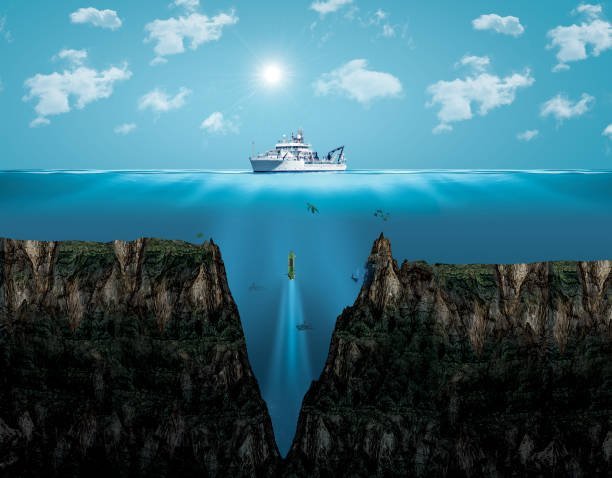
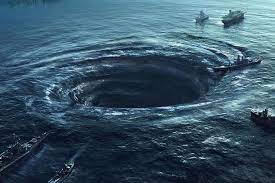
At first glance, it’s an ordinary stretch of ocean. But it became famous because of a series of mysterious disappearances and accidents involving ships and planes that crossed it.
Over the years, dozens of planes and ships vanished in the area without a trace, and many explanations have tried to shed light on the mystery.
Articles about the triangle started appearing in the 1950s and 1960s, after a few famous accidents caught the attention of local journalists. In 1964, a magazine writer gave the area its famous name: “the Bermuda Triangle.”
In 1974, a best-selling book described the disappearances as mysterious events with supernatural causes. It sparked a wave of theories trying to explain the mystery of the triangle.
All sorts of strange stories soon spread. The most popular claimed the disappearances were supernatural – the work of aliens, or advanced technology left behind by the people of the lost continent of Atlantis.
Other explanations included magnetic disturbances that confused compasses, gas bubbles that sank ships, and giant “rogue waves” that appear in the middle of the ocean without warning. Today, most experts think the real causes are quite ordinary: bad weather, seasonal hurricanes, human mistakes and simple technical problems.
The first recorded strange event in the Bermuda Triangle goes back to 1492, when a famous explorer crossing the Atlantic wrote in his logbook that his compass was acting strangely. Later, this was explained as a normal change caused by the long distance he had sailed, or by a local magnetic disturbance.
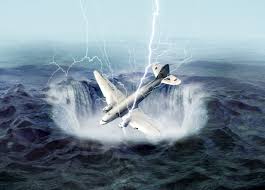
One of the most famous Bermuda Triangle cases is the loss of Flight 19. The 1974 book described the planes as vanishing without explanation in clear weather. But over the years, more details came to light that suggest it was an accident, not something supernatural.
Flight 19 was a routine training mission that took off from a U.S. Navy air base in Fort Lauderdale, Florida, in 1945. The flight leader was in charge of a group of student pilots flying five Navy torpedo bombers. Their job was to practice navigating, flying and dropping practice bombs over the sea. At first, radio messages from the flight were heard – but as stormy weather moved in, radio contact was lost, and all five planes disappeared.
Some researchers believe the natural explanation is that the planes simply ran out of fuel. They think the pilots lost their way and flew back and forth trying to find their way, until the fuel ran out and the planes went down in the ocean.
Back on land, rescuers tried to find the planes. A seaplane set out to search but had to turn back because of a technical problem. Then two more seaplanes were sent. One of them sent a routine radio report three minutes after takeoff – its last message. It vanished just like the five planes of Flight 19.
Researchers think it most likely exploded in midair – something that, in rare cases, could happen to that type of plane.
There were 13 crew members on board. By the end of that day, 27 crew members and six planes had disappeared without a trace.
In the late 1940s, two British passenger planes, the Star Tiger and the Star Ariel, disappeared. They remained a mystery for a long time, but decades later, people from the airline admitted that both planes were old and poorly maintained – probably the reason they crashed. They had kept quiet to avoid being punished for their carelessness, and instead their report claimed that “some outside cause” had overwhelmed both pilot and machine.
Another famous mystery is the merchant ship Mary Celeste, often linked to the Bermuda Triangle, which was sailing from New York to Europe in 1872. It was found a month later completely empty, with no signs of a struggle or emergency, and all its cargo still on board.
The weather was clear, the missing crew were experienced sailors, and there was plenty of food and water on the ship. All the crew’s and passengers’ belongings were still there, which made it very hard for investigators to find a natural explanation.
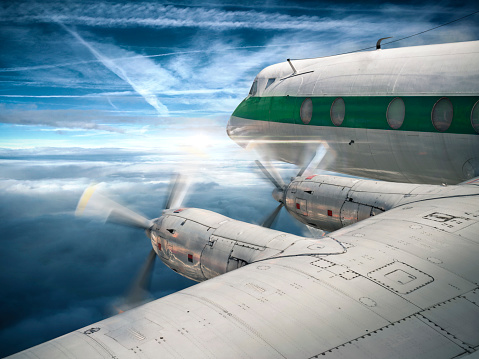
Because of all the mysterious stories, many people assume airline pilots avoid this part of the ocean. But anyone who has flown from Miami to San Juan, Puerto Rico, knows that’s not true – lots of flights cross the Bermuda Triangle every day.
Flights are constantly tracked by air traffic control, so pilots get help if something goes wrong with navigation. The weather is also checked closely before every takeoff. Accidents still happen, of course – but no more often than anywhere else in the world.