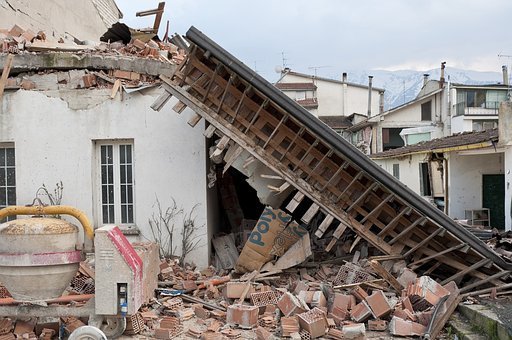
An earthquake is a natural event that usually happens where tectonic plates meet. Earthquakes happen on Earth every single day! But most of them happen deep underground – sometimes up to 80 km below the surface – so we don’t feel them.
The Earth is made of three main layers:
The core: The core is the heart of the Earth, right at its center. It’s made mostly of metal.
The mantle: The mantle is a layer thousands of kilometers thick that wraps around the core. It’s made of very hot rock – so hot and under so much pressure that parts of it can slowly flow, and where rock melts it forms magma, which can reach about 1,400°C! Deep inside the Earth, this hot rock is always slowly churning, like porridge bubbling in a pot.
The top layer – the crust: The crust is the Earth’s outer shell, a fairly thin layer sitting on top of the hot mantle – just a few kilometers to a few dozen kilometers thick. It’s where all the landscapes we know are found: continents, oceans, mountains and valleys, plus everything people have built, like houses and roads. The crust isn’t one solid piece – it’s broken into giant plates. One plate can hold several countries or even a whole continent. The plates are separated by deep cracks called faults.
The Earth’s top layer is made of tectonic plates. They aren’t smooth, solid pieces – they’re crisscrossed with faults and cracks.
Usually, the edges where plates meet aren’t smooth, so the plates get stuck against each other. Meanwhile, the hot rock in the mantle keeps churning.
Pressure keeps building up between the stuck plates. When it’s suddenly released, the plates jerk and shake the ground around them with powerful waves of energy. The spot underground where this energy is released is called the focus of the earthquake.
An earthquake creates seismic waves. These waves travel through the Earth and along its surface, shaking everything on the ground.
The waves spread out in circles from where the quake started toward places farther away. They’re strongest near the center, where they can cause a lot of damage, and they get weaker the farther they travel. Even so, a strong earthquake can cause damage tens of kilometers away.
After an earthquake, there are often “aftershocks.”
These are smaller quakes that come minutes, days or even months after the main one, as the plates settle into their new positions. They can cause damage too – and even topple buildings that were weakened by the first quake.
Soil liquefaction is when the ground starts acting like a thick liquid. It happens when shaking makes groundwater push between the grains of soil. The water separates the grains and weakens their grip on each other, so the ground behaves like a liquid.
Liquefaction is seen after almost every strong earthquake.
To measure earthquakes, scientists invented a device called a seismometer. It’s set into the ground and can measure even the tiniest shaking that we can’t feel.
A simple seismometer has a weight hanging on a spring. When the ground shakes, the device moves and the weight swings. That movement creates an electric signal whose strength shows how strong the shaking is. In the past, the readings were drawn on rolls of paper; today they’re stored on computers. The data is sent by satellite to scientists, who turn it into a graph. By using several seismometers at once, they can work out how strong the earthquake was and where it started.
The strength of an earthquake is described on a scale. The best-known one is the Richter scale, which shows how much energy was released during the earthquake.
It was first suggested in 1935 by a scientist who studied earthquakes in California, USA. Today scientists often use a newer, similar scale called the moment magnitude scale.
Small earthquakes usually aren’t felt by people at all. A magnitude-5 earthquake nearby can cause light damage, like cracks in walls, falling objects and shaking that people can feel. Earthquakes of magnitude 6 and above have caused serious damage and loss of life.
The strongest earthquake ever measured happened in Chile on May 22, 1960, with a magnitude of 9.5. The strongest earthquake felt in Israel in modern times was in the Gulf of Eilat (Aqaba) in 1995, with a magnitude of about 7.2.
Earthquakes can also cause giant tsunami waves. A tsunami is a huge sea wave caused by an earthquake or an underwater landslide.
Did you know?
Israel sits where two tectonic plates meet, along a long fault called the Dead Sea Transform (part of the Syrian-African Rift), so earthquakes can happen there. Still, over the past 60 years only a few earthquakes have been recorded there, and they were mostly moderate or weaker.