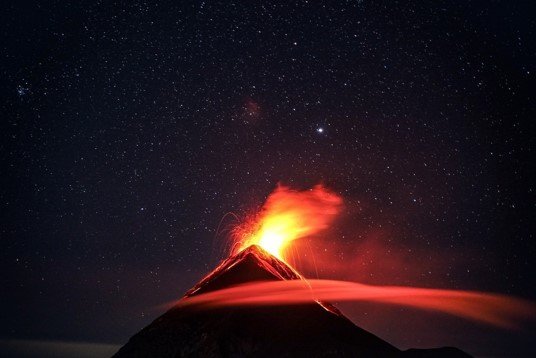
1) Simply put, a volcano is an opening in the Earth’s surface.
It’s usually found on a mountain, and it lets gas, hot magma and ash escape from beneath the Earth’s crust.
2) Volcanoes are often found where “tectonic plates” meet.
These plates are huge pieces of the Earth’s surface that fit together just like a jigsaw puzzle.
3) Some volcanoes form because of “mantle plumes.”
Ever heard of a mantle plume? It’s a column of rock that’s hotter than the rock around it and slowly rises up through the Earth. When it reaches a place where the crust is thin, it can break through. The top of a mantle plume, where the hot material bursts out, is called the “plume head.”
4) Volcanoes can create rich, fertile soil.
Over time, lava and ash break down into soil packed with nutrients – great for growing crops! That’s why some people like to live on the slopes of volcanoes.
5) About 350 million people live within the “danger zone” of an active volcano.
That means roughly one in every 20 people lives in an area at risk from volcanic activity.
6) Volcanoes are described as active, dormant or extinct.
This tells us how much volcanic activity there is. “Active” means there’s regular activity, “dormant” means there was activity fairly recently but the volcano is quiet for now, and “extinct” means it’s been so long since the last eruption that it probably won’t erupt again.
7) Volcanoes come in different shapes.
These geological wonders come in all shapes and sizes, but there are two main types: stratovolcanoes, which are cone-shaped with steep sides, and shield volcanoes, which are wide with gentle slopes.
8) Magma and lava are two different things!
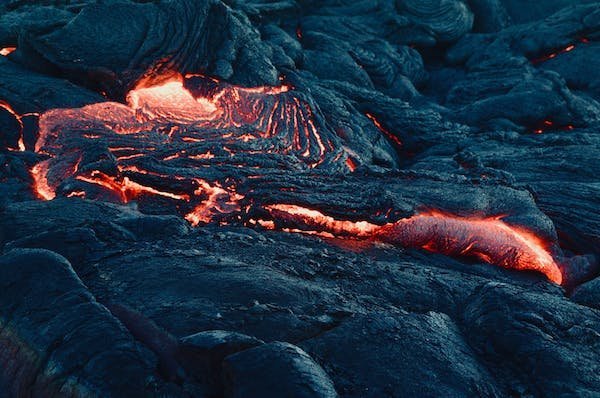
Magma is the name for hot liquid rock inside a volcano. Once it leaves the volcano, it’s called lava.
9) Volcanoes aren’t only on land.
They can also be found on the ocean floor and even under ice caps!
10) Lava can reach 1,250°C!
Lava is so hot it can burn up almost anything in its path. If you tried to measure it with a glass thermometer, the thermometer would melt!
11) The world’s biggest active volcano is Mauna Loa in Hawaii.
This geological giant stands a massive 4,169 m tall. It erupted in 1984, and again in 2022.
12) There are volcanoes all over the solar system!
Other planets and moons have volcanoes too! The biggest volcano in our solar system is Olympus Mons, on Mars.
13) The ancient Roman city of Pompeii was destroyed and buried by a volcano called Mount Vesuvius.
Amazingly, the layers of ash preserved the town and the remains of the people inside. Today, it’s one of Italy’s most popular historical sites!
14) About 1,900 volcanoes on Earth are considered active – they’re expected to erupt again!
Most of the world’s active volcanoes are on the “Ring of Fire,” a 40,000 km horseshoe-shaped zone around the Pacific Ocean.
15) The loudest sound in recorded history was made by a volcano called Krakatoa.
Krakatoa, in Southeast Asia, erupted in 1883 and released an enormous amount of energy – as much as thousands of the most powerful bombs ever made. BOOM!
16) It’s not just people who make use of volcanoes – birds do too!
Maleo birds bury their eggs in sand or soil near volcanoes to keep them warm. When the chicks hatch, they dig their way up to the surface!
17) Where does the word “volcano” come from?
It comes from Vulcano, a small volcanic island in Italy. The island was named after Vulcan, the ancient Roman god of fire.
18) Volcanoes in Israel
In the Golan Heights there are about 20 volcanoes that erupted a very long time ago, including Mount Avital and Mount Odem. Don’t worry – no need to panic! They’re all dormant or extinct and aren’t expected to erupt again.
What you need:
A disposable plastic cup or a heat-proof glass
A pack of modeling clay (brown or orange looks best)
Vinegar
Baking soda
Dish soap
Red food coloring (optional)
A cup
A teaspoon
What to do:
First, build your volcano. Take the disposable cup and cover it with modeling clay in the shape of a mountain. (You can also use a regular glass and peel the clay off when you’re done.)
Pour vinegar into a cup (about 3/4 of a cup).
Add food coloring to make it dark red. You don’t have to, but it looks much cooler and more realistic!
Add a spoonful of dish soap and stir gently so it doesn’t foam.
Put three spoonfuls of baking soda inside your volcano.
Pour the vinegar mix (vinegar, soap and food coloring) into your volcano – and watch it erupt!
What can we learn?
Our experiment shows a reaction between an acid and a base. Baking soda is a base, and vinegar is an acid.
Acids and bases are opposites, and when you mix them you get a chemical reaction called neutralization. They cancel each other out and turn into water and a salt – and along the way they release a gas called carbon dioxide.
Because we added soap to the vinegar, the gas makes lots of tiny soap bubbles – and that’s where the foamy eruption comes from!
The red color, of course, makes it look like a real erupting volcano.